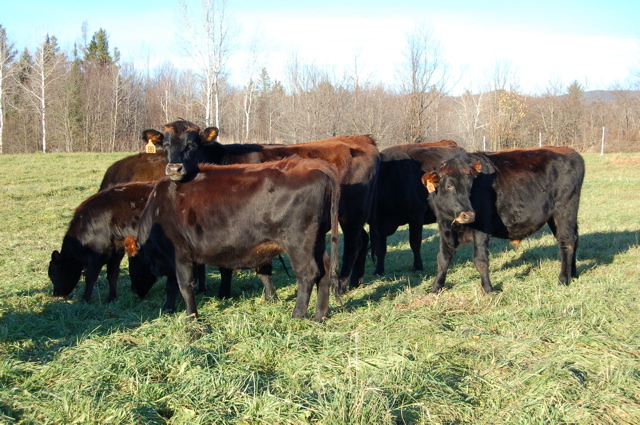
Cow herd in November

Ever since Alayne and I started this special place over 10 years ago, we have been concerned about what we feed our disabled dogs and cats.  We learned early on how to read the ingredient labels and how to distinguish low-quality food from the high-quality brands — and the only way to do that is ignore the packaging and marketing fluff and focus on the ingredients.  We even bought the AAFCO manual back in 2002 to learn what simple words like “meat” really mean in the world of pet food — and it’s not necessarily what you think.  (AAFCO is the industry group that sets the standards for pet foods.)

But as we focused on the quality of the food, we also began to think about the source of the food — about the animals who ended up in the food we were feeding our dogs and cats.  Alayne calls it “animal in a can" and “animal in a bag” — though most of us never think of it that way.  It’s a lot easier not to think about it … just open the can or bag and serve it up.

For most of the past decade — until 2009 — I was a vegan, and for several years before that, a vegetarian.  It troubled me as ethically inconsistent to be so concerned about what I ate, but not to give a second thought to what our dogs and cats ate.  For a very brief period a long time ago, we even tried a vegetarian diet for our dogs, with many unhappy results.  No matter what type of vegetarian diet we put in front of them — commercial or home-made — the dogs made it very clear they were not happy helping me work through this “ethical inconsistency.”  I’d never seen dogs walk away from food before, but this they did.  Not all, but too many of them.  I quickly abandoned the effort, much to the relief of both the dogs and Alayne.

Yet the issue remained.  Although Alayne was never a vegetarian or vegan, she always shared my concerns about the humane treatment of food animals. 

The Animal Welfare Dilemma

A couple of years ago I read “The Omnivore’s Dilemma,” Michael Pollan’s excellent book on America’s food system.  It seemed to me that those of us in the animal welfare movement face what I call the “animal welfare dilemma” — we focus so much on the welfare of the dogs and cats in our care, but what about the animals we feed them?  What about their welfare?

Best Friends, the nation’s largest animal sanctuary, has a wonderful slogan:  “A better world through kindness to animals.”  I think all of us in the animal welfare movement believe in the spirit and strength of that statement.  But does it apply to the food animals we feed our pets?  If not, why not? 

That was the central question for us.  How can we have one set of standards for the welfare of dogs and cats, and turn a blind eye to the welfare of the millions of livestock that go into our pet food?

For us, this is the animal welfare dilemma.

Now, there are plenty of dedicated nonprofit organizations focused on the treatment of farm animals; groups like Farm Sanctuary and the HSUS work hard to expose the cruelty of factory farming, where thousands of animals are crowded into filthy and stressful “confined animal feeding operations,” or CAFOs, and then slaughtered in high-speed assembly line fashion at the rate of several hundred a day.  These nonprofits also promote vegetarian and vegan lifestyles as the answer to factory farming, and believe that it is unjustified to kill and eat any animal, under any circumstance.  They do not seem to consider that “humane” farming is even possible.

But again, where does that leave our dogs and cats?  Should we really force dogs and cats to become vegetarians, because that’s what some of us want to be?  Yes, there are groups and websites that promote this very thing, though even the website Vegancats.org has, “after much soul-searching,” changed its recommendations on feeding meat to cats.  (Hello?)

The simple truth is that dogs and cats are, by their very nature, meat eaters.  To try and make them anything else is, well, downright unnatural.

Moreover, we know processed foods aren’t good for people, and what is more highly processed than pet food?  So a few years ago, we started buying cases of ground beef from Costco and began home-cooking again.  But each case was stamped with “Product of USA, Canada, Mexico, Australia & New Zealand.”  That led us back to worrying about the conditions those cattle were subjected to in the industrial food system — and how they ended up in the big tubes of ground beef we were feeding.  (Not to mention all the “food miles” involved!)

So, What Do We Do?

The question for Alayne and me became, how can we take responsibility for the entire “cycle of life” here?   How could we assure ourselves that the meat we were feeding our disabled dogs and cats came from animals who were raised as humanely as possible?

  • We realized that the best way to do that was to raise them ourselves.
  • We wanted to know exactly how they were raised, what they were fed, and most important of all, how they died.
  • We were fortunate that we had the land, facilities and skills to raise cattle on a small scale, and decided this was the right thing to do.

We began this long journey in 2008 back in Montana with several heifer (female) calves, and in 2009 we got two more heifers, along with two six-month old young steers.  Last summer here in New Hampshire our first five calves were born. 

Why Now?

The reason I’m writing about this now is because a couple of weeks ago I took our first steer, Sebastian, to slaughter.  I drove him over in our horse trailer to a very small, local, family-owned facility that processes three or four steers a day, not 400.  I was able to walk through the entire facility with the owner, stood on the kill floor, and examined their entire process for how they do the slaughtering.  It was quiet, clean, and as stress-free as any facility like that could possibly be.

When I first drove up I wasn’t sure I was even in the right place, because it looked nothing like a slaughterhouse.  It was a converted barn, tucked into a residential neighborhood.  The owner’s house was across the yard.  There were no cattle standing outside in feedlots, deep in manure, bellowing with stress.  There were, in fact, no sounds at all.

The owner, Bobby, and I unloaded Sebastian.  We watched as he walked down the outside hallway and turned to go into the stall that was waiting for him.  There, he got to touch noses with the two steers in the adjoining stall.  There were four steers total who would be processed the next morning, and Sebastian was among them.

Was it hard to do this?  You bet it was.  When I reached through his stall window to let him sniff my fingers and say goodbye, it was really tough to pull my hand away and turn to leave. 

But I knew what kind of life he’d had, and how his end would come.  And I knew we really had done everything we could to begin ensuring that the food we would be feeding our dogs and cats was raised as humanely as possible. 

It obviously takes a lot of beef to feed 35 dogs and our handful of cats, and it will be another year before we will have a large enough herd to provide a year-round supply.  So in the meantime, about half of the dogs started this week on a home-cooked diet using our own beef, while the other half will continue with their current diet and transition over as our supply increases.  Because of our move last year, we gradually transitioned the dogs back to a commercial diet until we could get everyone on our own humanely raised food.  We’ve been feeding Costco’s super-premium Kirkland brand — virtually the same quality as the Innova brand we used to feed (just compare the ingredient labels) and much less expensive. 

What else will they be eating besides the beef?  Well, we want to source as much of their food locally as possible, and this includes potatoes from Peaslee’s, a local farm just a few miles away in Vermont.  Alayne just bought 50 lbs of their potatoes to cook up with our first batch of beef.  We’re also buying carrots and other veggies that are grown locally.  This summer we will begin growing our own crops to add to the meat in their diet.  Board-certified veterinary nutritionists at DVM Consulting developed the recipes we’re using, and we’re using their Balance IT vitamin and mineral supplement.

One objection we’re no doubt going to get is this:  “But you’re a sanctuary!  How can you be doing this?!”  Yes, we are a sanctuary … for disabled animals.  And those animals need to eat.  Is it better to just keep feeding them “anonymous” food — “animals in a bag” — and not care or worry about how those animals were treated?  Or is it better to take responsibility for what we’re feeding and know it came from animals we humanely raised ourselves? 

Another objection we may get is that we gave our livestock names.  People will ask how we could give them each a name, only to turn them into pet food later.  We sure did name them.  As Alayne told me one day, "it’s important that they live a humane life with dignity and identity."  They’re individuals, so why shouldn’t they have names?

I want to be clear on one thing.  We are not saying this is what everyone should be doing, nor do we think it’s somehow “wrong” to feed commercial diets.  Clearly we have been doing that for a long, long time, and still are.  It’s just that we have a unique opportunity to address our concerns about humanely raised pet food and put our beliefs into practice — and we can do so cost-effectively for this many dogs and cats because we can raise the food animals ourselves.  Few people, and few shelters and rescue groups, have that opportunity. 

However, if you are interested in purchasing humanely raised food for your pets, one option would be to contact small farmers in your area about buying directly from them.  If you don’t have enough freezer space for a whole or a side of beef (and most people don’t), you might round up some friends with pets and do a group purchase.  Consider locally raised lamb, chicken and turkey, too.  You can find small farmers near you on Local Harvest, or go to your local farmer’s market.   Be sure to ask them about their animal welfare practices; ask if you can visit the farm to see for yourself.  Third-party certifications like Animal Welfare Approved and Certified Humane can give you some assurance of humane practices, but bear in mind that plenty of small farmers can follow these practices and not be certified.

And, if you want to do home-cooking for your pets, there are lots of books on the subject, as well as resources on the Web, that will help you get started.  There are too many to list here, but do a search on Amazon and you’ll see plenty to choose from.

A couple of other resources:

What’s Really in Pet Food by the Animal Protection Institute (now BornFree USA)

Meat: How alternative protein is going wild.  Bark Magazine, Summer 2010 Issue.

The photo at the very top of this post is part of our herd that was still out grazing in late November here in New Hampshire.  This next photo is Suzette, our queen bee and boss cow:
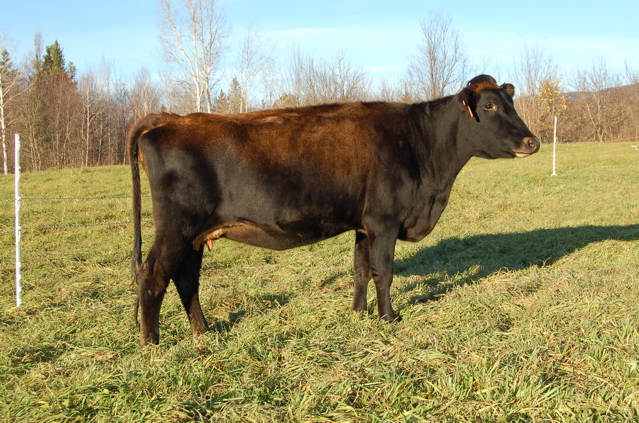
Suzette

Here's Alayne feeding a treat to some of them … that's Suzette's calf on the right, Suzanna:
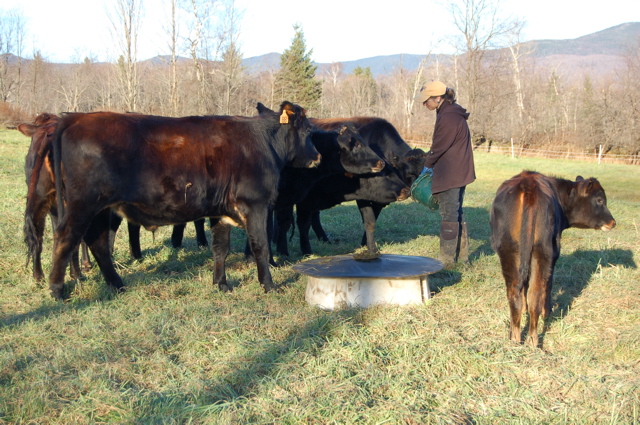
Alayne with herd

Another view, with calf Sophia on the right joining Suzanna:
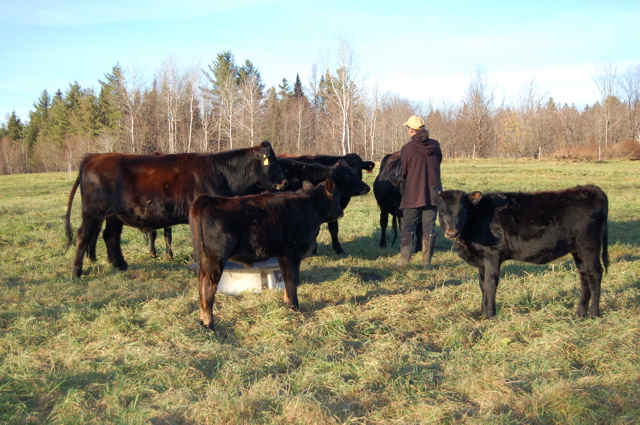
Alayne with herd 2

I will write more about our herd in future posts, but for now I thought you would like to see some photos of them. 

Posted in

67 responses to “Humanely Raised Pet Food”

  1. Phyllis Snow Avatar
    Phyllis Snow

    Although I realize you will have some people say you are (all) wrong about your decision as to what to feed your disabled animals, I support your decision whole-heartedly.
    While the animals, you use for food for your charges, have only a relatively short life, they have a good life. How do any of the other alternatives compare to the alternative you chose? At least the alternative you chose provides the “food animals” with a “high-quality” life even though it is short in time.
    Consider, too, these “food animals” would have no life at all were it not for RDR. Instead, the animals needed to supply your charges with food would have a distinctly lower quality of life as animals in the regular “food animal” channels.
    Thank you for all the thought and efforts you put into obtaining the information to make your decision. Thank you for sharing your decision. Thank you for being willing to spend the time obtaining food for your charges.
    Phyllis

    Like

  2. NinjaPonyDad Avatar

    Hard choice, excellent solution.
    You guys ROCK!
    Dignity and Identity…… I’ll never forget that.

    Like

  3. ginger Avatar
    ginger

    I applaud you & Alayne for doing the most thoughtful and important thing in considering what you feed your animals. I also am so pleased to read your post, as even as a vegan you can do this for the love of the animals. I’ve been a vegetarian for a many decades and I totally understand your considerations.
    It’s wonderful that you have the pasture and the time to not only take care of the special pets, but your cows as well.
    You two never cease to impress and amaze me with all that you do! Thank you from the very bottom of my heart.
    Warm hugs to all,
    ginger, Tobias & Tlingit

    Like

  4. Sue Heaps Avatar
    Sue Heaps

    Thank you for your post. This is an issue I battle with daily. We have a house full of 7 pets (3 dogs, 4 cats) – and my husband and I have our own battle going on with eating meat (we don’t eat lamb, pork or veal – but occasionally eat fish, beef & chicken). I do buy commercial food – high quality, human grade – for all the cats, but a while ago started making the food for our dogs. One of our dogs (who has since passed) had a very strict diet (low fat, low protein)…I followed the recipe found in “The Whole Pet Diet” authored by the founder of HALO pet food. It’s the Spot’s Chicken Stew. I buy organic, free-range chicken (although I always wonder…I too read Michael Pollan’s book). Along with the chicken, it is filled with tons of veggies, barley & kelp powder. The next best thing would be to follow your footsteps and raise our own chickens. Maybe someday – you guys are truly an inspiration to me. I so admire what you do, what you stand for and all you do for the animals you care for. Do what is right for you. You have posted something that I hope makes people think and be more aware what is fed to their beloved pets as well as themselves. We should all know where our food comes from. Thank you for everything you do.

    Like

  5. Jessica, NL Avatar
    Jessica, NL

    Great post Steve. Haven’t read all the comments yet but wanted to add my own first. I live the dilemma too, live small and applaud you all the way. Including the names.
    Hear hear.

    Like

  6. Mauro Salles Avatar
    Mauro Salles

    Guts for “Food, Inc”, the documentary film?

    Like

  7. Arielle Avatar
    Arielle

    As I am in the veterinary realm with my day job, I greatly appreciate the fact that you address the focus so many forget- that PROPER nutrition is important. Unfortunately, while I understand the desire of those to try to feed a vegetarian diet, I often am bothered by the fact that they forget the simple, basic fact that both dogs and cats need meat to survive. (Dogs less so than cats, and there are ways to get around it with dogs, though it is extremely difficult.)
    I feel the same way you do- happy meat is better. Happy means living with appropriate food, shelter, water, interaction, space, etc. I’m sure all your rescues appreciate it as well!

    Like

  8. C Markovic Avatar
    C Markovic

    I too applaud you for your decision to take the source of your animals food supply into your own hands. As most animal lovers, I too have struggled with this dilemma. It is and ethical quandary, but I don’t believe it is right to deprive our carnivorous pets of the diet nature intended. My dogs are on an all raw diet supplied by a small local company here in Oregon. Eventually, I would like to start making my own raw food with local organic, humanely raised, pastured meats. Commercial food is for the most part crap and full of fillers and potentially dangerous ingredients. If you want to take your animals health up a notch I encourage you to look into a raw diet. All the essential enzymes are not destroyed by cooking. As for the beef from your cattle make sure you include the organs and contents of the stomach. That is how wolves eat their prey and that is how they get all their nutrients. Raw meaty bones should also be included in their diets. I would recommend reading about “the raw meaty bones diet” which I believe to be the diet that most closely mimics the diet intended for dogs and cats.

    Like

  9. Heather Montana and Timmy The Wonder Dog Avatar

    I love you Steve and Alayne, not only for what you do but the thought you put into it. But, it doesn’t matter what other people think- you know you are doing the right thing. THAT IS WHAT MATTERS.
    Heather Montana and Timmy The Wonder Dog- Montana (we still miss you).

    Like

  10. Tracy Avatar
    Tracy

    do you and Alayne live in an alternate universe where there is 48 hours in each day? that is the only way I can imagine you can do everything you do! wow. I have one Pug, a hubby and two small kids and we can barely find the time to feed ourselves a balanced diet, nevermind investigating all the sources, options, etc. Good on ya and thanks for posting such a thought provoking segment.

    Like

  11. Melissa S Avatar
    Melissa S

    Wow. I have been a follower of your blog for a very long time, but this is the first time I have felt the need to post. I could not be more impressed with you. What a difficult choice, but I belive you have made the most compassionate choice available to you.Sebastian had a good life. I am not sure I would ever be strong enough to do that, but thank you for all you do for the animals.

    Like

  12. Nancy Avatar
    Nancy

    Oh boy, this is SUCH a tough one for me. I don’t eat red meat (or the other white meat) and I just get sick when I think about slaughter day. And I feel bad about my dogs and cats eating meat.
    But, I’m with you on this. The most important thing, I remind myself, is the the life the animal has lived and knowing it goes through the least amount of stress possible upon being slaughtered.
    Oh boy, I cried when I read about Sebastian’s last day, but I’m so grateful for all that he had. Kudos to you for tackling such a tough subject.

    Like

  13. Nancy Avatar
    Nancy

    PS–Mine eat meat. I know they have to.

    Like

  14. Cora Hellings Avatar
    Cora Hellings

    I have a tremendous amount of respect for the both of you and that will continue forever. I am probably commenting on this blog rather late because I had to absorb everything you’ve written. I do not have the answer; I only know that I cannot take an animal to slaughter or “processed” after winning it’s trust even if the slaughter house had a room nicer than the Ritz. With that said…what is the answer? I don’t know. I too had a small calf that I truly loved slaughtered; it’s been over forty years and I cannot forget.

    Like

  15. Marisa Avatar
    Marisa

    Steve and Alayne,
    I want to applaud you both so much for tackling these VERY difficult issues on a public forum. You are educating people, you are being honest with your supporters and you are questioning your actions and ethics as all of us should. Bravo.
    I, like many people here, am conflicted. I think one poster said it best when she wrote “Sebastian would have died of old age if I had to drive him.” This would definitely be me!!
    Yet, I too have a dog and cats and, although I believe dogs are omnivores rather than true carnivores there is no doubt meat is the healthiest option for both species. I am a vegan and have struggled endlessly with this dilemma because I do not believe the life of a cow or chicken or pig is less than the life of a dog or cat. I would never be able to directly kill Peter to feed Paul even though my animals ARE indirectly responsible for the deaths of other animals. Sigh. So difficult.
    In my research, I have found that although meat must be fed there are many vegetarian options that can be mixed in during the week so that meat consumption is minimized…particularly for dogs.
    With all these thoughts churning through my mind, I only have great respect for you and Alayne because you don’t hide from the hard facts that most of us try to sweep under the carpet. You have made the links transparent. Sebastian will be fed to Fuzzy. Sebastian must die for this to happen. Fuzzy will live.
    This is the very basic truth and everyone who eats meat or feeds meat to their companion animals needs to understand that this means the death of another animal who is just as much in love with life as we and our animals are. They frolic in the grass, they love their mothers and they enjoy basking in the warmth of the sun’s rays.
    If we have cats and dogs we are complicit in the deaths of other animals and I have NEVER seen another rescue acknowledge this and take responsibility for it. Absolutely astounding. I believe there is still hope for the world yet.
    But, even though we may choose to make an animal’s life as humane as possible before accepting the ultimate responsibility of taking that life it is very important to remember that EVERY animal would prefer life to death and to never take the death of any animal lightly whether they are dog, cat, chicken, cow or pig.
    Although our cats and dogs may need to eat meat we certainly don’t and I would encourage everyone who cares about these issues to take steps towards veganism. This would help to alleviate much of the suffering of animals raised for food.
    I am reminded of a fictional pig who urges us to always look outside the human perspective…to remember that the world has other eyes looking outwards than just our own.
    Wilbur burst into tears. “I don´t want to die,” he moaned. “I want to stay alive, right here in my comfortable manure pile with all my friends. I want to breathe the beautiful air and lie in the beautiful sun.”
    –E.B White (Charlotte´s Web)

    Like

  16. Sarah O. Avatar
    Sarah O.

    Thank you so much for raising this issue! I am a city dweller and obviously cannot raise my own beef. I have trolled the web constantly for the last 7 months since I got my little dog, searching for any kind of pet food company that concerns itself with the living conditions of the animals it uses. I have emailed pet food companies, I have searched the PETA site. NOWHERE can I find anything that addresses this concern. Even PETA lists “cruelty-free” products SOLELY on the basis of whether there has been lab animal testing.
    I have never received a response from anyone and I continue my search. I guess that cooking my own dog food is the only way. Although I have been a vegetarian for many years, I don’t expect my dog to be one. I have been using USDA certified organic as I understand that this does provide some limited guarantees about the living conditions of the animals.
    I know there are many people out there who care about this. I don’t understand why none of the pet food companies have been willing to fill that gap. If anyone knows of a pet food manufacturer who does just use humanely raised animals, I would love to hear from you

    Like

  17. Jill Maxwell Avatar
    Jill Maxwell

    Wow! You guys are amazing! This is the kind of thinking and action we need to save our planet. You are paving the way to a more conscious future on this planet 🙂

    Like

Leave a reply to Rhonda Cancel reply