And now for something entirely different!
This isn't a post about a new recipe I just found, although there are some very tasty chicken and squash recipes out there. No, this is about what we feed our chickens.
I've mentioned before that one of the many reasons for the move to the New Hampshire farm was so we could become more self-sufficient. This is why we're producing food for the dogs, starting to grow hay for the horses and other livestock, and growing some food for ourselves. This has been a process of learning how to do all these things, and we are a long way from being where we want to be … though we are definitely getting there.
Raising our own chickens is one step in that direction. If the objective is to be responsible for providing our own food in the form of meat and eggs, and knowing the birds were raised humanely and without antibiotics, growth hormones and other icky things, then having chickens meets all those goals. However, if the objective is also self-sufficiency, then having to buy your chicken feed from someone in a 50-lb bag sets you pretty far back from that goal. You may not be buying your chicken at the grocery store any longer, but you're still very dependent on someone else farther up the food chain (so to speak).
Now, nearly every modern book on raising chickens, as well as every county extension office, will tell poultrykeepers to head to the local farm and ranch store and buy the commercially produced, specially formulated "balanced" feeds designed for either the laying flock or the broiler flock. This is, of course, highly processed food — nothing fresh about it. Set out the standard grit, oyster shell, and fresh water, open the bag of commercial feed and pour into a feeder, and you're done. (One recently published book, Harvey Usery's The Small-Scale Poultry Flock, does actually encourage people to make their own poultry feed, though quite a few of the inputs are still purchased.)
The problem with commercial feeds is not only the expense, but you also don't know what went into the feed in the first place (GMO grains, drenched in pesticides and herbicides, etc.). And if you want to use only organic feed, it's far more expensive. Indeed, the cost of all animal feed has been rising dramatically in recent years, due to growing worldwide demand for grain, to competing uses like ethanol, and to reduced harvests from drought.
For all these reasons, we've been working on this issue for the past couple of years and experimenting with growing alternative feeds that we can produce ourselves for chickens. Yes, you can feed lots of greens and veggies from the garden during the summer, and you can put your chickens on pasture (like Joel Salatin does) where they can eat nutritious plants like clover, but the trick is providing sufficient protein and carbohydrate feed right through a long northern winter, too.
Rather than just rely on modern texts on how to raise chickens, we went back to the old sources — the agricultural "how-to" books from the century before everyone went to their local Tractor Supply to buy their animal feed. We wanted to know how the old-timers raised their flocks. One of our favorites is "The Dollar Hen" by Milo Hastings, published in 1909.
What we found is that they always raised chickens outdoors — for access to sunshine and insects, grubs, and worms, as well as the grass and clover — and they fed them a variety of grains, greens, and meat or milk for protein. Yes, meat. As Hastings wrote, "Chickens are not by nature vegetarians. They require some meat to thrive. It has been proven in several experiments that young chickens with an allowance of meat foods make much better growth than chickens with a vegetable diet, even when the chemical constituents [i.e., protein, etc.] and the variety of the two rations are practically the same."
So we also feed our chickens goat milk (yes, we're milking goats — more on that when we start milking again in the spring) and meat, like organs. If you want proof that chickens aren't vegetarians, set out a bowl of meat and a bowl of any other food you can choose, and the chickens will devour the meat first. We've done this. They are omnivores with a strong carnivore tendency. Thus we roll our eyes whenever we see egg cartons in the store labeled "eggs from vegetarian fed chickens". That is not natural.
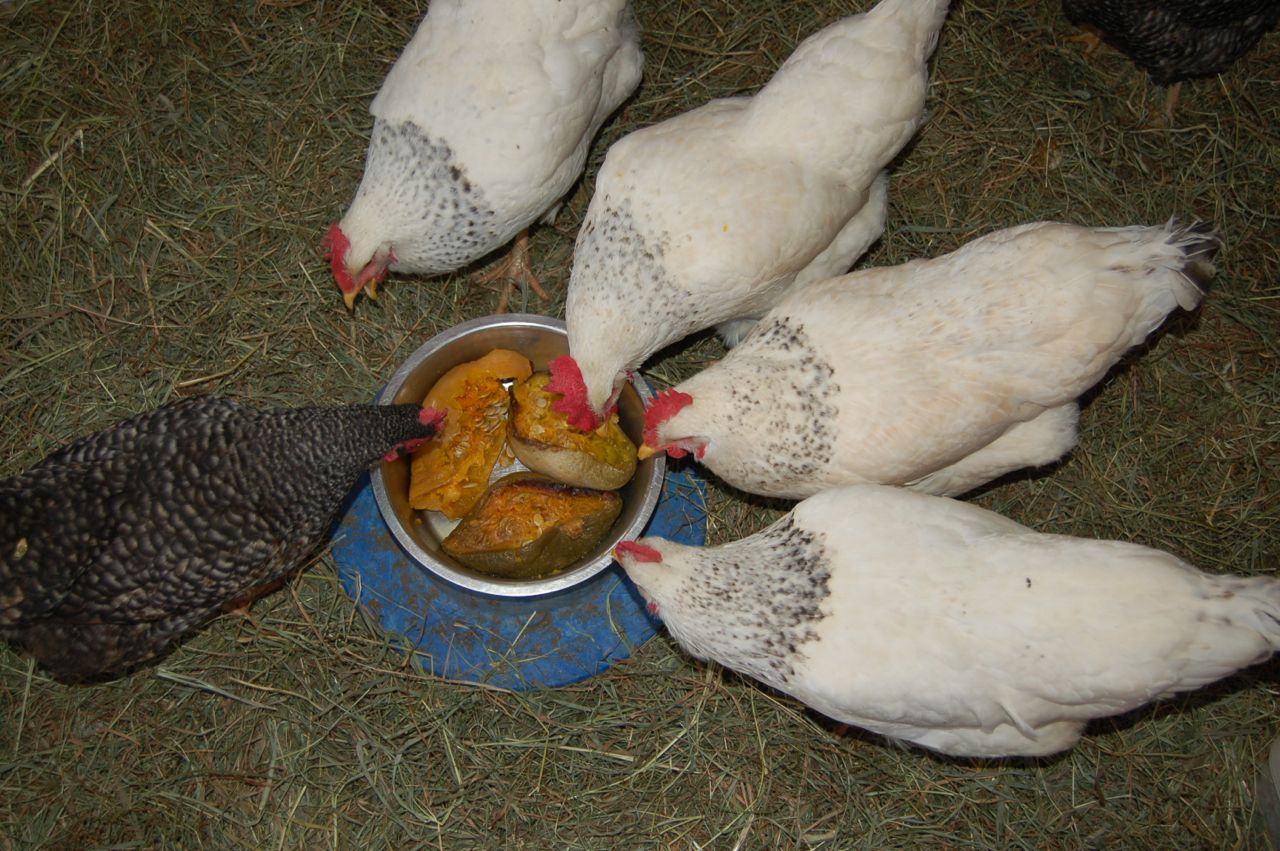
Last year our corn crop failed, first to torrential downpours and then to crows pulling up the new shoots and eating the seed corn, so we don't have our own corn to feed this winter. Other than corn, growing other grains in sufficient quantities to feed livestock is difficult if you don't have the specialized equipment to plant, harvest and thresh the grains. This is why we're focusing on crops like winter squash and potatoes — both of which can store well all winter — as two of the main staples we're able to feed our chickens during the winter.
Basically, our idea is that if we feed our chickens a fresh, natural diet of "real" foods, they will thrive. And yes, they certainly are. Those girls — some of whom are now five years old — are continuing to lay right through the winter.
New Shelter Challenge Contest — Please Vote for the Farm!
The latest Shelter Challenge started Monday, January 7 and ends on April 28. Grand prize in this round is $10,000, $3,000 for second place and $1,000 for third place, plus $1,000 for weekly winners and $1,000 for state winners. There are also other categories … please see the Shelter Challenge website for details.
*** You will find us listed as Rolling Dog Farm. The state is NH for New Hampshire. ***
Please remember, you can vote every day … consider bookmarking the voting page to make it easy.
We just won $1,000 as a weekly winner in the last contest, and thousands more in the previous contests. The Shelter Challenge really does bring in a lot of money for the animals here!
You can vote in the Shelter Challenge here.
Thank you for your votes!


 Rolling Dog Farm Blog
Leave a comment