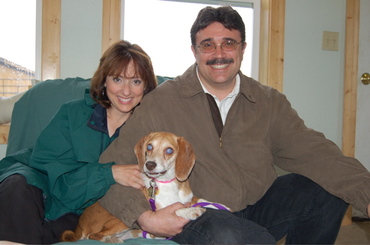
• Shep_and_jennifer_1

    This is blind Shep, the dog who arrived from Afghanistan at the end of May, out and about this afternoon for some leash training with his "coach," Jennifer J. from Portland, Oregon.  Jennifer has been a fabulous supporter of the ranch and was here this weekend to lend a hand.  She also brought some Portland weather with her — lots of rain, which here in the dry Rockies we are always happy to see.  One of Jennifer’s projects today was working with Shep on his leash skills, something we started doing shortly after he came.

    Shep is doing really well and is quickly figuring out how to walk quietly on a leash without getting tangled up underfoot.  (When you’re blind this takes a bit more practice.)  As you see in this next photo, though, he also had some ideas of his own on how this is supposed to work:

    Shep_and_jennifer_2

    Shep’s two weeks in isolation are about to end, and in a couple of days he will be able to meet and play with the other dogs.  But meanwhile there is this leash thing to master, so up and down the wet drive they went, teacher and student:

    Shep_and_jennifer_3

  • I was responding to emails yesterday evening in my office when blind Briggs and blind Austin — the two Beagles who arrived recently from Atlanta Beagle Rescue in Georgia — began a wrestling match behind my chair.  Briggs and Austin have become the best of friends and roughhouse like this multiple times throughout the day.  It’s very quiet — no barking at each other, no tough-guy growling — yet it still has a certain intensity to it.  Watching these two go at each other brings to mind a combination of Japanese sumo and American high-school wrestling.

    Here is yet more proof that being disabled doesn’t keep animals from doing the fun, everyday things that a "normal" animal gets to enjoy.  Briggs was born with vision but lost his sight  to glaucoma.  Austin was born blind.  But as you’ll see, they both know how to pin the other guy to the mat!

    As the wrestling match continued, I picked up the video camera off my desk and started shooting from my desk chair.  The entire thing lasted nearly five minutes, including an encore, but here’s a clip with about 90 seconds of the action:

  • Wobblers_den

    Since you saw Smokey and Charlie in their new wheels a couple of days ago, I thought you’d like to see what their new quarters look like.  We call it "The Wobblers’ Den," and it’s set up on the front porch of Widget’s House.

    As cute as these two boys are, there is a problem with their daily care.  They have an inability or unwillingness to "hold it" when they’re indoors or in a crate for the night.  They are not incontinent per se — unlike our Dachshunds whose disk problems and resulting neurological damage make them unable to control their bowels or bladders.  We have other wobblers who are fastidious about their potty habits and have plenty of self-control, like Noodle — who is far more compromised than these two brothers.  There’s just something about bringing Smokey and Charlie indoors or putting them in a crate that seems to trigger a "release," and then their wobbliness makes an enormous mess … including getting poop smeared all over themselves and in every corner and surface of their crates.

    We have tried changing their diets, the amount of food they get, the timing and frequency of their meals, you name it.  Nothing seemed to make any difference.  They could be outside all day, then we bring them in and — voila! — an accident five minutes later.  After months and months of trying to find a solution, we finally gave up trying to keep them as indoor dogs.  (We already have enough ‘close encounters of the fecal kind’ every day as it is!)  So we made them outdoor dogs much of the time, weather permitting … with a heated igloo and other shelter in our isolation yard.  We used this yard for them because it gave them more protection from the weather than any other area we had.  But of course, this made it difficult when new arrivals came and we needed the isolation yard for them.

    So we decided to move the boys over to Widget’s House this spring and create a special place for them on the big covered porch.  A week ago our fence contractor put in the fencing for their den, giving them a big part of the porch and a small gravel yard for their potty business.  (Yes, they do use their potty yard, which shows they can exercise self-control.)  We put down rubber stall mats on top of the concrete porch, and then this week the final furnishings arrived:  gymnastic tumbling mats.  Those are the blue and green mats you see in the photo.  We had tried to find something that would cushion them when they fell over, yet firm enough for them to walk on (especially important given how wobbly they are in the first place).  We also needed it to be easy to clean and rinse off, and relatively weather-proof under a covered porch.  We finally hit on the idea of these tumbling mats.

    The boys also have access to the Widget’s House yard when we let them out, and they’ll be able to use their new wheelchairs in this yard as well as on the rest of the porch, too.  They also like being in the center of things, getting to watch all the activity going on around them.

    All in all, this is a big "lifestyle" improvement for the two brothers, who really seem to enjoy their new Wobblers’ Den!

    Update on Penny:  Dr. Rockwell called first thing this morning to say that Penny has bounced back in a remarkably fast turn-around.  Her blood work and temperature are now normal, no more vomiting or diarrhea overnight, and today she was able to drink some water and hold it down.  They will start her on small amounts of food this afternoon.  Penny should be able to come home in a couple of days.  What a relief!

  • Penny_on_stretcher_in_truck

    Our ‘morning surprise’ today was finding blind Penny had suffered bouts of bloody diarrhea and vomiting in her crate overnight.  She was in respiratory distress, she was shivering, her body temperature was low, and she didn’t want to walk.  Penny had some diarrhea on Sunday night, and thinking that episode was from a routine intestinal bug, we had started her on an antibiotic.  Yesterday she seemed okay, and last night when I let her out for the final pit-stop before bedtime, she was her usual self.  When I opened the door to let her back into Widget’s House, she walked in with the rest of the dogs like she normally does.

    But this morning she was a dog in very bad shape.

    We cleaned her up the best we could, put her on the stretcher and loaded her in the truck.  I called our clinic, Montana Veterinary Specialists, to let them know I was on the way with an emergency.  I took the photo above of Penny just before we hit the road for Helena.

    At the clinic we found her temperature had dropped further, to about 97.4 degrees.  Our vet Dr. Jennifer Rockwell started her on IV fluids and antibiotics, took X-rays and ran blood work.  Here’s Jennifer looking at one of the digital X-rays:

    Jennifer_with_pennys_xrays

    This was the first time I’d seen the clinic’s new digital X-ray machine at work, and it was amazing.  The images are available in something like 45 seconds, and the clarity is phenomenal.  You can zoom in, rotate, adjust contrast, and — best of all — easily and immediately transmit the images electronically to a board-certified radiologist for a consultation. 

    Although the X-rays didn’t show any obstructions in her intestinal tract, we did see unusual white spots in her chest … but not the nodules you’d normally associate with either pneumonia or cancer.  So Jennifer has sent Penny’s X-rays to our radiologist in Spokane, Dr. Jeff Siems, for him to review.

    Meanwhile, Penny’s blood work showed a very high packed cell volume, which is a key indicator of hemorrhagic gastroenteritis, or HGE.  This is a serious but usually treatable condition.  Penny’s symptoms — the bloody diarrhea and vomiting — are certainly consistent with HGE.  You may recall that blind Widget came down with HGE back in March and scared the daylights out of us.  For right now, pending further diagnostics and the consultation with the radiologist, Jennifer is treating Penny at the clinic for HGE.  By late this afternoon, Penny was stable and sitting up in her cage, which was a good sign.

    Please keep your fingers crossed for her!

  • Helen_with_brenda_and_jayme

    When I was busy taking photos at the vet clinic this afternoon, I didn’t notice this moment when our vet, Dr. Brenda Culver, and vet tech Jayme J. had both crossed their arms over blind Helen.  It wasn’t until I uploaded the images onto the computer that I saw this odd pairing of crossed arms, as if it were some kind of Rottweiler religious ritual of some sort.  Or maybe this was a new feng shui practice involving Rottweilers as the energy field.  If so, I’m just not sure who had the yin and who had the yang end of Helen.

    But the moment passed and Brenda moved on to the purpose of Helen’s visit, which was to examine a growth on her inner thigh that we had found.  Brenda did a needle aspirate to draw cells out of the growth and then examined them under the microscope:

    Brenda_at_microscope

    The cells turned out to be mostly fatty ones with some blood, suggesting a simple and harmless if large lipoma.  But because of the size and rapidity of the growth, Brenda will do some further diagnostics to make sure there isn’t something else going on deep inside it. 

    Next up was an eye exam on Carmel the blind Beagle, shown here with the slit lamp:

    Carmel_eye_under_slit_lamp

    When Brenda measured Carmel’s eye pressures with the Tono-Pen, she got much lower readings (in the 30s) than I did last week.  She showed me that when Carmel squinted during the measuring and her lower eyelid simply brushed against the base of the Tono-Pen tip, it skewed the readings … even though the tip of the Tono-Pen was right where it should be, in the center of the cornea.  In other words, I need to work on my eyelid-suppression technique!

    The mystery is that Carmel’s eyes are far more painful than the pressures Brenda got today would suggest they should be.  The solid gray of Carmel’s eyes are from corneal edema, or fluid, and Brenda said this was one of the worst cases she’d seen.  Because the fluid is stretching the cornea, the corneal nerves can become ruptured and exposed, which in itself can be very painful.  There are several potential causes of this kind of edema, from infections to viral inflammations and diseases like glaucoma.  The corneal edema could be only one element.  It’s possible she’s had glaucoma secondary to uveitis, for instance.

    But there are other things to rule out before we know what we can do for Carmel, so Brenda is going to consult with our veterinary ophthalmologist, Dr. Yakeley in Spokane, Washington.

    Despite how her eyes feel, Carmel is one happy little girl, and she kept jumping on Brenda trying to give her kisses:

    Helen_and_carmel_with_brenda

    Meanwhile, Helen was wondering why there was yet another blind Beagle at the ranch.

  • Smokey_charlie_and_noodle_on_wheels

    Today three of our wobblers — Noodle and brothers Smokey and Charlie — got to try out their new wheelchairs for the first time.  Although we’ve had their wheels for several months, we had to wait for the snow to melt (that took until the end of April) and then the mud to dry up (mid-May) before we had decent ground to use.  Shirley L. and James C. from Portland, who brought blind Carmel out to us last week, have been volunteering at the ranch over the weekend and assembled the chairs yesterday. 

    All three wobblers have cerebellar hypoplasia, a neurological condition which affects their motor skills and balance.  Animals are born with this condition but it is not progressive.  Often the animals can walk just fine but are wobbly; that’s the case with Noodle’s sister Soba and our other wobbler Allie.  But Noodle can’t really walk properly — she can use all four legs, but her back is hunched, her front legs splay out to the side, and she rockets forward in short bursts.  Charlie is more challenged than Smokey and often falls over.

    Typically in our experience, animals born with cerebellar hypoplasia get better as they get older, and their brains and bodies learn to compensate for the disability.  They figure out how to walk with a wider stance, for example, and they use their tails to help maintain their balance.  But Noodle and Charlie not only did not improve as they got older, they actually became less stable … we think simply because of their added weight as they grew.  Smokey stayed about the same.

    We thought all three would benefit from quad wheelchairs, so we ordered custom-fitted units from Doggon’ Wheels for them. 

    In the photo at the top of the post are Alayne and Shirley with Noodle on the left, Smokey in the middle and Charlie on the right.  I took the photo after they had been in their chairs for about 10 minutes, so they were pretty tired from all the racing around!  Shirley, James and Alayne served as the pit crew for our racing team.

    Smokey and Charlie initially did not like being in the wheelchairs because they felt confined.  Their first instinct was to bite at the straps holding them in place.  But once we got them moving, they suddenly realized they could move like never before … and off they went!  Noodle was fine being in the chair but she took some more time figuring out how to put her front legs straight down and how to walk with them; she’s so used to them going out sideways that this was entirely new to her.  But once she got the hang of it, she enjoyed the new mobility, too!

    I also shot some video of the three dogs using their chairs this morning.  As you’ll see in this brief 1:15 minute clip, although they may have difficulty with the motor skills they were born with, they’re enjoying an entirely new set of motor skills!

  • Carmel_with_shirley_and_james

    Okay, so she’s not as exotic as a blind Shepherd from Afghanistan, but at least she isn’t another blind Beagle from Georgia!  No, she’s a blind Beagle from Washington state.

    This is Carmel from Gig Harbor, and with her are Shirley L. and James C. from Portland, Oregon, wonderful supporters of the ranch who kindly drove Carmel out to us yesterday. 

    Carmel’s owner was going through some difficult times and could no longer afford to provide for her or get her the medical care she needed for her eyes.  Carmel’s vet talked with a veterinary ophthalmologist in Olympia, Washington, who recommended they contact us about placing Carmel at the sanctuary.  So after talking with the owner and the vet, we agreed to take Carmel.

    Typically we don’t take dogs and cats from private individuals, because we try to reserve our very limited space for when shelters and rescue groups call us about a disabled animal who has no other options. Usually that’s the last call they’re going to make for the animal.  We have made exceptions, though, in cases where we’re convinced the owner has already tried everything possible and where medical care is clearly needed.  When we saw the first photos that Carmel’s owner emailed us, we winced looking at those solid gray eyes. 

    Shirley and James picked up Carmel on Monday and kept her at their house for us until they could get to the ranch.  After Carmel arrived at their home, Shirley emailed to say, "She is one SWEET girl!!!!"

    Just before we took the photo of Shirley and James with Carmel, I used our Tono-Pen to measure the intraocular pressure in Carmel’s eyes.  I got consistent readings in the upper 80s (defined as millimeters  of mercury, or mmHg) in both eyes.  Normal eye pressure in a dog is generally in the 15-25 mmHg, so this is incredibly high.  In fact, the readings I got were even a bit higher than we had in blind Briggs, and we knew how painful his eyes were.  (However, I never quite trust my own IOP readings until our vet in Helena, Dr. Brenda Culver, validates them with her own Tono-Pen!)

    Carmel sees Brenda early next week, and meanwhile, she is on pain medication for her eyes.  Like all of these incredibly stoic animals, the discomfort she must feel certainly doesn’t affect her disposition.

    She has settled right into the routine here, making herself at home in our house and exploring the yard.  Poor Briggs was so excited (again) to see a new girl arrive at the ranch, but alas — like all the others before her — Carmel has kept her distance from the teeter-tottering, overly eager Beagle from Georgia.

  • Barbara Edwards, the quiltmaker who each year makes a beautiful quilt to raffle off for the sanctuary, called to say that our blog readers had already bought all the raffle tickets she had planned to sell for this year’s quilt!  She was just amazed at the response she’s received in the mail so far.  Because we know that some checks are still on the way to her or about to be mailed, Barbara will expand the raffle ticket allotment to accommodate everyone.  So Barbara will allocate raffle tickets to all the folks who have sent in their checks or whose envelopes are postmarked no later than this Saturday, May 31st.

    It’s clear that there will definitely be far more than $1,000 from this raffle for the animals — and that is a real blessing!  Thank you!

  • Shep_with_steve

    Yes, you read that right.  Afghanistan. 

    We were contacted back in March by the Afghan Stray Animal League, a U.S.-based non-profit organization that works to help homeless animals in Kabul, Afghanistan, by supporting a small shelter there.  The shelter had taken in a blind Shepherd puppy, an animal that stood no chance of adoption.  They had named him Shep.

    Afghan culture doesn’t have much of a concept of "pets" or companion animals — not unexpected in a country with such grinding poverty and bloodshed — so the shelter mostly adopts animals to foreigners living in Afghanistan.  Other cultural norms make Afghanistan a rough place to be an animal … especially a weak or disabled one.

    It took a couple of months to work out the travel logistics, but late last week Shep flew from Kabul to Islamabad, Pakistan, and on to JFK Airport in New York.  The Afghan Stray Animal League was able to raise about half the money needed for his airfare, and we paid the rest.  After spending the weekend at a veterinary boarding facility at JFK, we flew Shep out to Montana yesterday.  He arrived in Helena last night at 11 p.m. on a Northwest Airlines flight.  After a potty break outside the Helena airport, I loaded his crate in the bed of the truck and put Shep in the big back seat.  He sat there quietly for the entire drive back to the ranch, and we got home about 1 a.m. this morning.

    He’s a tiny thing for a Shepherd, weighing about 30 pounds.  I think half his weight is just in those ears!  His eyes are clear, so I suspect he has progressive retinal atrophy or a similar retinal deficiency.  We’ll be taking him next week to see our vet, Dr. Brenda Culver at Montana Veterinary Specialists in Helena, for a comprehensive eye exam.

    Alayne took the photo of Shep and me this afternoon.  After days of traveling and being in kennels and crates, Shep was enjoying spending the day outside, soaking up some Rocky Mountain spring sunshine.  He is a very sweet boy, and an affectionate one, too, as you can see:

    Shep_kissing_steve_2

  • Lilah_eye_exam_may_27

    You may recall that when our mare Lilah poked her right eye out last week, we had noticed some changes in her left eye but weren’t sure what they were.  Our equine vet Dr. Erin Taylor — who was attending an equine ophthalmology course last week in Florida when Lilah injured herself — came out today to examine that other eye.  That’s vet tech Julia holding Lilah while Erin uses her new slit lamp on Lilah.

    Erin noticed two things.  First, Lilah has nuclear sclerosis, the cloudiness that occurs in the lens nucleus as a normal part of the aging process.  We see this in old dogs a lot, too, and it doesn’t affect vision.  The other thing that Lilah has are vitreal floaters, in which some of the vitreous fluid in the eye begins condensing into particles that float around in the remaining fluid.  This can also be an age-related change, though in some cases floaters develop as a result of equine recurrent uveitis.  Lilah has congenital stationary night blindness but not uveitis, so most likely her vitreal floaters are an aging issue.  They are generally considered to be benign.

    All in all, a good report … Lilah won’t be joining the ranks of the blind horses any time soon.  (Unless she pokes that left eye out!)