• Patti_and_boyfriends

    Now here’s a trio you don’t hear much about, but they are real fixtures at Widget’s House, our main dog building.  That’s blind Patti on the left and her two boyfriends, blind Levi in the center and blind Cedar on the right.  Both Patti and Levi were blinded by abuse, while Cedar went blind from progressive retinal atrophy.  Cedar has a pair of world-class ears that normally stand straight up, but when he realized I was taking his photo, he dropped his ears.  I took dozens of photos, and in every one he was pulling his ears down.  I don’t know why.  Some things only they understand.

    Patti_and_levi
    Patti is a big love of a dog who adores people but not other female dogs, so she’s in a dog paddock with Levi and Cedar.  She’s been with them for years, and they really are her boys.  When we let her out in the morning, she stands at the back door, waiting for Levi and Cedar to come out.  When we open the door and let Levi out, she races up to him growling like she’s going to tear him apart … and then goes happily bounding after him as he scampers off into the yard.  Then she sprints back to the door to be ready to greet Cedar in the same ‘ferocious’ way.  It’s her little morning tough girl ritual.  The three of them are inseparable, and spend all day roughhousing and playing with each other.

    Individually, each of them has a lot of energy, and together they could run a small power plant if only we could figure out how to harness their collective energy.  Just trying to get them to sit still in one spot, long enough to get some photos taken, was a real undertaking.  They get very excited when it’s time to come back inside, and each one wants to burst through the door to get in first.  It’s like a bunch of school kids at the playground:  "Me first!  Me first!"  So the challenge for us is to make them sit and stay and wait their turn, then come inside in a quiet and orderly manner, one by one.  That’s the theory, anyway.

  • Love_of_dog_bakery
    The Love of Dog Bakery in Laurel, Maryland, has graciously named the sanctuary as their ‘Charity of the Month’ for December, and will donate 5% of their sales this month to the ranch.  Check out their delicious dog treats here.  Many thanks to owners Julie and Rob Newman for this generous gift!  They first learned about us this fall from a series of articles in a Baltimore Sun blog written by Pulitzer Prize-winning reporter John Woestendiek.

  • Roy_with_erin_dec_6

    On Thursday morning, as I was still absorbing the news about Wobbles, we had yet more medical issues to cope with.  The evening before, as I was heading back to Missoula from Orlando, Alayne had called our equine vet, Dr. Erin Taylor, to tell her that our old mule Roy needed some attention.  He’s had ventral edema, in which fluid seeps into the body tissue and stays there, turning the flesh into the consistency of playdough.  This happens because of a circulatory problem, but the underlying cause can be hard to pinpoint.  This has been going on for a couple of weeks, and Erin had looked at him several days ago.  But the edema was growing in size, and his prepuce — the sack around his sheath, where his penis comes out — was swelling even more noticeably.  This is what it looked like on Thursday morning, and you can see the ‘shelf’ that is the edema:

    Roys_edema_dec_6

    So Erin came out Thursday morning to examine Roy again and get some medications on board.  That’s what she’s doing in the photo at the top of this post.  While she was here, Erin also did a physical exam on new arrival Bo, the blind Appaloosa.  You can see how skinny the poor guy is in this photo we took that morning:

    Bo_with_steve_and_erin_3

    And, while Erin was here, we also asked her to look at blind Allie the Lab, whose right eye had just turned red the day before.  It suddenly looked like a red plum.  Erin examined her and then spoke by phone with our small animal vet and ‘eye goddess,’ Dr. Brenda Culver in Helena, about her findings.  Here’s what that eye looked like:

    Blind_allie_close_up_2
     

    Brenda suspected Allie’s retina had detached in the back of the eye, causing the bleeding that turned the eye red.  So after Erin left, I bundled Allie into the truck and headed to Helena.

    Here’s a shot of Brenda examining Allie at the clinic, using her slit lamp — essentially a microscope for the eye.  Brenda’s vet tech Rick R. is holding Allie.  Brenda also took pressure readings in both eyes, and found Allie’s left eye — the "okay" looking one — had suddenly zoomed to 50 units of mercury.  This indicates a very painful glaucoma.  Her red eye was about 30, not as bad but uncomfortable anyway, even aside from the pain of the detached retina.  So Brenda recommended we go ahead and enucleate, or remove, both eyes.

    Allie_with_brenda

    I think I’ve mentioned this before, but a common misconception about blindness is that it is the ‘end stage’ of the disease process … and nothing could be further from the truth.  Over and over again, our blind animals continue to have their eyes deteriorate to painful states from ongoing disease processes — long after they’ve lost vision.  If you look at the photos of Allie on her original Web page, you’ll see her eyes were nice and clear … but blind from progressive retinal atrophy.  Contrast those photos with the one above, and you can see that since then — in just two years — cataracts developed, then glaucoma, and finally a detached if atrophied retina.

    Brenda did Allie’s surgery on Friday and called to let me know that she came through the operation just fine.  We’ll pick her up early this week.

    —-

    A note about Wobbles:  We’re still waiting on necropsy and pathology results, but in the meantime Alayne and I wanted to let you know how much we appreciated all of the wonderful, heartfelt messages folks have posted on the blog and/or emailed us.  We are very grateful for your thoughts about the loss of our little wobbler.

  • Wobbles_for_web_home_page

    Our adorable cat Wobbles died suddenly yesterday, while I was flying back from Orlando.  Alayne told me the news after I got home.  He was found dead in the cat house, lying in a litterbox.  We have no idea what happened.  We are, as you can imagine, devastated by the sudden loss of our little boy.  Wobs, as we called him, was one of our iconic animals … he demonstrated better than anyone how much a disabled animal can enjoy life.

    He had arrived as an 8-week old kitten from a shelter in Moses Lake, Washington.  He was our first animal with cerebellar hypoplasia, and his wobbling antics endeared him to everyone who knew him.  We had never encountered this neurological condition before his arrival, and since then many other wobblers — cats and dogs — have followed him to the ranch.

    Wobbles loved — absolutely loved — people, and he was always the first to wobble out to greet visitors to the cat house.  He was an affectionate tyke with a built-in purr machine.  If you picked him up and held him, he would sink into your arms and purr away.  He was also a scamp, and despite his compromised motor skills, he was an ace at bursting through the screen door to get outside.  And what did he love to do once outside?  Roll around in the dirt and gravel, getting as dusty as he could.  He was the original "rolling cat" at the Rolling Dog Ranch.  The cat house will never be the same without him.

    We are still coming to terms with the suddenness of it.  He was young, only about five years old, so his death was completely unexpected.  Late today I took his body to our vets in Helena so they can do a necropsy to find out what caused his death.  We feel we owe it to him to at least understand why this little life was taken away so early.

    I was struck tonight by reading his original story we posted on his page several years ago.  The last line reads, "We’ll never be able to call Wobbles a real ‘stand-up guy,’ but this little youngster should enjoy a long … if unbalanced … life here at the ranch."

    It was not to be.

    Goodbye, Wobs.  We love you.

  • Spinner_the_wonder_bladder

    Although it seems Alayne and I spend much of our day being nothing more than glorified doormen (doorpeople?), constantly letting dogs in and out, we do have one dog who hardly ever needs or wants to use our service.  That’s blind-and-deaf Spinner, seen here snoozing away at 1:45 p.m.  Yes, that’s right, it’s nearly 2 p.m. and she still hasn’t gotten up since going to sleep the previous night.  (I took this photo last Thursday.)

    We call her "wonder bladder dog" because of her amazing ability to hold her pee.  In fact, if we didn’t make her go out — which I did after taking the photo — it might be evening before she stirred.  Early Thursday afternoon I had come in from doing something outside and noticed Spinner still asleep in the living room.  I asked Alayne, "Hey, did you put Spinner out this morning?"  She said, "No, I thought you did!"

    That’s when I realized I should tell the wonder bladder story.  Now, as far as Spinner was concerned, it was rather rude of me to tap her on the nose and wake her up to put her outside at 1:50 p.m.  She was perfectly content to sleep right on through the afternoon.

    My only question is, where can I get one of those bladders?

    —

    Alison and I fly out of Orlando tomorrow afternoon and won’t get back to Helena until 11 p.m., and I’ll still need to drive home to the ranch, so I probably won’t be posting anything tomorrow night.

    —

  • Dillon_resting_on_baron

    I took these photos last week, after I noticed blind-and-deaf Baron and our old boy, Dillon, taking turns resting their heads on each other while sleeping off and on over the course of a couple of days.  So there’s Dillon above, using Baron as a head-rest.

    Not to be outdone, here’s Baron using his uncle Dillon for the same purpose.  He’s too small to get his head on top of Dillon, so leaning his head against Dillon’s body is the next best thing:

    Baron_resting_on_dillon

    But on a cold winter’s day, there’s really nothing better than snuggling all curled up with a bigger friend.  Thus Baron wrapped himself inside Dillon for extra warmth:

    Baron_curled_up_with_dillon

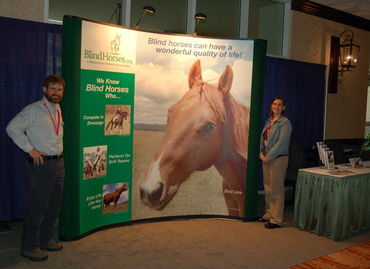
  • Steve_and_alison_at_aaep

    We’re in Orlando at the annual convention of the American Association of Equine Practitioners (AAEP), which is all the horse vets in the country.  (I don’t know why they call themselves ‘practitioners’ instead of ‘veterinarians.’)  The AAEP also has members from around the world, including about 400 from Canada and about 800 from other countries.  We particpate in the AAEP’s annual convention to promote our BlindHorses.org Web site and hand out our "Top 5 Tips & Myths" brochure.  That’s our exhibit display in the photo above, and with me is Alison James, our development director from Helena.  This was the first day, and the convention runs through Wednesday.

    We’ve found over the years that too many equine vets still hold on to the old myths about blind horses — that they can’t have a good quality of life, that you can’t put them out on pasture, that they’re dangerous, etc.  Usually this is just because of a lack of experience and knowledge about these special animals.  As a result, too many equine vets still default to the euthanasia recommendation when a client’s horse goes blind, rather than discussing all the options available to the owner, including keeping the animal.  We want equine vets to be the first line of defense for a blind horse, not the first one saying, "You’d better put it down."  So we’re here to educate about, and advocate for, blind horses. 

    It’s always a positive experience coming to the AAEP convention — this is the third year in a row we’ve attended — because there are vets who recognize that blind horses can have a great life, and they come up to share their own blind horse success stories with us.  We also have a lot of vet students who come by to visit, including a group of Mexican vet students this afternoon.  We had several international vets stop by today as well, including from Saudi Arabia, Chile and Malaysia.

    Speaking of blind horses, look who arrived in the predawn darkness on Friday morning, just before I left for Florida:

    Bo_arrives

    Yes, another blind Appaloosa.  This is Bo, an older (we think probably 15 years old) blind gelding from Oregon.  He was abandoned by his owners at a boarding stable in Eugene.  After months of trying to reach the owners and placing liens on the horse, the folks who run the stable finally gained legal ownership of Bo.  Then they promptly announced that they would take the blind horse to a nearby place called Wildlife Safari for lion food if no one stepped forward to take him. 

    At that point a lady named Rachel H., who had cared for Bo after he had been abandoned at the stable, called Whispering Winds Equine Rescue in Roseburg, Oregon.  Susan P., who runs the rescue, then contacted us.  Even after we had agreed to take Bo, the stable owners were still threatening to take Bo to Wildlife Safari, so Susan hurriedly arranged to have Bo trailered out to her place to keep him safe until we could get there.  She also took care of his vet check and Coggins test, and got him ready to travel.  We hired Bob Hubbard Horse Transportation to pick up Bo at Susan’s ranch and bring him out to Montana.  They’re professionals who haul horses all over the country, using the type of big semi vans you see in the photo.

    It was a chilly 9 degrees above zero when we unloaded Bo Friday morning.  Dr. Heather Kaese, who had been out the previous day to examine our blind Appaloosas (see previous post), stopped by to examine Bo and take blood samples for the research project.  Heather confirmed that he, too, is blind from uveitis.  (Hello, Appaloosa Horse Club!)

    Thanks to Rachel and Susan, Bo will now be safe for the rest of his life … and thanks to our donors, who make it possible for us to provide a sanctuary for a blind animal like Bo.

    —

    When Alison and I arrived at our hotel in Orlando late Friday night, it was a humid 73 degrees.  In the elevator up to our rooms, there was a big poster promoting an ice show at the hotel.  (In Orlando?)  The poster proudly announced that all the ice sculptures had been frozen to … yes, 9 degrees above zero.  We felt right at home.  Sort of.

    (Click on photos for larger image.)

  • Rocky_with_heather_erin_and_brenda

    Today we hosted Dr. Heather Kaese, a veterinarian and ophthalmology researcher who is working to understand the genetic links between uveitis and Appaloosas.  As we documented in our new Web site, BlindAppaloosas.org, Appaloosas are much more likely to get uveitis, the leading cause of blindness in horses, than other breeds.  Consequently, blindness in Appaloosas is, sadly, far too common.  So Heather and her research team are trying to find out why Appaloosas are at such risk for this disease.

    Heather is a board-certified internal medicine specialist and a resident in ophthalmology who currently practices in Kansas City.  Earlier this year we sent Heather and her research colleagues blood samples from all of our blind Appaloosas.  Her visit today was to do actual eye exams on each of them to confirm that they are in fact blind from uveitis.  If any of them had turned out to be blind from something else, it would skew the research data.

    Dr. Erin Taylor, our equine vet who is a board-certified surgeon, and our small animal vet, Dr. Brenda Culver who has a special interest in ophthalmology, also came out today to work with Heather.  In the photo above, you see Erin on the left, Brenda in the middle, and Heather on the right holding the slit-lamp.  They’re examining blind Rocky, one of our 13 blind Appaloosas.  Heather confirmed that all of them were indeed blind from uveitis.

    Our horses are just a small part of the data sample that the researchers are collecting, and we’re delighted to help in any way we can.  Now if only we could get the Appaloosa Horse Club, the official breed association, to acknowledge this problem in the breed and devote any resources to the research effort … that would really be something.

  • Picture_4

    A new Web site devoted to all things dog, called appropriately enough DogTime, just published a story on the sanctuary this week.  The writer, Leslie Smith, and her husband Mike had come out to the ranch for a visit this past summer, so Leslie is writing from first-hand experience.  As you’ll see, Leslie features blind Evelyn as an icon to illustrate what these special animals are like … and what kind of life they enjoy.  The image above is what I took as a screen shot from their home page.  You can read the story here.

  • Lisa_and_blind_foal
    One of the things we do is spend a lot of time emailing or on the phone answering questions and helping folks who have disabled animals.  This is particularly true when it comes to blind horses.  A few months ago we were contacted by a couple in Maine who had just decided to take a blind foal.  Now, this is very unusual, because typically when we get a call about a blind foal it’s because someone wants us to take it off their hands.  Not this time. 

    The couple, Lisa Bither and Jim Arthur, had seen our BlindHorses.org site and had some questions about caring for the blind baby they had just agreed to bring to their Black Horse Farm.  We’ve been in touch with them a number of times since then.

    Well, the baby is now nearly four months old, and the local paper in Lewiston, Maine — the Sun Journal — did a story yesterday on the foal and her new life at Lisa and Jim’s farm.  The photo above is one that ran with the story, which was headlined "Blind Love."  You can read the Sun Journal article here.

    Our hats are off to Lisa and Jim for saving this little girl!

    —

    Speaking of news articles, the Helena Independent Record here in Montana carried a story in today’s paper about our recent award from the International Fund for Animal Welfare.  You can read the story here.  Note that the article somehow placed us in Helmville rather than Ovando (no, we haven’t moved!), and Alayne hasn’t changed her name to ‘Elayne,’ but it’s a very nice piece.