• Well, at least we tried.

    Our equine vet, Dr. Erin Taylor, called last night at 11:30 p.m. to say Tonto had just died.

    Erin said she was surprised because he had come through the surgery so well and then recovered so quickly and easily from the anesthesia.  But in the end, it had all been just too much for his old body.

    I told her we didn’t have any regrets about doing the surgery and were glad we had given him a chance.  Erin said, "You’re right, because if we had gone ahead and euthanized him earlier, you would always have wondered ‘what if?’  At least you know you did everything you could."

    Our only regret is that we weren’t there with him when he died.  It’s so important to us that we’re with them when they go, so when they die like this, it hurts even more.

    It’s been a rough two weeks.

  • Tonto_and_erin

    Our equine vet, Dr. Erin Taylor at Blue Mountain Veterinary Hospital in Missoula, called early this afternoon to say Tonto had taken a serious turn for the worse.  Given his symptoms and following further examinations, she concluded that he might have a nephrosplenic entrapment.  She explained that in the horse there is a ligament that extends from one kidney to the spleen, and the colon can sometimes get wrapped around, or hooked, on that ligament.  Erin was going to try a fairly simple procedure  to "bounce" the colon off the ligament.  She’d know in 30 minutes if it worked and would call me with a report.

    It didn’t work, and he was getting worse.  There was another possible procedure, in which the horse is put under general anesthesia, placed on its back, and then rolled back and forth to dislodge the colon.  She doubted that would succeed in Tonto’s case, and given the risk of putting a horse — especially an old one — under anesthesia, Erin didn’t think it was worth doing.  If it didn’t work and he still needed surgery, now we would be risking anesthesia twice.

    Our options at this point were to simply wait and see if the problem could somehow resolve on its own; euthanize him; or proceed directly to surgery.  Neither Erin nor I thought the first option was acceptable or realistic.  He was in a lot of pain and deteriorating rapidly.  Erin walked me through what we faced if we decided not to euthanize him and went with the third option.  It would be major abdominal surgery, which is plenty risky for an elderly gent like Tonto, who is probably 25 years old.  Not only does he have to survive the surgery, but the recovery as well, with all its complications.  It’s also expensive — about $4,000.
    Tonto_on_operating_table
    I told Erin that, yes, we could definitely think of lots of other ways to spend $4,000, and we knew that some people would definitely question — understandably — why we would do this for an old, blind horse.  But the only thing Tonto has is his life, and how could we take that away from him if there was a reasonable chance surgery could save him?  We certainly understood we might lose him during surgery, or to post-surgery complications, but Alayne and I couldn’t live with ourselves if we didn’t at least try.

    So I asked Erin to proceed to surgery.  She said, "Okay, but it will take us 20 to 30 minutes to set up.  You’ve still got time to call us if you change your mind."  I told her we wouldn’t be changing our minds.

    About two hours later, Erin called to say she had just finished surgery and — surprise! — Tonto had an another intestinal problem:  he had a pelvic flexure retroflexion, in which the colon is flipped backwards 180 degrees.  Ouch.  There was a lot going on in there!  She said there was no way that could have been fixed other than with surgery. 

    Tonto wasn’t completely awake yet from the anesthesia but was stirring.  They were holding him down for a while longer because horses will sometimes try to get up too quickly, before they are able to function, and break a leg or otherwise injure themselves.  She’d call when he was up and recovered.
    Tonto_in_recovery
    Ten minutes later the phone rang, and Tonto was fully up on his feet and in the recovery room.  Erin said, "He’s bionic!  He got to his feet with no problem at all, he just sprang right up!"

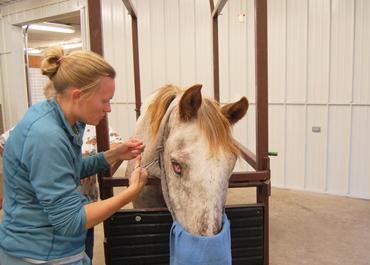
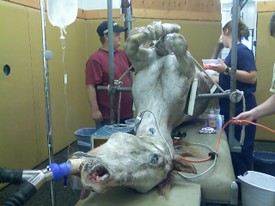
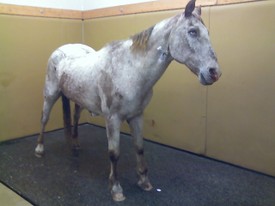
    The photo at the very top of this post is one I took last night of Tonto at the clinic; Erin was suturing his catheter into place.  The second photo is one Erin took with her cell phone camera while the vet techs were prepping him for surgery.  The third photo is another cell phone shot Erin took of Tonto in the recovery room.

    We’ve cleared the first hurdles. Now we have to get through the post-operative phase, and that includes getting his digestive system working again.  Please keep your fingers crossed for this old boy.

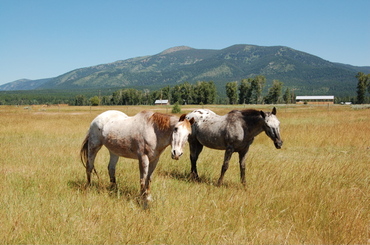
    I told Erin this evening that the photo of Tonto in the recovery room makes him look like a taxidermist just got finished with him — maybe it was the cell phone camera quality, maybe it’s his stance, but the poor guy looks a bit, well, stuffed, doesn’t he?  So here he is in a happier moment, in a photo I took a couple of months ago when he was out on pasture with his best friend, blind Scout:
    Scout_and_tonto_for_blog_july25

  • Erin_tubing_tonto_3

    It was shortly after 5 p.m. today when I noticed blind Tonto wasn’t eating his evening grain.  Uh oh.  In the several years we’ve had Tonto, I have never seen him not eat.  Then, before I could even say "colic," he sank to his knees in the corral.  And with that, my heart sank too.  I knew he was colicking.  We got him up, listened to his heart rate (fast) and took his temperature (normal).  I gave him a dose of Banamine, an anti-inflammatory.

    But even as we worked on him, Tonto got worse.  He tried kicking at his belly.  He finally just lay down and rolled over on his side.  I called our equine vet, Dr. Erin Taylor at Blue Mountain Veterinary Hospital in Missoula.  She told me to load him up and bring him in, and said she’d go for a run with her dogs while I made the hour-plus drive to the clinic with the horse trailer.

    Erin was waiting when I finally arrived with Tonto.  First she did a general exam, then a rectal to see what what was going on internally with his intestines.  In the photo above, Erin has inserted a tube through Tonto’s nose and then down into his stomach.  She pumped water in, then siphoned out the contents of his stomach.  Also in the photo is vet tech Janet L., who helped Erin with the procedures.

    Erin_preparing_tontos_catheter
    In this photo Erin is preparing a catheter so Tonto can have IV fluids throughout the night.  The blue cloth over his face served as a "snort ‘n sneeze" shield so we wouldn’t get sprayed by Tonto while Erin was pumping the water into his stomach. He was hanging his head low because he’d been sedated for all of this.

    We led him out of the horse stock, put him into a stall, and hooked up the IV fluids.  It’s too soon to say how serious a case of colic he has; we’ll have a much better idea tomorrow.

    (Click on photos for larger image.)

  • Copper_kid_in_front_pasture

    We got the word this evening in a phone call from Dr. Melissa Hines, chief of the Equine Medicine Service at Washington State University’s College of Veterinary Medicine.  The myelogram on our wobbly horse, Copper Kid, did not show the areas where the spinal cord is compressed.  Both WSU’s radiologist, who conducted the myelogram today, and Dr. Barrie Grant, the surgeon who would have done Copper’s spine stabilization operation, could not detect the areas of compression on the myelogram images.  Without being able to identify them, surgery wasn’t an option.  If you can’t see them, you can’t fix them.

    This doesn’t mean Copper doesn’t have spinal cord compression.  The myelogram essentially takes a two-dimensional view, rather than a three-dimensional view as you would get from an MRI.  (Horses are too big for MRIs.)  The myelogram captures the ventrodorsal, or top-to-bottom, view of the spine, and if the compression is occurring only laterally, or side-to-side, it may not show it.  Dr. Hines had cautioned us last week, when I dropped Copper off at WSU, that even though it’s rare, sometimes this happens.

    In cases like Copper’s where the myelogram does not reveal the compression, Dr. Hines said they routinely test the spinal fluid for a neurological disorder called EPM, or equine protozoal myeloencephalitis.  EPM is caused by a parasite and is not really endemic in our area.  Given Copper’s history, clinical signs, and our location, it is very unlikely he could have EPM … but you just never know.  It would actually be a good thing if he turned out to have EPM because it is treatable.  We will have those test results by Thursday this week.

    If Copper doesn’t have EPM, then all we can do is bring him back to the ranch, arrange a stall and pen for him where he can be safe and visit with his buddies over a fence, and then hope that nature will help stabilize him over time.  Our biggest concern will be winter, where the snow and ice can be treacherous for an animal that is neurologically impaired and unstable on his feet. 

    The good news is that Copper was able to get up after the myelogram — that was a big hurdle and a major worry, because the procedure can exacerbate the neurological instability.  Some horses have never been able to walk again afterwards.  So we were sweating that one.  Also, the WSU folks have now seen him lying down to sleep and getting up on his own (although he’s a bit shaky doing it!).  We had not seen him sleeping lying down in the two weeks after he had the relapse.  Although horses can snooze standing up, at some point they really do need to lie down to get a deep sleep.  Thus we were relieved to hear he is now doing this.

    I plan to head back to Pullman later in the week to pick him up.

    The photo above I took a couple of years ago when Copper was able to trot around on pasture.  Here’s the video again I took when Copper left the vet hospital a couple of weeks ago:

  • Peabody_with_alayne_on_last_day

    Peabody was already old and blind when he arrived at the ranch several years ago with an amazing story.  His tenacious zest for life — even with a failing body — was remarkable.  Two years ago he survived a stroke that we thought would surely do him in, yet he bounced back.  But in the past year he began to have more and more health problems, and increased difficulty getting up.  He would have his good days and his bad days.  And on the bad ones Alayne and I would look at dear Peabody and wonder if the time had come.

    Yet he still loved to greet visitors, and he would trot off the Widget’s House porch with his geriatric Shepherd shuffle to say hello.  He positively couldn’t stand Travis, our dog with a fused jaw, and when he knew Travis had come out the door, Peabody would try to take off after him to give that young whipper-snapper a piece of his mind.  Despite his health problems and creaky body, Peabody still loved to eat, too.

    So it was evident he continued to enjoy life, even with his ups and downs.

    But in the middle of last week he started to lose interest in food.  He seemed morose and more rickety than normal.  On Friday Alayne noticed a few of the other dogs would go up to Peabody, sniff him, and then back away as if troubled.  When Alayne went over to Widget’s House Friday night about 9:30 p.m. to put the dogs up, she found Peabody laying down in the yard.  Now, Peabody would rarely ever lie on a dog bed or cot; he almost always preferred the ground, which is the last thing his ancient body needed.

    But when Alayne started stroking him, he didn’t respond … even though he was very much alive.  She tried to help him get up, but he couldn’t stand.  It was almost like another stroke.  She called me for help.  I picked him up, got him to his feet and onto the porch, but he collapsed again.  His back legs weren’t working, and his front legs were barely functioning.   We carried him inside and put him into a giant dog crate on a thick, soft bed.  Peabody is the only dog we’ve ever had who didn’t like being crated, but he lay down on the bed in the crate and didn’t stir.  He didn’t seem to be in any pain, but he did look like he had given up.

    On Saturday morning I pulled him out of the crate and helped him out to the porch.  He still couldn’t walk.  I laid him down on the big round bed.  I hoped breakfast would make a difference, but it was clear his zest for life was now gone.  He looked miserable.  I knew the moment had come.

    I took the photo above of Alayne with Peabody just before we lifted him onto the stretcher and carried him out to the truck.  I drove him to our vet clinic in Helena and got there around 11 a.m.  A few minutes later I was holding his old Shepherd head in my hands as he slipped away.


  • Smoke_august_19

    This is what our world looked like today.  Thick, acrid smoke right down to the valley floor.  We have been smoky for days … really, weeks now … from forest fires near and far.  We didn’t think it could get any worse.  But it did, and this was as bad as it’s been.  The winds came roaring in just as our visitors arrived for their tour this afternoon, driving more smoke into the valley. 

    Smoked_out_ovando_mtn_aug_19
    It was so thick we couldn’t even see Ovando Mountain, which rises more than 7,000 feet just behind the ranch to the north.  The slopes of the peak start barely a mile from us.  Behind those trees you should see the mountain.  In a word:  Awful. 

    Smoke_with_ovando_mountain_aug_2
    For comparison’s sake, here’s a photo I took back on August 2nd, looking in the same direction towards Ovando Mountain.  We thought it was smoky then!

    Yesterday a lightning bolt started a fire on the mountain to the east of us, and from the kitchen window last night we could watch it spot out ahead of itself, with new fires popping up.  All day today helicopters were in the air, picking up water in a nearby lake and dropping it on another small fire on the back side of Ovando Mountain. 

    So far the animals are doing okay — we haven’t seen any respiratory issues yet from the smoke — but we’re just keeping our fingers crossed. 

  • Widget_testing_futon

    Blind Widget, who has been named an honorary bed tester by West Paw Design, decided she needed to try her skills at something bigger.  Alayne and I had bought a futon sofa as a Christmas present for ourselves and just now got around to setting it up.  (Yep, that was last Christmas … this is how our life goes!  It’s been sitting in the wood shed for seven months.)  We ordered a futon sofa because we could put a waterproof mattress cover on it, so the incontinent gang like Bailey could sit on the couch with us. 

    Widget_rubbing_on_futon
    Alayne had just opened the box and started putting the liner sheet on the mattress when you-know-who climbed up to check it out.  "I think you better have this thing tested before you go much farther," Widget seemed to be saying.  "You just never know."  In this shot Widget is performing the "rub-all-over-it" test.

    Widget_side_testing_futon
    And here Widget is conducting the all-important "side support" test to make sure the bed comfortably supports her ample shoulders and hips and the rather expansive in-between part, too. 

    Suffice to say that the futon mattress met all the criteria for a successful bed test.  The hardest part was simply rousting the sleeping bed tester so we could finish setting the mattress up.

    (Click on photos for larger image.)

    —-

    Copper Kid Update:  Dr. Hines from WSU called this afternoon to say Copper’s myelogram has been rescheduled for Monday morning now.

    —-

  • Copper_kid_at_wsu

    I drove Copper Kid, our young very wobbly horse, to Washington State University’s veterinary teaching hospital today.  After watching him for the past couple of weeks confined to a stall and not getting any better after the sudden relapse of his Wobbler’s Syndrome, we finally decided to pursue the surgical option for spine stabilization. I took this photo of 4th-year vet student Kate F. checking Copper’s heart rate.  Kate was there to welcome us, check us in and take Copper’s case history.

    The first step is to find out if Copper is actually a candidate for surgery.  So Copper will have a myelogram done, a procedure in which a contrast fluid is injected into the spinal column and then X-rays taken as the fluid moves down the spine.  This process "illuminates" the trouble spots where the spinal cord is being compressed.  The equine surgeon who does this operation will review those images to determine if he thinks surgery can help.

    There are risks to the myelogram procedure itself.  Because Copper is already very neurologically impaired, it’s possible that the myelogram might worsen his condition.  He will also have to undergo general anesthesia, which is always a bit worrisome with large animals, let alone one with a neuro problem.

    The internal medicine specialists I met with this afternoon at WSU, Dr. Macarena Sanz and Dr. Melissa Hines, also cautioned that in some cases the myelogram does not show the localized areas of cord compression — and without being able to pinpoint them, the surgeon can’t operate.

    So we have quite a few hurdles to get over before we’ll even know if surgery is truly an option.

    If we can proceed to surgery, Dr. Sanz told me that in 80% of those cases, there is at least a one-grade improvement and in 40% of the cases, there is a two-grade improvement.  The scale ranges from Grade 1, barely noticeable, to Grade 5, recumbent and unable to get up.  Copper is a Grade 4 … as bad as you can get and still walk.  Thus any improvement for him would make a huge difference. 

    Of course, there is that other 20% of cases that see no improvement at all.

    The myelogram is tentatively scheduled for this Friday.  Depending on when the surgeon can review the images, we may know as soon as that day … or early next week.

    If Copper becomes a candidate for surgery, we will launch a medical fund to help raise the money to pay the considerable cost of his operation.

    In the meantime, please keep your fingers crossed for our youngster.  As wobbly as he was when we arrived at WSU this afternoon, it didn’t stop this affectionate boy from nuzzling the vet students … who of course loved him right back.  I warned Kate and her colleagues that Copper would try to sit in their laps if they let him.

    (Click on photo for larger image.)

  • Oscar_in_back_of_truck

    Alayne got this shot of old, deaf Oscar snoozing in his favorite place, our Dodge Ram 2500 pick-up truck.  This is the "Mega Cab" version of the Ram, and you can see why they call it that … this is the back seat area, folded down.  We can actually set up a giant dog crate in there, it’s that big.

    And it’s plenty big enough for a tiny miniature Dachshund who wants to sack out while his Mommy unloads ranch supplies.  Whenever Alayne is anywhere around the truck, Oscar races to get inside.  He loves going for a ride, but if the truck’s not going anywhere, why, there’s no better place for a nap.

    (Click on photo for larger image.)

  • Two_kittens

    In addition to Blanca, here’s what also arrived this past weekend:  Two adorable 12-week old kittens who came to us from the Panhandle Animal Shelter in Sandpoint, Idaho.  The shelter had named them Spazzy — that’s him on the left — and his sister Teeny.  They were born with missing bones in their rear legs — it looks like both the tibia and fibula are simply not there.  Perhaps as a result of that, their back feet are upside down and backwards … notice how Spazzy’s left rear foot is positioned.

    When we hold them up in the air, their rear legs just dangle and kind of spin around.  And yet … put these two on the ground, and they can get around just fine.  Teeny does a modified bunny hop while Spazzy scoots around at a blur.

    The shelter had placed these two with a foster mom, Nicki D., who emailed us with some background on them.  In her message she wrote, "So basically, these guys are hardly any different than taking care of a normal cat. Except that they are disfigured, and people start talking euthanasia and removal of limbs around them."  (Nicki’s emphasis.)

    Nicki also told us that Spazzy is the "great adventurer" while Teeny is "a dreamer."  They are both sweet and affectionate, and Teeny just starts purring as soon as she sees you. 

    But … I think it’s time for a name-the-kittens contest!  Please post your name suggestions on the blog, and if we pick your names, we’ll send you either a Rolling Dog Ranch hat or a set of our greeting cards … your choice!

    Here’s some video of this duo that I shot in my office this afternoon.  You’ll see that except for those back legs, these two are happy, healthy and spunky little guys.