• Daisy_kibble_hunter
    Little Daisy gets really worked up at meal time.  She gets so excited she acts like she’s going to blow a gasket.  She also gets terribly bossy with the other dogs who are crowded around the dining table where we fix their bowls.  Daisy couldn’t get care less that she’s the smallest dog in the house … actually, the smallest animal on the ranch!  One minute she’s barking and growling at all the dogs around the table ("Back off, bucko, that food’s for me!"), and the next minute she’s jumping up and down on my shoes, urging me to "Hurry up!" with the food preparation business. "Hey, mister, what’s taking so long up there?!"

    So we came up with a new routine to keep her occupied while we fill the dog bowls … I toss one piece of dry kibble across the floor.  She’ll race to track that thing down and gobble it.  Because Daisy is so small, she can follow the kibble anywhere — under the chair, under the cot, wherever it goes — and retrieve it.  The only place that stumped her was when an errant toss on my part landed the kibble under the stove.  (Oops — had to fish that one out ourselves.)  As soon as she hunts down one kibble and starts heading back to the table to give the other dogs what-for, I toss another piece of kibble in a new direction … and off she goes!

    (Most of the other dogs in the house are blind, so they’re a bit mystified by what’s going on around them at this point.)

    Because of her spinal problem Daisy walks with a distinctive clump-clump-clump sound, her rear legs sometimes fishtailing sideways on her.  Thus even with my back turned I can tell when she’s found her piece of kibble.  The clump-clump-clump sound is replaced by a crunch-crunch-crunch sound, and when I hear the clump-clump-clump start up again, I know it’s time for another kibble toss.

    I took this photo of Daisy this evening to show you her expectant pre-kibble toss look.

    (Click on photo for larger image.)

  • The equine surgeon at WSU, Dr. Claude Ragle, told me this evening that Brynn’s kidney values remained normal AFTER they took her off IV fluids for 24 hours.  This means she is not in renal failure, which is such a relief.  He also said Brynn is back to her normal, chipper self.  They were not able to do the ultrasound today because Brynn got bumped from the schedule by an emergency case, so we still don’t know the status of her other kidney. They plan to do that tomorrow.  But overall this was very encouraging news.

  • Penny_and_alayne_1
    Alayne took three of the animals to the vet today — blind Penny, old deaf Pappy and blind Turtle.  I took these photos this afternoon just before Alayne left for Helena with them.

    Penny has a growth on her chest, kind of a weird lump hanging loosely under her skin.  It didn’t feel like a routine fatty tumor.  Soon after she arrived here from a California shelter we had to have a mast cell tumor removed from her chest.  The operation was a success, but of course we always worry about these things coming back.  So when we discovered the growth, it was one of those "uh oh" moments. 

    Pappy_and_bailey
    Our dear old German Shepherd Pappy has a skin mass on one leg that he has licked and licked until he’s become almost obsessive about it.  It’s benign and our vets have looked at it before.  But he’s been working at it so much recently it’s really become rather, um, gross.  Now we have to put a cone on Pappy to keep him from licking it.  Of course, that makes him a bit grumpy.

    Once the camera came out, so too did Bailey the miniature Dachshund, who LOVES to have his photo taken (really!).  So as soon as he heard me start taking photos of Pappy, Bailey came scurrying over from the other side of the living room.  First he posed right next to Pappy’s head (photo came out too blurry to use), then — realizing Pappy isn’t wild about having other dogs in his face — he hopped over to the other bed to pose.

    Turtle_feb_19
    Finally there was blind Turtle, who needed to have her stitches removed following her eye surgery and also to get a T4 thyroid test.  We’ve noticed she’s been losing weight, even though she seems to have a normal appetite.  We hope that’s as simple a problem as being hyperthyroid and not something more worrisome.

    (Click on photos for larger image.)

  • Brynn_with_dr_1
    We had some mixed news about Brynn from the surgeons at WSU this weekend.  After 24 hours on IV’s, by Friday night Brynn’s kidney values had improved … her BUN was normal and her creatinine had dropped a lot, but was still higher than normal.  Her temperature was lower although she still had a fever.  As Dr. Claude Ragle told me that evening, "everything’s going in the right direction." 

    The potential problem:  They had a difficult time during ultrasound on Friday even locating one of her kidneys.  It’s not clear whether leftover gas in her abdomen from the laparoscopic procedure earlier in the week interfered with the imaging, or whether in fact she’s had a kidney now shrivel up.  (She had both kidneys when we ultrasounded her when she was still a baby.  The photo shows our equine vet, Dr. Bill Brown, examining Brynn when she was 10 days old.)

    When Dr. Ragle’s colleague, Dr. Kristin Gablehouse, called Saturday, the news was getting better:  Brynn’s BUN and creatinine levels had returned to normal, and so had her temperature.  Whew!  But … but … it’s possible all the improvement in her kidney values was due to the IV therapy.  The only way to know is to take her off IVs and then re-test.  So they continued to run IVs to Brynn on Saturday and then took her off them today.

    On Monday they will do another blood panel and check her kidney values.  If they’re still normal, we can assume she just had a temporary "renal insult," as they call it.  If her BUN and creatinine are elevated again, it means she’s most likely now in kidney failure.  That will make any further surgery pointless.

    They will also do another ultrasound of her kidneys on Monday … if only one is functioning … well, I don’t know what the impact will be.  So now we’re anxiously awaiting a phone call from WSU tomorrow.

  • Scout_corneal_stain
    Last Thursday night, as I was closing up the barns around 10 p.m. and checking on all the horses, I noticed our blind horse Scout squinting with his left eye.  It was also tearing.  The sclera — the white part of the eye — was reddish, too.  Hmm.  Classic signs of a painful eye.  I called Alayne, who was over at Widget’s House putting the dogs up after letting them out once more before bedtime, to let her know we had some medicating to do.

    I headed back to the house to get a pen-light and my favorite selection of eye ointments and drops.  When I returned to Beauty’s Barn, Alayne was already there and had a halter on Scout.  Now, this sweet old Appaloosa is just as gentle as they come, but he does NOT like us giving him oral medication or eye medication … so he tosses his head about in protest as soon as he thinks we’re about to do anything.  Scout is also able to keep his eyelids shut tight — I call the eyelid the strongest muscle in a horse! — to keep out prying fingers, which makes a head-tossing horse with a painful eye a "non-compliant patient."

    After several attempts to a) hold head still and b) open eyelid, I succeeded in shining the pen-light on his eye … and it revealed what looked like a corneal ulcer developing on the surface.  Corneal ulcers can become major problems quickly — some become "melting" ulcers that literally eat right through the cornea.  I put the right kind of ointment in the eye (the wrong kind can exacerbate the ulcer), gave Scout some grain for his troubles, and closed up the barn. 

    Scout_tossing_head
    On Friday morning I hauled Scout in to Missoula so our equine vet, Dr. Bill Brown, could examine the eye.  That’s where I took these photos.  In the first photo Bill is doing a corneal stain, which "illuminates" disruptions on the corneal surface.  Sure enough, my late night diagnosis was correct — Scout had a corneal ulcer.  In the second photo, Scout is showing Dr. Bill his head-tossing maneuver just because … well, just because.  (Notice flying lead rope!)  If you click on this photo for a larger image, you can see the flourescent stain on Scout’s eye and side of his face.

    So at this point we’ll continue with the treatment we already had Scout on, and closely monitor the eye … because these ulcers can get away from you pretty quickly.

    By Sunday evening, whenever Scout would hear me coming, he’d shut that eyelid and keep it that way!

  • Brynn_laparoscopy
    My heart sank when I got a call last night from Dr. Kristin Gablehouse, the resident equine surgeon at WSU.  Yesterday they noticed Brynn seemed depressed and a bit listless, not her usual self.  They ran a blood panel and found her critical kidney values — BUN and creatinine — had suddenly shot up. 

    Despite all of her urinary issues and plumbing problems, Brynn’s BUN and creatinine levels had always been normal.  Now her BUN was at 54, while she had been at 21 and the high end of the normal range is 27.  Her creatinine was at 3.9, while she had been at 1.2 and the high normal is 1.7.  Percentage-wise, these were dramatic spikes.

    What makes these so alarming is that typically you won’t see a change in BUN and creatinine until you’ve already lost most of your kidney function.  In fact, you might have only 25% of one kidney still functioning before you see a change in these values.  In economics we’d call these a "lagging indicator."

    Brynn_with_terri
    Dr. Gablehouse said they didn’t know for sure what was causing the change.  It’s possible that because of the lengthy laparoscopic procedure the day before (on Tuesday) and her earlier procedures, she isn’t drinking as much as she used to or needs to.  Our equine vet, Dr. Bill Brown, told me this morning it’s also possible that the sedation on Tuesday could have lowered her blood pressure and reduced blood flow to the kidneys temporarily.  Dr. Gablehouse doubted it was due to infection in her kidneys since Brynn was already on antibiotics. 

    Whatever the cause, they hooked Brynn up to IVs last night to get more fluids pumped into her.  That definitely helped, because today her kidney values had improved.  The BUN dropped to 29 and the creatinine dropped to 2.9.  Unfortunately, she now has a fever as well.  She started the day at 102.6 and by tonight had actually gone up to 103.  The surgeons are going to ultrasound her kidneys Friday morning to see if they can get a better idea of what’s going on.  They will also run another blood panel to see if the kidney values continued to improve or not.

    So we are clearly worried about our little blind girl.  Please keep your fingers crossed.

    Brynn_and_vet_student
    These photos were taken during Brynn’s procedure on Tuesday.  I just received them from the hospital staff yesterday, which is why I couldn’t post them on the Tuesday evening blog.  In the first photo Dr. Ragle is operating the laparoscope inside Brynn’s abdomen.  In the second photo Brynn is being comforted by Teri Olson, a senior vet tech at the hospital.  In the third photo you see Brynn with one of the vet students who was present for the procedure.

    (Click on photos for larger image.)

  • Callie_with_willie_1
    I was taking some photos for a different blog post when this scene presented itself.  That’s blind Willie, a recent arrival, on the cot.  Blind Callie the Dachshund, who has no sense of ‘personal space boundaries,’ loves to share other dogs’ beds, cots, and … why yes, their food, too.  So here she was contemplating climbing up and snuggling next to Willie.

    Callie_with_willie_2_1
    Apparently she wasn’t getting good vibes from Beagle Boy because then she shot me this perplexed look.  I think that’s a "I don’t think he’s inviting me to join him" expression.  (Notice the furrowed Dachshund brow.)  A few moments later, upon further reflection, she wandered off in search of friendlier accommodations.

    (Click on photos for larger image.)

  • Brynn_in_horsestock_at_wsu
    Dr. Claude Ragle, the senior equine surgeon at Washington State University’s veterinary teaching hospital who is working on Brynn’s case, called me this evening with a report on the diagnostic procedures they performed today.

    After making a small incision in Brynn’s flank this morning, they inserted a laparoscope — a lighted scope that allows doctors to see inside the abdomen — to get a clear view of the exterior of her bladder and the ectopic ureters.  The results confirmed what they suspected from the last round of endoscopy a few days ago, which was that her ureters were not laying across the outside of the bladder wall and thus were not connected to the bladder wall tissue.  If that had been the case, they could have punched small holes from inside the bladder wall and up into the ureters, allowing them to drain into the bladder. 

    This photo is one the hospital staff took last week during Brynn’s endoscopy.  That’s Dr. Kristin Gablehouse on the left and Dr. Ragle on the right.

    So Dr. Ragle said there’s only one thing left to do: a urethral extension.  The surgical team will basically create — using Brynn’s own body tissue — a tube that will extend her urethra all the way to the very edge of her vulva, to what Dr. Ragle called the ‘vulvar lips.’  Because Brynn’s ureters — the tubes that normally carry urine from the kidneys to the bladder — are emptying into her vagina, the goal of the urethral extension will be to re-direct the urine back down and into her bladder.  Right now the urine just dribbles out of her vagina, causing the urine scalds all over her thighs and legs.

    Dr. Ragle thinks that the urethral extension will essentially change the internal "lay of the land" in her vagina and cause the urine to either do something unnatural — flow uphill at a dribble, through the urethral extension — or take the easy way and flow downhill and into the bladder.  He said it’s all fluid dynamics, so in theory the urine will take the path of least resistance and flow back down and into the bladder.  When it’s full, she should have the urge to pee and expel the urine normally through the full length of her extended urethra using the mare’s "abdominal thrust," with her back legs spread apart and the urine shooting out well past her backside and legs.

    Because this little blind girl has now had three rounds of procedures, Dr. Ragle is going to give her some "time off" this week and let her just hang out for a while.  He expects to do the urethral extension surgery next week.

    (Spellchecker weirdness:  The blog spellchecker helpfully suggested ‘periscope’ instead of ‘laparoscope.’  Well, kind of the same idea, I guess!)

  • Dillon_rolling_in_snow_feb_11
    Every morning when we let the "cottage dogs" out of Kelly’s Cottage, the first thing old Dillon and blind Kenai do (well, okay, it’s really the second thing they do after a good pee) is take a good roll in the snow.  They especially love doing this when there’s fresh snow on the ground, as there was this morning.  I took this photo of Dillon finishing his last roll.

    Kenai_rolling_in_snow_feb_11
    Although almost all of the dogs love rolling around on their backs in the grass during the other three seasons of the year, only a few qualify as "snowy rollers."  Dillon, one of our original Seattle dogs, and Kenai are two of the regulars.  This photo is of Kenai in mid-roll this morning.

    Kenai had come to us in late December a few years ago from an animal control shelter in the Mojave Desert in California.  We were worried how a ‘desert dog’ would adjust to an abrupt arrival in the middle of a Montana winter.  Fresh from the Missoula airport, I let her out of the truck, walked her into the snowy yard …  and she immediately dropped to the ground on her shoulder and began plowing her way through the snow with her face.  She hasn’t had enough snow yet!

    (Click on photos for larger image.)

  • The Daily News, the local paper in Pullman, Washington — where Washington State University is located — published a front page story today on our visit to the veterinary teaching hospital earlier in the week.  The photos were taken by the paper’s photographer, Geoff Crimmins, while we were there Tuesday morning.  The reporter interviewed me on Tuesday and then spoke with all of the hospital veterinarians working on Brynn and Claude yesterday.  The fourth-year student interviewed in the article, Heather Knapp-Hoch, was Claude’s ‘case manager.’  She has already passed her boards to become a vet, even though she doesn’t graduate until May.  Then Heather is on her way to a residency in oncology, so one day she will be a board-certified veterinary oncologist.  Here’s the article:

    WSU vet students learn lessons in life; every day a new challenge at vet teaching hospital

    By Hillary Hamm, Daily News staff writer

    Thursday, February 8, 2007 

    Heather Knapp-Hoch knows veterinary science is rarely routine.

    “It challenges me every day. I never feel that it’s mundane,” said the fourth-year veterinary student at Washington State University. “There are days that can be very stressful. For me I like the challenge. Every time you see something different, you learn from it.”

    Knapp-Hoch experienced a challenge Monday, when two new patients were admitted for care at the WSU Veterinary Teaching Hospital.
    Daily_news_claude_photo_1
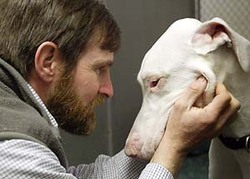
    Claude, a 6-month-old Great Dane, has wobbler’s syndrome, a malformation of the neck vertebrae which causes pressure on the spinal cord. Claude’s gait is clumsy and his back legs easily give out. He also is blind and has hip dysplasia.

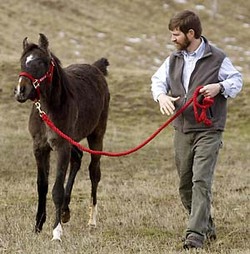
    Claude was brought to the hospital by Steve Smith, owner of Rolling Dog Ranch Animal Sanctuary in Montana, a facility that harbors dogs, cats and horses with disabilities. Claude was joined by Brynn, a blind 7-month-old foal who has a hole in her heart and malformed neck vertebrae that makes it difficult for her to graze. She also has been diagnosed with a disease that causes her urine to empty into her vagina rather than her bladder. Rarely able to control her bladder, painful urine scalds mark her backside.

    The Rolling Dog Ranch Animal Sanctuary in Ovando, Mont., was started in 2000, when Smith and his wife, Alayne Marker, quit their jobs with Boeing in western Washington and moved to Montana. The sanctuary now has 80 animals who suffer from disabilities such as missing limbs, blindness, deafness and other diseases.

    Brynn and Claude are rare cases because of the combination of illnesses in each animal, said Claude Ragle, a WSU veterinarian and equine surgeon. Each new case is a chance for students to learn something new and work with modern veterinary tools.

    “It’s real life. You can talk about something rare, but this horse didn’t come from the moon. It came from Montana,” he said. “One of our jobs here is discovering new knowledge. Having a facility of this capacity is really great.”

    Fred Wininger, a resident WSU veterinary neurosurgeon who cared for Claude, agreed.

    “We’re regarded as one of the premier hospitals in the Northwest. We take a lot of pride in our hospital and our students and our doctors. There’s a big team unit here,” he said. “Here, they get to see what can be done on the cutting edge of medicine.”

    The WSU Veterinary Hospital receives referrals from across the country. The hospital’s client base has allowed for high-tech diagnostic tools, such as an MRI and modern surgery techniques. Students have their hands in every part of client care, from diagnostics to medication administration and even acting as aides in surgery.

    “We get to see cases that the everyday private practitioner doesn’t see very often. We see a diversity of ailments,” Knapp-Hochs said, noting that every new case provides her with confidence in her field.
    Daily_news_brynn_photo_1
    Smith said it was an easy decision to bring Brynn and Claude to Pullman, rather than have them receive care from his local veterinarian, who happens to be a WSU graduate.

    “These two needed care that you can only get at a teaching hospital like this,” he said.

    Just because the tools are high tech doesn’t mean every story has a happy ending.

    Brynn’s prognosis is good, and veterinarians are discussing the options to reroute her urinary duct. Claude’s diagnosis is a bit more grim.

    Smith made the decision Tuesday to refuse Claude the surgery that would stabilize his vertebrae with acrylic cement. The extensive surgery “would not make him better,” he said.

    The decision to deny Claude the surgery was not dictated by the $6,500 price tag.

    “People always second guess when you spend a dollar on an animal,” Smith said. “If an animal can enjoy life, we want to give them that chance.”

    Smith said the animal sanctuary does have a ceiling for veterinary care for each animal because of the nonprofit nature of the business, but the choice to abandon the surgery was a quality of life issue.

    “This was a very difficult decision to make. They didn’t give us any false hope or undue pessimism,” Smith said. “It’s a quality of life thing. We just concluded that in the end, we couldn’t do it.”

    Instead, Claude will undergo medical management through decreased exercise, a prescription diet and steroids to control his vertebrae inflammation. Smith drove Claude back to Montana on Tuesday. Brynn will stay at the hospital for surgery.

    Knapp-Hoch said telling owners bad news is extremely difficult, especially when animals are like members of the family.

    “We provide all the options, but in the end, it’s frustrating to give bad news,” she said. “It’s very difficult. But to look at that animal, to know that I can’t fix it and can’t make its pain go away, is even harder. Those are important learning cases. It’s good experience. Compassion can be taught, but all of us are here for the benefit of the animals.”

    Ragle said compassion is emphasized in veterinary teaching, just as it is in human medicine.

    “It’s veterinary medicine, but animals all have owners. They have families,” he said.

    Knapp-Hoch said every new case she sees solidifies her love of animals and veterinary medicine.

    “Every animal deserves a chance, even if they have weird things going on,” she said. “I wouldn’t be in this field if I didn’t feel that way. I believe in giving an animal every shot you can give it.”