• Beth_with_dog_food_in_trailer
    Our pet food distributor delivered our latest order of dog and cat food this afternoon.  In this photo we’ve just opened the back of their trailer, and our employee Beth is doing her best Vanna White imitation to show you the pallet marked "Rolling Dog Ranch."

    On that pallet were twenty 36 lb bags of California Natural chicken and rice dry dog food, twenty cases of the canned California Natural dog food, three cases of the canned California Natural cat food, and five 16.5 lb bags of the California Natural dry cat food.  Total weight: 1,022 pounds.  Total cost: $957.51.

    Steve_with_dog_food
    Beth took this photo of me hauling some of the cases of the canned dog food into Birdie’s Cottage.  This is where we store the food Alayne and I use for the dogs who stay with us in the house.  Birdie’s Cottage, along with Kelly’s Cottage next to it, are the two buildings where we put many of those dogs up for the night.

    (Click on photos for larger image.)

  • Rosie_and_alayne
    This is blind Rosie, an American Quarter Horse mare who lost her eyesight to training abuse many years ago.  She arrived today.  Rosie went blind at the age of four, but her owners at the time kept her because of her sweet disposition.  But two years ago they gave her to another family in the Flathead Valley of Montana, who had her bred.

    Yet Rosie comes from a troubled line of Quarter Horses who trace their lineage to a famous stallion named Impressive.  By 2003 more than 55,000 Quarter Horses, Paints and Appaloosas carried Impressive’s bloodlines.  Unfortunately, much too late, the horse industry discovered that Impressive had a genetic mutation that causes a muscular disorder called hyperkalemic periodic paralysis, or HYPP.  Many of his offspring would turn out to be afflicted with the disease, which is commonly referred to as "Impressive Syndrome."

    Although there is now genetic testing that can determine whether a horse carries the mutation — and Rosie tested negative — the market for horses with Impressive’s bloodlines has pretty much dried up.  So Rosie’s value as a broodmare diminished.  Rosie’s family also planned to move in the near future, and didn’t think they would have room for her at their new place. 

    If the family couldn’t place Rosie, they planned to euthanize her.  They didn’t want to send her to the auction, where she would have ended up going to a slaughterhouse.

    Rosie reminds us very much of Lena, our blind Quarter Horse mare who was our very first resident at the sanctuary.  These two mares have the same calm, easy-going personalities, they’re both chestnut colored, and both went blind from training abuse.  I think Rosie will be right at home here!

    (Behind Rosie and Alayne in the photo is our employee Beth’s cabin on the left, and Widget’s House, our main dog building, on the right.  That’s Ovando Mountain in the distance.  Click on photo for larger image.)

  • Brynn_with_dr
    We just discovered that little blind Brynn, who came to the sanctuary last weekend when she was one-week old, has major medical problems aside from her blindness.

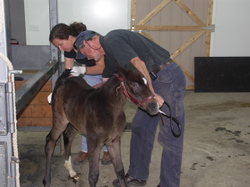
    We noticed when she arrived that she peed a lot, but the folks who brought her assured us this was normal for her, and we knew that foals in general urinated more than adult horses.  We also noticed her neck seemed very short and stubby, although we were told that Arabian foals typically looked like this.  Still, by Friday we noticed Brynn had urine scalds on her hindquarters.  I called our equine vet in Missoula, Dr. Bill Brown.  To summarize a lengthy conversation, Bill basically said, "Uh oh.  Let’s get her in."

    Bill already had a full day, so I planned to meet him at the clinic at 5:30 p.m. Friday evening.  I loaded Brynn and her momma in the trailer late in the afternoon and drove them in to see Bill.  It wasn’t long before the bad news started coming.

    Right away Bill could tell Brynn’s frequent urination wasn’t natural at all.  In fact, she most likely has an ‘ectopic ureter,’ which means the kidney is bypassing the bladder altogether and is dumping urine straight into the urethra.  There’s no pooling of urine in the bladder, hence the constant dripping and squirting.  We don’t know without running further diagnostics (endoscopy and dye tests) whether only one kidney is doing this or both, but judging from the amount of urine coming out, I suspect it’s both.

    Listening to her heart, Bill detected a severe heart murmur, either Grade 4 or 5 (with 5 being the worst).  Bill could actually feel the murmur with his hand on Brynn’s ribcage.  That’s how bad it is. 
    Brynns_urine_sample
    We then did a urinalysis and ran a blood panel, and learned two new things.  Brynn has what is known as "failure of passive transfer," in which she didn’t get enough basic antibodies from her mother.  Specifically, her immunoglobulin antibody (IgG) levels are way too low.  This makes her predisposed to infections.  The blood panel also showed that her liver values are screwed up, so there is something going on with that critical organ, too.

    And then there’s her neck.  We took X-rays, which showed Brynn has malformations in her vertebrae at the top of spine.  Parts of the vertebrae appeared to have fractured into fragments in certain places.  Bill looked at them and said, "I can’t explain why it looks that way."

    Yikes.

    What do we do now?  Well, we don’t give up on a two-week old little life because nature dealt her a really bad set of cards.  We’re going to do an echocardiogram of her heart to pinpoint the cause of the murmur.  We’re going to give her a plasma infusion to boost her core antibody levels.  And we’ll consult with a specialist about the ectopic ureter problem, which may be fixable with surgery.

    However, the heart murmur could rule her out as a candidate for surgery because she may not be able to tolerate the anesthesia.  If so, that means all we can do is keep applying vaseline to her rear end to prevent the urine scalding.  Bill says that another foal he saw with a similar heart murmur lived about one year before dying of complications. 

    There’s nothing we can do about her vertebral malformations except wait and see what happens as she grows.  Bill’s concerned she could become a ‘wobbler.’  Only time will tell.

    At this point we don’t even know how much any of this would cost, except for the plasma infusion, which is about $450.  If her life expectancy is only a year, of course we’ll have to decide not only what we can afford but what’s reasonable to do.  We could be facing some very difficult decisions ahead.

    Meanwhile, this baby girl has no idea she has this long list of medical problems.  She’s perky, happy, vigorous, and has a real zest for life.  She’s also a very affectionate and loving little thing.  We had several volunteers and groups of visitors here this weekend, and they all fell in love with Brynn. 

    We’ve had other animals who defied the odds, and we can only hope that Brynn will, too.  Please keep this tiny creature in your thoughts. 

  • Mordecai
    Mordecai Siegal, the author of 28 books about dogs and cats, and the president of the Dog Writers Association of America, Inc., just posted a wonderful article about the sanctuary in his column on Good News For Pets.com.  It’s a great story, and it’s illustrated with photos from our most recent slide show, too!  We’re grateful to Mordecai for the terrific column and to Jean C. of Nevada for telling Mordecai about us in the first place.

    Alayne realized this weekend that Mordecai also edited two of our favorite medical books, The UC Davis Book of Dogs and The Cornell Book of Cats.

  • Dog_food_bowls_on_table
    This is what our dining room table looked like this evening as I was preparing dinner for the dogs.  The bowls you see are for the dogs who live with Alayne and me in our house or in the dog cottages next to our house.  About half the dogs at the sanctuary are here with us, while the other half live at Widget’s House, our main dog building. 

    However, having just said "our main dog building," I wonder whether that’s really Widget’s House or OUR  house.  We joke that the size of our dining room table sets the limit on how many dogs we can have here. 

    So how do we decide who lives where?  Well, we keep all the smaller dogs (like Widget, Bailey and Callie) with us, along with some of the old ones like Pappy, as well as those who need a calmer environment, like deaf and blind Spinner.  (Psst…we also have a few favorites who became ‘house dogs,’ like Birdie.)  Those who are sick or recovering from surgery stay with us, too.  We also keep the new arrivals with us until we get a chance to know them, understand their personalities and figure out where they would fit best.

    If you’re wondering what we’re feeding, it’s California Natural chicken and rice, a super-premium natural dog food from the company that makes Innova.  We mix dry kibble with a couple of heaping tablespoons of the canned version, then pour some warm water into each bowl and stir to make a gravy.  Yum!

    (Click on photo for larger image.)

  • Sammy_goes_back_to_hospital
    Just four days after coming home from a two-week long hospital stay, we had to take little diabetic Sammy back to the vet clinic this morning.  Our internal medicine specialist in Helena, Dr. Britt Culver, last week had found Sammy responding very well (finally) to cat insulin, of all things.

    Sammy seemed fine Friday and Saturday but he "crashed" (as we call it) on Sunday morning, his diabetes going out of control again.  We talked with Britt at home and we got Sammy through it, but this morning Sammy was still not his normal self.  So Alayne bundled him into the truck and drove him to the clinic in Helena.  I took this photo a few minutes before they hit the road.

    Britt and his wife Brenda, our primary care vet, will now conduct an expanded 24-hour glucose curve, requiring blood draws and monitoring glucose levels every two hours around the clock.  They are taking Sammy home to continue the curve test overnight.  To avoid having to prick him every two hours for the blood, they will also insert a catheter in his vein so they can draw the blood they need that way.

    They’re hoping that the 24-hour curve will give them more data and a better explanation of why Sammy is chronically unstable.  (The previous curves were on a 12-hour basis.)  We’re keeping our fingers crossed.  This little guy has spent almost as much time in the hospital as he has at the ranch.

    (Click on photo for larger image.)

  • Our wonderful horse trainer Nichole Zupan now has blind Nikki trotting…and we haven’t even passed the two-month mark in Nikki’s training yet!  Here’s some video I took of Nichole riding Nikki at a trot.  You can tell Nikki is still getting used to the idea, but trot she does!

    http://www.dropshots.com/dropshotsplayer.swf

  • Brynns_first_evening
    Here’s our newest arrival, a blind foal named Brynn who came late this afternoon.  A few days ago we had a call from a lady in Helena, who said her mare had just delivered a blind baby but her boarding facility wouldn’t let her keep the foal there.  She had, in fact, been given an ultimatum to have the foal gone by this weekend. 

    The lady asked if we could take the foal and keep the mare with the baby until she was weaned.  She even offered to pay us board fees for the mare.  Once weaned, the mare would go home and the foal would stay here at the ranch.  We agreed to take little Brynn, and Mom and baby arrived about 4 p.m. today.

    In the first photo is baby Brynn with Alayne and Kathryn, and the white mare is Mom.  In the background is Dr. Gregory H., an emergency room physician from California, who’s a wonderful friend and supporter of the sanctuary.  Greg was volunteering at the ranch — he cleaned corrals all day, which is hard work!

    Brynn_nursing
    Brynn was born on June 3, so she’s just barely a week old.  Here she is nursing this evening.  This will be the third year in a row we’ve had a blind foal arrive.  I think we’re getting the hang of it!

    (Click on photos for larger image.)

  • Fundraiser_with_overview
    Our first annual "Road Trip" event at Caras Park in downtown Missoula on Saturday was a great success!  We woke up to a drenching downpour and groaned, but by the time we got started at 10 a.m., the rain had finally quit and people started venturing outside.  The turnout actually exceeded our expectations, and the animals were a hit. The first photo shows the basic layout in the pavilion, which was a nice location for this kind of open, drop-in gathering.  We would have waves of people come by with lulls in between, and during one of the quieter moments I took the camera and shot these photos.

    Fundraiser_with_travis_and_family
    We had lots of people who met a disabled animal for the first time.  Here a father is explaining Travis’ condition to his little girl; our volunteer Mary Ann F. on the left is holding Travis.  Having a fused jaw didn’t keep Travis from being a real showman; he wanted to personally greet everyone who stopped in.

    Fundraiser_with_quincie_and_allie
    In this photo our volunteer Quincie A. is talking with a couple about wobbly Allie, who is laying at her feet.  Allie loved all the attention and had finally worn herself out by the time we closed up at 2 p.m.

    Fundraiser_with_horses_in_trailer
    We brought blind Lena and blind Nikki along, too, and folks loved meeting these girls — especially kids!  People were fascinated to hear about blind horses.  Our volunteer Vicky C. is on the left in the photo, and our horse trainer Nichole Zupan is standing next to the trailer at the rear.  You can’t really see this from the photo, but there’s a child in front of the woman wearing the red jacket, and Nichole is helping the child feed a handful of hay to Nikki.

    Buddy_and_charlie_reunion
    And we also had two reunions with adopted dogs!  Susan S. brought blind Buddy (on the left) out to see us, and Neely V. brought Charlie.  Buddy was adopted only a couple of months ago, but we hadn’t seen Charlie in nearly a year. It was just great seeing these two wonderful dogs again.

    We couldn’t have done this event without the terrific support from all of our volunteers — thank you so much!

    (Click on photos for larger image.)

  • Rollingdogranchflyer_for_blog_1
    We’re taking several of our disabled animals on a ‘road trip’ today to the Caras Park Pavilion in downtown Missoula.  It’s part meet-the-animals, part fundraiser.  We’ll be at Caras Park from 10 a.m. to 2 p.m.  If you happen to be in the Missoula area, we hope you can stop by and see us! 

    (Click on photo for larger image.)