• Dog_food_in_horse_trailerIt takes a lot of food to feed the gang here, and this is how it arrives … 2,500 pounds at a time.  We  place a bulk order with Natural Life Pet Products in Kansas and get a great price for this high quality pet food.  They ship it out to us on two pallets, and we take the horse trailer to the Yellow Freight terminal in Missoula and pick it up there.

    What’s on the pallets?  24 cases of canned cat food, 48 cases of canned dog food, 10 bags of cat kibble, and 40 bags of dog kibble.  Total cost: $2,424.92.

    How long will it last?  About 2 to 3 months on average. 

    In the back of the truck was another 500 pounds of ‘equine senior’ grain for the horses I picked up at Cenex on the way out of town.  We go through about 50 pounds of the senior grain every day.

  • Vet_tripAlayne hauled a full truckload of animals to our vets in Helena today.  In the back of the truck are, on the left, Fluff and Puff Hooligan, our ‘barn-cats-in-training’.  They needed another eye exam, and Puff needs another round of minor eye surgery (some tissue grew back where it shouldn’t).  Next to Fluff and Puff is little blind Ashley, who went in for an eye exam and a spay.  (Hmm, we wondered why the house was so quiet tonight.)

    In the back on the left is blind and deaf Spinner, who was going in to get a health certificate for her trip to San Diego, and also bloodwork in preparation for the eye surgery.  On the right in the green crate is blind Sugar, going in for surgery on a ruptured anal gland (lovely!) and also an eye exam.

    Behind Sugar’s crate is a smaller crate you can’t see … in it is Snowball, a deaf cat who came to us from a gruesome animal hoarder case.  We got him over a severe upper respiratory infection, but we did not have any luck with a chronic mouth infection called stomatitis.  I’ve kept it at bay with daily Baytril injections, but haven’t knocked it out.  We may have to pull all his teeth — this sounds awful, but we’ve had to do it on three other cats and it’s the only thing that finally gets rid of the bacteria that causes this strain of stomatitis. 

    Our vets will do the various tests and procedures over the next two days, and we’ll pick up the crew in Helena on Friday.  This was kind of our typical vet run.

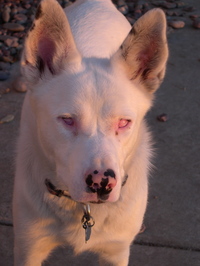
  • Spinner_for_web_2_1A month ago we posted a story about Spinner, a blind and deaf dog who recently arrived from a shelter in Spokane, Washington.  At that point we didn’t know why her eyes were completely white.  Now we know.

    Our vet in Helena, Dr. Brenda Culver, did an exploratory exam with Spinner under anesthesia two weeks ago.  She found that Spinner actually has bright blue beautiful husky eyes … but they have rolled forward towards the bridge of her nose!  The white we’re seeing is actually the back of her eyeballs.  Brenda, who is a regular vet but has a special interest in ophthalmology, had never seen this condition before.  She e-mailed photos of Spinner’s eyes and the surrounding tissue to a veterinary ophthalmologist at Virginia Tech, asking "what is this?"

    Last Wednesday, he told Brenda that Spinner appears to have an extremely rare condition called ‘restrictive strabismus.’  This affects the muscles that attach to the eyeballs.  He e-mailed us a study on the condition from a veterinary journal.  Of the 10 dogs in the study, four had both eyes affected, the other six had one eye affected.  In the end, an international team of vets operated on a total of 13 eyes, and 10 had successful outcomes.  The surgery is very complicated, and obviously it’s not a 100% success rate.   But we liked those odds.

    On Thursday last week, I tracked down one of the authors of the study, Dr. Tony Basher, who is in private practice at the Veterinary Specialty Hospital of San Diego.  He is a board-certified specialist in both veterinary ophthalmology AND surgery, making him one of only two vets in the world with that distinction.  He is also one of only a handful of veterinary ophthalmologists who has performed surgery on restrictive strabismus cases.  To make it even better, Dr. Basher was also geographically the closest to us of any of the opthalmologists who participated in the study. 
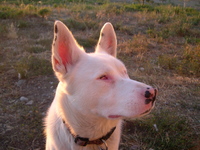
    Spinner_for_web_1We e-mailed Brenda’s images of Spinner’s eyes and the other info to Dr. Basher on Friday.  This afternoon, Dr. Basher’s office called with great news.  Dr. Basher could see Spinner next Monday for an evaluation, and if all goes well, surgery is scheduled for Tuesday! 

    So I hopped on the phone to make reservations for Spinner and me to leave for San Diego on Sunday. We’ll fly from Missoula to Seattle, then to San Diego. 

    Even if we can surgically correct the problem with her extraocular muscles, we don’t know if her retinas are firing or if she has other ocular problems.  There are a lot of unknowns here.  We also may not be able to pull the eyes completely back to normal position, for instance, which would leave her with impaired vision … but still vision.   We just won’t know how this is going to go until we do it.

    Yet there’s a chance — and a reasonable one — that we might be able to give Spinner her eyesight back.  And there is no better gift we could give any animal than that. 

    I will be taking our laptop on the trip and hope to post updates on the blog, so stay tuned for progress reports early next week.  In the meantime, please keep your fingers crossed!

    (Click on photos for larger image.)

  • Ashley_1This baby girl arrived last night at the ranch from the Yolo County SPCA in Davis, California.  The shelter had asked us earlier last week if we could take a blind 10-week puppy who had been dumped in their overnight bin.  Jerry Black, our incredible volunteer who drove to Bozeman on Thursday to pick up Turtle and Mink, went to the Missoula airport yesterday evening to pick up little Ashley and drive her out to us. 

    Ashley_2Ashley is a lot smaller than she appears in these photos, weighing all of 10 pounds.  She is the youngest, smallest puppy we’ve ever had.  She is totally blind but, like our other born-blind animals, completely intrepid.  She marches around, taking big exaggerated steps to feel her way along, and then she puts each paw down with a determined ‘thump!’  It sounds like a tiny Roman legion heading our way.

    Ashley spent a good part of her first day here exploring the yard.  She quickly found the front steps to the house, memorized the location, and goes straight there when she wants to come in. 

    She is adorably cute, playful, inquisitive, and affectionate.  In short, your perfect puppy.  Except she can’t see.  But she doesn’t know that’s a handicap, because she doesn’t know what sight is.  She assumes the world is dark for all of us, so she’s not at any disadvantage.  That’s why our born-blind animals are so confident.  It is truly inspiring to see a little blind girl like Ashley just take charge of life.  It never occurs to her that she shouldn’t.

  • At first glance the title of this post looks like we’re branching out from dogs, cats and horses … but we’re not.  Turtle and Mink are two disabled cats who just arrived from the Humane Society of Gallatin Valley in Bozeman, Montana. 

    Turtle_closeupTurtle is a blind tortie who is already quite adept at finding her way around her new digs.  She is a gentle, sweet soul who is a little … let’s be honest here … on the plump side.  Although she’s shy about raising her head up — I could never quite get the photo I wanted to show you her eyes — she purred for me as she lay curled up in that bed.

    MinkMink is a true ‘wobbler’ … very unsteady on his feet from some kind of neurological disorder.  He kind of lurches across the floor.  We’re not sure if it’s cerebellar hypoplasia, like our cat Wobbles, or some other issue.  But like Wobbles, he has learned to compensate by using a wide stance with his front legs.  He also extends his tail rigidly outwards and shifts it around to help balance himself.  Mink is quite the character … very affectionate and playful.  I had to keep picking him up and moving him away because every time I’d try to take a photo of Turtle, he’d lurch right into the frame and then lean against me.  (Warning:  attention hog.)

    He and Turtle were together at the Bozeman shelter, and they’ll be together in the same cottage here, too.  Turtle will hiss at Mink occasionally when he gets right next to her, but only as a gentle reminder … "don’t fall on me!"

    ——

    A note to everyone who wrote in with concerns about Bonnie and Clyde’s return to Texas:  The lady who owns Bonnie and Clyde loves them a lot.  They will not end up in a regular shelter.  She had searched for a year to find a place for them before contacting us.  We just weren’t the right place because they weren’t disabled.  She’ll make sure Bonnie and Clyde get the best care.  If we weren’t convinced of that, we wouldn’t have sent them back.  We know they’ll be just fine.

  • One of the many beautiful things about where we live is the sheer number of rainbows we get to enjoy seeing.  Our valley is officially named ‘Kleinschmidt Flat,’ after the earliest settlers in the 1800’s, but Alayne and I have often thought it should be renamed ‘Rainbow Flat.’ 

    Rainbow_october_20For some reason — we’re not sure why — we have an incredible number of rainbows out here.  And not just one at at time, but often two.

    Today we had a series of rain squalls come through the valley … the sky would grow dark, the wind would come roaring in, the rain would come pelting down … and then 20 minutes later, the squall moves through and the sun comes out. 

    At about 4 p.m. this afternoon, we saw this rainbow out the back door, looking to the east.  If you click on the photo for a larger image, you may be able to see the second companion rainbow to the right … it’s faint, but coming out of the clump of cottonwoods at the right side of the photo.  By the time I grabbed the camera the light had already shifted enough that the twin rainbow had started to fade.

    The main rainbow had one end (what you see here) in our hayfield, and the other end was about 1/4 mile to the north of us in our neighbor’s alfalfa field.  We could see the entire glowing rainbow, from end to end.  Of course, the animals seemed singularly unimpressed by nature’s glory; they were more interested in the approaching dinner hour.

  • You may remember reading about two cats named Bonnie and Clyde who arrived here on October 9th from Austin, Texas.  We had agreed to take them because we’d been told the cats were ‘disabled’ and had cerebellar hypoplasia, making them wobbly and unbalanced on their feet. Well, after a couple of days lurking in a wide-open crate (see photo), the two cats finally ventured out … and we learned they weren’t disabled at all!

    Bonnie_and_clyde_1These two cats could run, jump, climb, and do anything a normal cat could do, with no sign of wobbling or any disability whatsoever. They leaped onto window sills, jumped through the open window into the outdoor enclosure, and raced across the cat house floor.

    We were incredulous that anyone would have described Bonnie and Clyde as ‘disabled.’  We gathered it was a handy way to get them a permanent spot in a nice sanctuary, rather than take them to a local shelter.  Since we have so few open spots and save our very limited room for truly disabled animals, we told Bonnie and Clyde’s owner that we would either send the cats back to her, or trade them to another shelter that had genuinely disabled cats.  The owner initially said she didn’t want us to send them back.

    So last weekend we arranged a trade with the Humane Society of Gallatin Valley, a no-kill shelter run by wonderful folks in Bozeman, Montana.  They have a blind cat named Turtle and a true ‘wobbler’ named Mink they were excited to send us in exchange for taking Bonnie and Clyde.

    Then, yesterday, the owner said she wanted them back after all, so we made travel arrangements for Bonnie and Clyde to fly back to Austin today.  A few hours after making the reservations, the owner contacted us again, now saying she wanted us to send them instead to another shelter in Arizona.  Fed up at that point, we declined to do so and went ahead with Bonnie and Clyde’s planned trip.  So I took them to the airport this afternoon, and as I post this, the two cats should have arrived safely in Texas.

    Of course, the Bozeman folks had been so gracious about offering to take Bonnie and Clyde, and they were so delighted with the idea of their two disabled cats coming to the sanctuary, that we decided to go ahead and take Turtle and Mink anyway.  Our go-everywhere volunteer, Jerry Black, is heading to Bozeman tomorrow to pick up Turtle and Mink and bring them to the ranch.

    The irony here is that because these two non-disabled cats, Bonnie and Clyde, made a brief stop at the sanctuary, two disabled cats will now have a new home here.  In the end, this seemed to work out alright, didn’t it?

  • Alayne took two calls in the last 24 hours from people whose horses had gone blind, and their vets had told them they should just put the animals down.  Both individuals actually wanted to keep their blind horses, and had called us seeking more information on how to care for them.

    This, unfortunately, we see a lot.  Too often equine vets immediately tell their clients to euthanize their blind horses, and they trot out (no pun intended) all the old myths about blind horses — they’re dangerous, they can’t have a good quality of life, it’s inhumane to keep them alive, etc. 

    Display_final_layout_1It’s not because these vets lack compassion or don’t care.  It’s usually because they simply don’t know any better and have very limited experience with blind horses.  Much of their experience is confined to the initial period when a horse is losing its vision, and the animal is frightened and upset at the encroaching blindness.  That’s generally when the client calls the vet.

    What happens is that too many vets extrapolate from this early stressful period that the horse will ALWAYS be like this, rather than seeing it as a temporary phase and allowing the horse time to adjust.  (Wouldn’t you be scared to death if YOU started going blind?)  Thus they end up counseling their clients to euthanize their blind horses as the "only humane thing to do."

    So we’ve realized that we need to reach out to the equine vet community with our message about blind horses.  To that end, we are going to attend the annual convention of equine vets (the American Association of Equine Practitioners) this December in Seattle.  We will have an exhibit at their trade show to promote our BlindHorses.org Web site, hand out our blind horse brochure, and talk with as many vets as possible.  The image you see here is a mock-up of what our 8-foot wide exhibit display looks like.  The dominant photo is our beautiful blind mare Lena.

    (Click on photo for larger image.)

  • Widget_on_green_bed_1Who ever came up with the saying, ‘working like a dog?’  Really, do you think they had a dog?  The only thing our guys work hard at is sleeping.  Alayne fixed up a new bed last weekend … actually a couple of West Paw beds piled on top of a Kuranda dog cot, topped with a flannel sheet … and it’s been a big hit.

    In the first photo you see the ever-ready sleeper herself, Widget, showing her sunny-side up sleeping style.  Then there’s our old Shepherd, Pappy, trying out the new bed, too.  His only problem is the Pappy_on_green_bed_1bed is so deep and plush, and his hind legs so weak, that he can’t get out of the bed without some help from us!

    In the photo behind Pappy is little Goldie, one of our original ‘six-pack’ of dogs who moved to Montana with us from Seattle in 2000.  Goldie is completely blind but has the same kind of fearless personality that Widget has.  Just to the left in that photo is 14-year old Dillon, also part of the ‘six-pack’ from Seattle.  He had spent 5 years in a small pen and was scared to death of people when we adopted him.

    Widget_sleeping_with_back_end_outFinally, if you saw our last post about the Standoff of the Short-Legs, here is a photo of Widget in that same chair yesterday morning.  She  brow-beat Oscar the miniature Dachshund into making way for her.  We’re not sure what to call this sleeping position.  If the one above is ‘sunny-side up,’ would this one be ‘back-side out’?

  • Widget_and_oscarThis is a scene that happens often around the house.  Burrowed deep in a pile of dog bedding on the favorite ‘sleeping chair’ is Oscar the elderly miniature Dachshund.  Looming over him is Widget, our blind Beagle/Dachshund mix.  She is determined to sleep in that chair.  So her chair-stealing strategy is to climb up the ramp, plant her front feet on the cushion, and stand there, looming silently and indefinitely, until Oscar finally gets nervous and abandons his perch. 

    We call this the ‘Standoff of the Short-Legs.’  Widget never physically pushes Oscar out or sits on him.  No, sir.  Her technique is simply to wait him out until he can no longer stand the tension and skitters off, tossing a Mini Doxie growl over his shoulder at her.

    Widget always wins in the end.  Until this morning, when I took the photo.  For some reason she gave up, turned around and headed down the ramp.  I think it was because she heard the camera clicking, and maybe thought this was not portraying her at her best.  I’m not sure.  But for the first time I can remember, Oscar won the standoff.  I think Widget just wanted to appear magnanimous on camera.