• Widgets_house_in_snow_1Well, look at this!  Our first snow of the season, on September 24th.  That’s not unusual for this part of Montana, where our first frosts are often in August.  There was a winter storm warning this weekend for the higher elevations (5000′ and up — we’re at 4,100′), and we woke up to rain at first.  But as the morning went on, the temperatures dropped, and the rain turned to snow.  Big, heavy, wet flakes.  (Photo shows Widget’s House, our disabled dog building.)  It finally quit snowing after a couple of hours, and by early afternoon the snow had all melted. 

    Still, a great reminder of the winter to come!

  • We had to put old, blind Frasier to sleep today.  This elderly fellow had come to us just about a year ago from a shelter in Illinois.  We knew he had heartworms when we had agreed to take him.  Only after he arrived did we learn he was also in right-sided heart failure.  And there was more.  Frasier had pulmonary hytertension, ascites (fluid build-up in the abdomen), and allergic airway disease.  If all that wasn’t bad enough, he had a yeast infection that made his skin and hair oily and stinky.  He was, as we described him then, a medical disaster.  The least of his problems was his blindness!

    With excellent medical care, we went to work on this old boy.  We restored his heart and pulmonary functions to safe levels (although he remained on multiple heart medications right up to the end), eliminated the fluid build-up, got the allergic airway disease into remission, and successfully treated him for heartworms, too.  We were still treating the yeast infection when Frasier suddenly started to go downhill in the last few weeks.  He began losing weight, seemed listless, just didn’t look right.

    Frasier_last_morningWe took him back to our specialist for another examination last week.  On ultrasound we found he had developed a thyroid tumor AND a giant spleen tumor.  The thyroid tumor had engulfed the carotid artery that supplies his brain with blood and two major nerves.  Surgery to remove the thyroid tumor alone would be very tricky and full of risks for an old dog like Frasier with his history of medical problems.  As for the spleen tumor, we wouldn’t even know how far the cancer had spread until we opened him up.  We might find it was already too late.

    There was no point in doing only one of the surgeries.  We’d have to do both.  After consulting at length with our specialist about the risks and likely outcomes, we decided not to put Frasier through this. 

    It turned out that nature had already taken its course anyway.  In the past couple of days Frasier had begun shutting down.  He stopped eating.  No amount of cat food or other usual ‘lick-the-bowl-clean’ yummy stuff could entice him to eat more than a tablespoon or two.  He lost all interest in anything.  Yesterday we decided the time had come.  I took the photo of Frasier this morning, before we loaded him in the truck for the last ride to town.  Sadly, this is how he had looked for the past couple of weeks. 

    We had brought Frasier through a lot in the year he was here, and we know he enjoyed his time just hanging out being an old dog.  We’re glad we could give him that.  Bless his heart.

  • Spinner_for_webThis blind and deaf girl came to us on the same day that Kodiak did, and although we mentioned her briefly in a post that day, you haven’t seen her since.  Well, she’s doing just great.  We named her Spinner because she spins around rapidly in tight circles, head straight up in the air, her nose working furiously to gather ‘data’ from the air. 

    We noticed her doing this on her very first evening.  At the time we thought maybe she was just getting used to her new environment.  It turns out that this is really her way of figuring out what is going on around her. 

    And in the mornings, when we carry her (yes, she prefers to be carried … she slinks on the ground if we take her by a collar or put a leash on her) out of the cottage and set her on the ground, she spins in even faster circles, nose up, but also barking like crazy … as if to let the world know she’s come out.  She is so cute and so sweet.

    Spinner_for_web_2The sclera — the tissue commonly referred to as "the white of the eye" — has covered the entire surface of the eye.  There is no iris, pupil, or anything else there.  Just this white tissue.  Yet we’ve discovered that it seems she can detect light.  Soon after she arrived, we were looking for her one night to put her up in the cottage and went out with a flashlight.  Once the flashlight beam hit her face, she suddenly whipped her head around, right in the direction of the light.  She’s deaf so we know she didn’t hear us coming.  We tested again with the flashlight with the same response.  We’ve taken photos of her with a flash and she seems to react to the flash, too. 

    We’re taking her to the vets next week for some exploratory surgery.  It’s too soon to know what, if anything, we might be able to do for her eyes — what she has is an extremely rare condition — but the fact that we think she can see light, even under such thick tissue, makes the possibilities very intriguing.

    (Click on photos for larger image.)

  • You may remember reading a few weeks ago that a wonderful friend of the animals, Mark C. from Missoula, had bought a special bed for Kodiak, our paralyzed Malamute.  The bed has a mesh lining so urine flows through and drops into a tray below.  This keeps paralyzed dogs from getting soaked in their own pee.  Well, poor old Kodiak died a week later and never got to use the bed that Mark had so kindly bought for him.

    Keisha_on_kodiaks_bedAs all this was unfolding with Kodiak, our old three-legged girl Keisha was starting to have incontinent problems of her own.  And when we say "old," we mean it:  She’s now 17!  When you get to that age, I think you’re entitled to have a bladder control issue.  (See Keisha’s remarkable story here.)

    We’ve been finding Keisha’s bedding damp in the morning, and even outside sometimes she can’t get up in time to pee.  Her one remaining back leg has hip displaysia, which has gotten worse in the past year, so her mobility is more and more constrained.

    Enter Kodiak’s special bed.  I took this photo of Keisha on the bed tonight, just when we put the dogs up.  Now the trick will be seeing if we can get her to STAY on the bed.  She may have limited mobility, but when she wants to move, she can!

    (Click on photo for larger image.)

  • House_with_fall_colorsAlayne and I took two of our blind mares, Lena and Nikki, and their sidekick Lonesome George out to pasture this morning.  As we turned around to head back to Lena’s Barn, we noticed this beautiful sight — the cottonwoods in brilliant gold colors, framing the house.  Fall definitely arrives early here in the Northern Rockies.

    The house overlooks six of our blind horse pastures, spread across about 60 acres of the property.  From the living room we can easily see what’s going on in those pastures. 

    Alayne_with_water_tankA short while later Alayne and I moved a big, 300-gallon water tank from one of the horse corrals to the 30-acre pasture where the sighted horses stay.  During the summer these horses use an irrigation ditch that runs across the pasture for water.  However, at this time of year the flow in irrigation ditches becomes unpredictable — and the irrigation "season" ends Oct. 1 anyway.  So we decided it was time to set up the 300-gallon tank for the sighted horses just to be safe.  (As it turned out, there was plenty of water in the ditch today.)  That’s Alayne in the tractor, moving the tank.  There’s hardly anything you can’t move with a tractor!

    (Click on photos for larger image.)

  • Pappy_leaving_vet_hospitalAfter two days in the hospital being treated for aspiratory pneumonia, Pappy came home to the ranch this evening.  He seemed just a little put out with me for having left him at the hospital for a couple of days.  (Animals do know how to lay guilt trips, don’t they?)  But once Pappy got settled in his favorite spot — the back seat of our Chevy pick-up — he decided to forgive me. 

    Ever the willing chauffeur, I drove this wonderful old Shepherd back to the sanctuary.  As we wound our way up Montana Highway 200 along the Blackfoot River, he alternately looked out the windows at the passing scenery or snoozed.  It’s about an hour drive from Missoula, so he had plenty of time to do both.

    Pappy_leaving_hospital_2Pappy will need to stay on a daily antibiotic for the rest of his life to prevent the aspiratory pneumonia from recurring.  It’s called Orbax and he’ll be on a full strength 68 mg dose for two weeks, then we’ll cut that in half and monitor how he does.  Since we can’t restore complete nerve function to his larynx, he will continue to ingest food and fluid in his lungs.  The drug should help keep it from developing into pneumonia. 

    I took the photos of Pappy this evening at the clinic right after putting him in the truck.  There next to Pappy on the bed in the first photo is the box of Kodiak’s ashes I also picked up at the clinic.  So in their own way, both old dogs came home this evening.

  • Pappy_recuperating_1Our treasured old German Shepherd, Pappy, is back in the hospital tonight.  In July he had miraculously survived both pneumonia and meningitis.  He spent 10 days in the hospital then and took weeks to regain his strength once he came home.  But Pappy had been back to his old self for a quite a while, going out with us on barn chores and supervising Alayne and me as we made our rounds. 

    Yesterday morning, however, he seemed reluctant to go out with us on barn chores, so we left him inside.  Yesterday evening we noticed he was coughing and gagging periodically … nothing major, but not normal.  Then Alayne remembered this was how his last episode with pneumonia had started.  Uh oh.  We started him on two antibiotics, Baytril and Augmentin.  This morning he had a fever of 104.2.  I called our specialist in Missoula, Dr. Dave Bostwick, and sounded the alarm.

    I bundled him in the truck and drove the 60 miles into town.  Dave took some X-rays that showed, sure enough, aspiratory pneumonia.  This is the result of Pappy somehow getting bits of food or fluids into his lungs.  But why again — and so soon?  Dave checked Pappy’s gag reflex by sticking his hand into Pappy’s mouth.  Although we could tell that Pappy’s eyes and brain registered "Hey, this guy just shoved his hand into my mouth!", inside his throat there was little gagging.  That showed there was hardly any effort by the larnyx to close up and keep that hand out out of the trachea. 

    The larynx has several jobs to do, and a crucial one is to protect the airways and keep food and other debris out of the lungs.  Dave explained that in old dogs, the laryngeal nerves can decay, leading to failure to keep food out of the lungs.  This nerve decay can also affect their ability to bark — the larynx is where the vocal cords are, too.  Sure enough, Pappy’s bark was virtually non-existent this evening. 

    Pappy_closeup_indoors_3There isn’t anything we can do to fix this nerve decay problem, so the only thing we can do is try and stay on top of the potential for pneumonia.  That means keeping Pappy on a daily antibiotic, probably Baytril.  By this afternoon Pappy’s temperature had returned to normal, but we put him on IVs and I left him at the hospital this evening.  He will stay there for the next couple of days to make sure we knock out this bout of pneumonia quickly.  At Pappy’s age, and given what he just went through in July, we can’t run any risks.

    You can see Pappy’s original story here.  To read about Pappy’s homecoming from his last hospital stay in July, click here.

  • New_allie_with_alayneAllie, a blind three-year old Lab, arrived at the ranch today.  Her family in California had tried for over a year to find a place that would take a blind dog, and finally contacted us several weeks ago. 

    The family has two small children — the youngest is 18 months old — and Allie kept accidentally knocking them over because she couldn’t see them.  Add Allie’s youthful energy and playful nature to her blindness, and the collisions were frequent.  So the family had to keep Allie isolated by herself much of the time, and they didn’t like having to do this.  They wanted Allie to be in a better environment.

    Once we agreed to take her, the family worked out travel arrangements.  The dad, John S., flew up with Allie from the Bay Area this morning to Spokane, and then drove over to Montana with her.  Here’s a photo of Alayne and Allie, which we took shortly after John left to head back to Spokane.  (Click on photo for larger image.)

  • Rich_with_laddie_and_marieToday our farrier, Rich Boyle from Simms, Montana, made his regularly scheduled visit to the ranch.  Rich comes about every 6 to 8 weeks to trim the horses’ hooves. We had 13 horses who needed trimming, from our rambunctious 5-month old blind foal Destiny (now she was a handful!) to old, easy-going blind Shasta, who just had eye surgery last week.

    The photo shows Rich trimming Laddie, a recent arrival, out in one of our pastures this afternoon.  The farrier’s assistant (or so she thinks) is Marie, a mare who came from a ranch out along the Rocky Mountain Front. It was Rich, in fact, who first learned about Marie’s plight and arranged for her to come to the sanctuary.  (Click on photos for larger image.)

    Both Laddie and Marie are blind and are completely bonded with each other.  They spend their days together grazing in this pasture.   Marie always had ‘relationship issues’ with just about every horse we paired her with.  Until Laddie.  Now these two are inseparable, and they get very upset if they don’t know where the other one is.

    Water_tankWhile we were out trimming horse hooves, we also were filling water tanks.  The big gray tank you see in the photo serves four of our blind horse pastures … the fencelines meet at this central location so the horses can all drink from the same tank.  We fill the 200-gallon water tank in the truck at the hydrant by Lena’s Barn (you can see the barn in the distance) and then drive out to fill up the tanks in the pastures.  (Some day we’d like to run a water line to this spot, but it’s a long way and would cost a lot!)

    If you noticed the haze in the photos … well, this is still smoke from lingering forest fires in the region.  The fires aren’t near us, but the smoke is everywhere.  Usually our skies are blue and clear and you can see for miles.  With a cold front  — and much needed rain — coming in this weekend, the smoke should clear soon.

  • We put Kodiak to sleep today.  He let us know he was ready.

    He had not improved overnight at all.  In fact, he couldn’t even raise his head up this morning.  He hadn’t been sternal (i.e., able to sit up on his chest and front legs) since yesterday morning, and he still couldn’t sit up.  We tried again to get him sternal but he’d immediately fall back over.  I held his head up so he could drink, but he didn’t want any water.  He wouldn’t eat.  Kodiak had barely peed during the night … and usually there’s a lot of urine in the morning.  He hadn’t pooped in 24 hours.  It’s as if his body was shutting down.  His left front leg was still limp and lifeless. 

    I called our specialist in Missoula, Dr. Dave Bostwick, to let him know we were bringing Kodiak in.  Then Alayne and I carefully moved Kodiak onto our animal stretcher and loaded him into the truck.  I headed into Missoula to see if Dave thought there was anything we could do for him.

    Dave found that Kodiak had now lost all deep pain sensation in his hind legs, as well as in his newly paralyzed left front leg.  Dave said the inability to get sternal, to hold his head up, the sudden loss of his front leg … all that pointed to ascending myelomalacia, in which the spinal cord turns to jelly.

    It’s called ‘ascending’ because the process is moving up the spinal cord towards the brain from the point of injury or trauma, as opposed to ‘descending’ myelomalacia, where it is moving down the spinal cord.  In Kodiak’s case, given the complete loss of his hind legs now, it’s also possible the myelomalacia was progressing in both directions.  Dave said there was nothing we could do at this point.

    I told Dave I was ready to let him go.  I knew that this time Kodiak was ready to go, too.  He wasn’t ready the last two times we faced this decision, but today was different.  He was letting us know.

    I held this big old boy’s head in my hands and kissed him while Dave was putting him to sleep.  I told him how much we loved him, and how sorry I was that we couldn’t do anything more for him.  And then he slipped away.

    I know Kodiak was loved more in the month we had him than he had been in his entire life.  He had more people caring for him than he ever had before.  To all of you who have posted such wonderful thoughts and comments about this special boy, thank you from the bottom of our hearts.
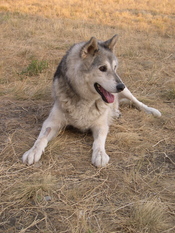
    Kodiak_1_1This is how I hope you’ll remember him … a smiling, happy Kodiak on his first evening at the ranch.  It was August 11 when we took this photo of him.

    We’re having his body cremated and his ashes brought back to the ranch.  He’ll be in our hearts forever.

    Bless you, Kodiak.  We love you.