• Steve Sandvil 1

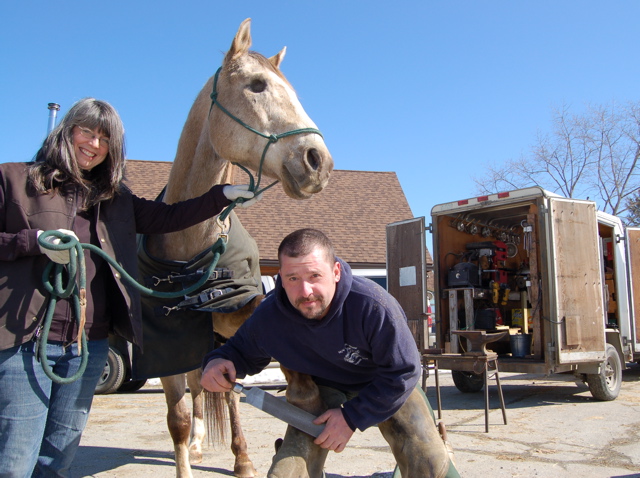
    Here's a fellow you haven't seen before … this is our terrific farrier, Steve Sandvil, who was here on Tuesday.  He's been coming out to work on our horses since last summer, but for some reason I've never gotten him on the blog.  Alayne (a.k.a. "Potato Lady") came outside from kitchen duty briefly to hold Bridger (a.k.a. "Scarface") while I took these photos.  She's still wearing the rubber gloves she uses when she's busy washing and mashing potatoes.

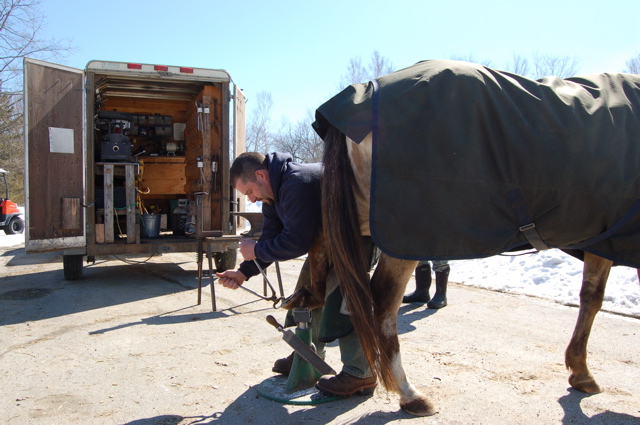
    Meanwhile, Steve had finished trimming Cash's feet so Kate was keeping him occupied over at the "salad bar" on the truck:

    Kate with Cash

    Here's another view:

    Sandvil 2

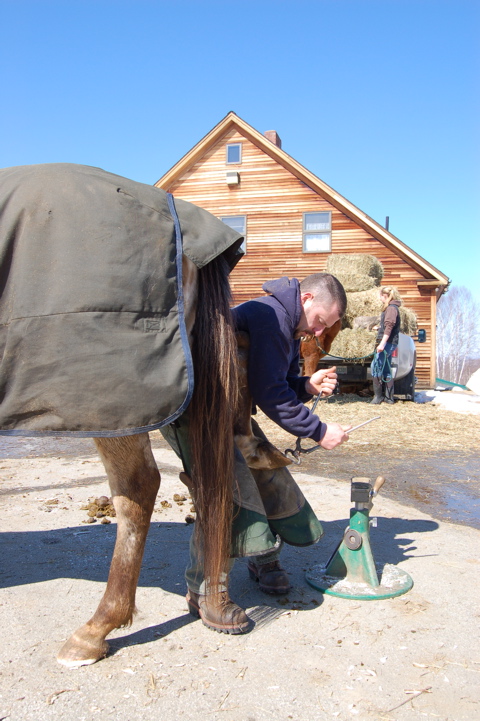
    With this last shot I've now covered three of Bridger's four feet … you can see in the background Kate is still keeping Cash amused at the salad bar:

    Sandvil 3

    We've always had problems with blind Rosie's hooves and struggled over the years with various attempts to fix the issues with her front feet; in just three visits, Steve managed to do some corrective shoeing that fixed 'em once and for all.  I would've taken photos of Steve working on Rosie on Tuesday, but someone had to get back to her potatoes.

    600x120_ShelterChallenge_2011_Jan

    Please Keep Voting!

    The new Shelter Challenge started on Monday, January 10th, and ends at midnight on March 20th.  Grand prize in this round is $5,000.  There are no second- and third-place prizes this time, but new categories … please see the Shelter Challenge website for details.

    And remember, you can vote every day, so consider bookmarking the voting page to make it easy.

    You can vote in the Shelter Challenge here.

    Please note:  Use Rolling Dog Ranch for our name and NH for the state and our listing will come up.

    Because of your votes, we came in 2nd nationwide and won $5,000 in the Shelter Challenge that ended in December 2010.  Please help us win this round of the contest by voting every day, and by encouraging your family, friends and colleagues to vote every day, too.  Thank you!

  • Potatoes on truck

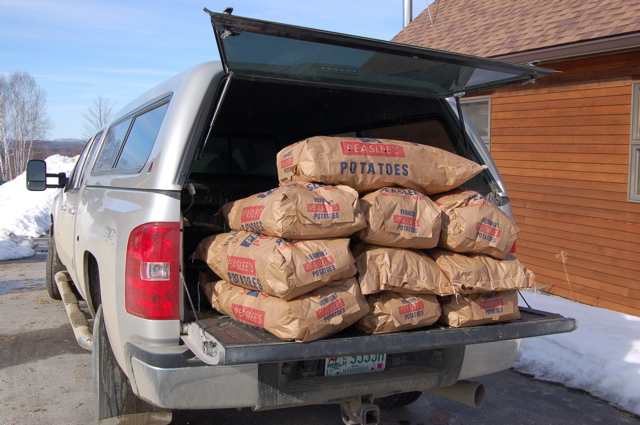
    Yesterday I drove over to Peaslee's, the farm just across the Connecticut River in Guildhall, Vermont, to pick up a load of 500 pounds (228 kg) of potatoes.  This has been a family farm for 80 years, and you can read about the history of this wonderful local institution (and see a related video) here.  I took the photo above when I got back and started to unload the 50-pound (23 kg) bags. 

    The potatoes, of course, are for the pet food we're making using our own humanely raised cattle.  We're going through about 20 pounds (9 kg) of potatoes a day, cooking and then mashing them.  For the first several weeks we were mashing them by hand, along with the cooked carrots, but you can imagine the toll that took on our arms, day after day.  So we recently bought a super-duper mixer, which has really lightened the load a lot. 

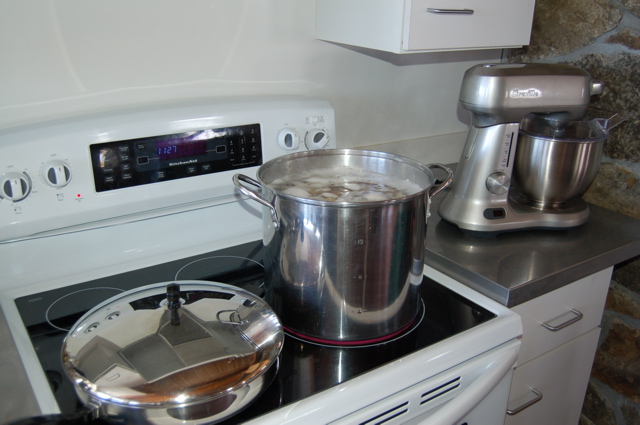
    Here's a photo I took late this morning after Alayne had started 15 pounds of potatoes boiling on the stove … the arm-saver mixer is on the right:

    Potatoes on stove

    Alayne cooked and mashed a total of 50 pounds of potatoes today; we always try to keep at least one day's worth of food already prepared and in the fridge, just in case something happens and we run out of time to cook and mix the huge batch of food we feed every day.

    The dogs love their new diet; we haven't seen them this excited about eating since … well, since the last time we were doing home-cooked meals for them!

    (Now, someone's bound to ask if we know about raw diets … yes, we do.  We tried that a few years ago and found that it worked well for some dogs and not others. We decided cooking was the best approach for us.)

    600x120_ShelterChallenge_2011_Jan

    Please Keep Voting!

    The new Shelter Challenge started on Monday, January 10th, and ends at midnight on March 20th.  Grand prize in this round is $5,000.  There are no second- and third-place prizes this time, but new categories … please see the Shelter Challenge website for details.

    And remember, you can vote every day, so consider bookmarking the voting page to make it easy.

    You can vote in the Shelter Challenge here.

    Please note:  Use Rolling Dog Ranch for our name and NH for the state and our listing will come up.

    Because of your votes, we came in 2nd nationwide and won $5,000 in the Shelter Challenge that ended in December 2010.  Please help us win this round of the contest by voting every day, and by encouraging your family, friends and colleagues to vote every day, too.  Thank you!

  • Baron with speaker 1

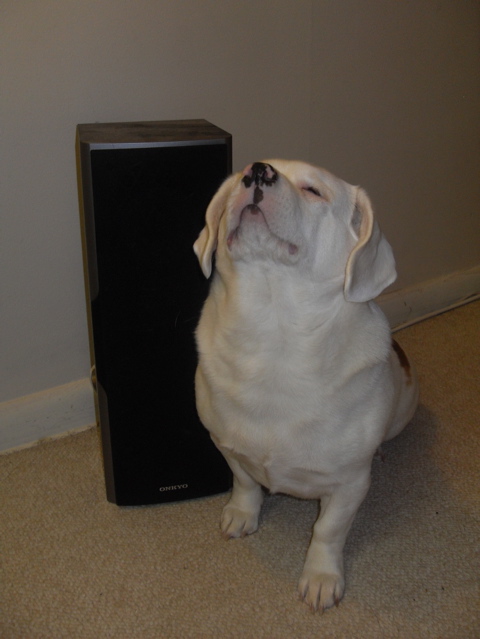
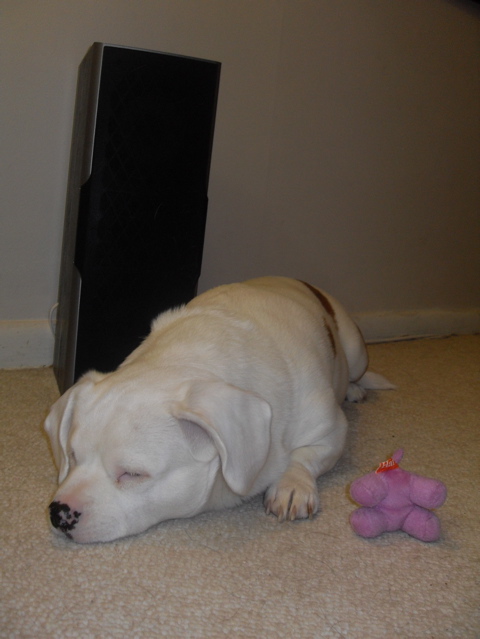
    Wendy M., who adopted blind and deaf Baron and blind Stoney from us a couple of years ago, just sent us these photos of Baron groovin' to music he can't actually hear.  She's noticed that he gravitates to the speaker when she plays music on her stereo.  Wendy wrote, "He will lean up against it and do what we call his 'Stevie Wonder' impersonation: tilt his head back and wave it back and forth. I think he really enjoys the vibrations. I've attached a couple of pictures of Baron with his favorite toy, Headless Mouse."

    You can see that Baron, after feeling the good vibrations, settles down for a nap with Headless Mouse:

      Baron with speaker 2

    Thanks for sharing these, Wendy!

    600x120_ShelterChallenge_2011_Jan

    Please Keep Voting!

    The new Shelter Challenge started on Monday, January 10th, and ends at midnight on March 20th.  Grand prize in this round is $5,000.  There are no second- and third-place prizes this time, but new categories … please see the Shelter Challenge website for details.

    And remember, you can vote every day, so consider bookmarking the voting page to make it easy.

    You can vote in the Shelter Challenge here.

    Please note:  Use Rolling Dog Ranch for our name and NH for the state and our listing will come up.

    Because of your votes, we came in 2nd nationwide and won $5,000 in the Shelter Challenge that ended in December 2010.  Please help us win this round of the contest by voting every day, and by encouraging your family, friends and colleagues to vote every day, too.  Thank you!

  • Clyde March 10

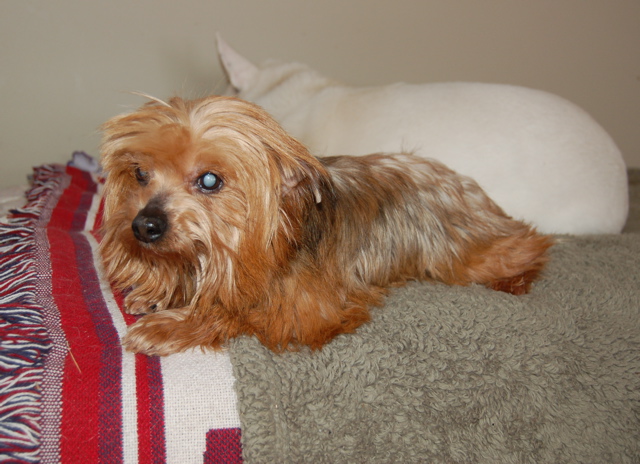
    Since everyone was clamoring for a photo of blind Clyde, here he is in a shot I took this afternoon.  I had picked up Clyde and blind Samantha from the vet clinic this morning after dropping them off yesterday — Sam's ear had begun swelling again and needed some more drainage work, and Clyde needed attention for a rather unusual problem.  There's no other way to describe it:  His penis wouldn't retract into his sheath.  That's right.  Yep, the little pink thing was poking out all the time. 

    Actually, there is another way to describe it:  Paraphimosis.  Who knew?  (Remember, you heard it here first.)  And in the canine world, I think the correct term is prepuce and not sheath, which is what we call it in horses.

    Alayne and I tried to put the gun back in the holster, so to speak, but to no avail.  That meant it was time for some professional assistance. 

    When our vet, Dr. Nancy Lefavour, called yesterday evening for an update on Sam's latest ear surgery (she's doing fine), she cheerfully told me that our other vet, Dr. Chris Plumley, had succeeded in getting Clyde's stuck penis unstuck.  Of course, this is one where I'd gladly let a professional tackle the job.  I've already had my fair share of sheath work like this and this … somewhat bigger than a Yorkshire terrier, not to mention riskier!

    600x120_ShelterChallenge_2011_Jan

    Please Keep Voting!

    The new Shelter Challenge started on Monday, January 10th, and ends at midnight on March 20th.  Grand prize in this round is $5,000.  There are no second- and third-place prizes this time, but new categories … please see the Shelter Challenge website for details.

    And remember, you can vote every day, so consider bookmarking the voting page to make it easy.

    You can vote in the Shelter Challenge here.

    Please note:  Use Rolling Dog Ranch for our name and NH for the state and our listing will come up.

    Because of your votes, we came in 2nd nationwide and won $5,000 in the Shelter Challenge that ended in December 2010.  Please help us win this round of the contest by voting every day, and by encouraging your family, friends and colleagues to vote every day, too.  Thank you!

  • Molly in tub 1

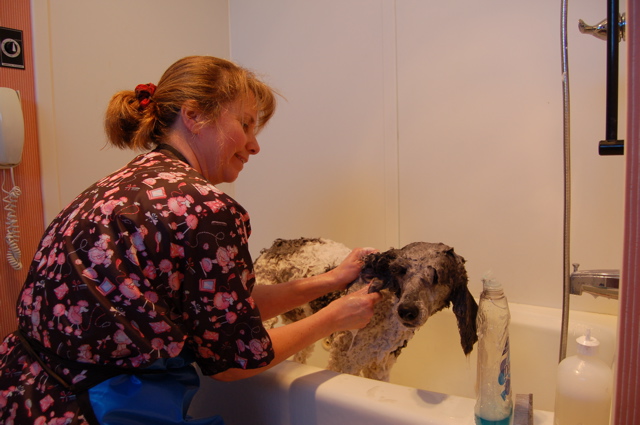
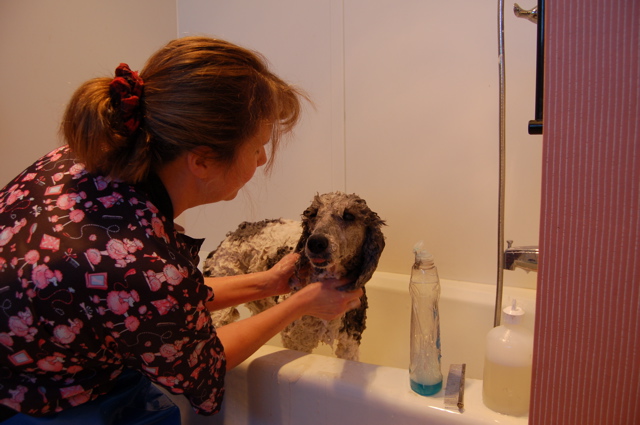
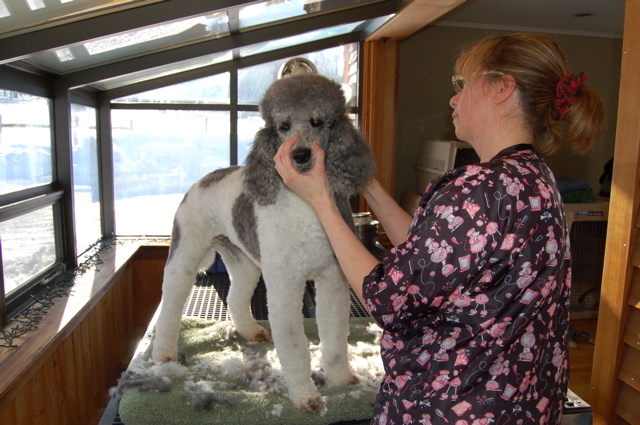
    Our wonderful groomer, Lori Fillion from Littleton, New Hampshire, came out today for her regularly scheduled appointment for the two blind Poodle sisters, Molly and Priscilla.  Those two girls take up much of the day, but Lori can usually fit in at least one more who might need a make-over, and today it was the blind Yorkie, Clyde.  But the main production is always Molly and Priscilla, of course.  That's Molly in the bathtub in the photo above, and here she is a few seconds later, sticking her tongue out (at me for taking her picture in the tub?):

    Molly in tub 2

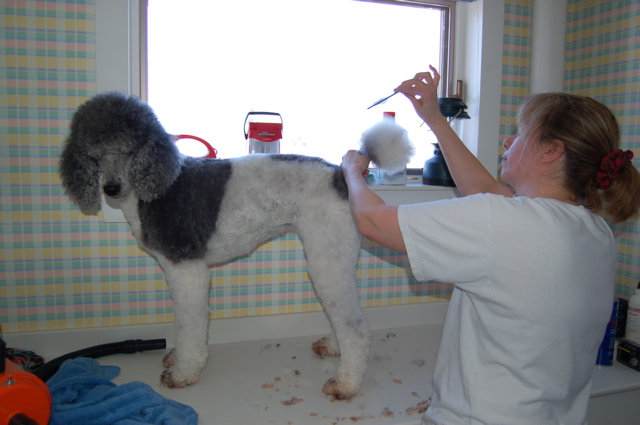
    Then, after sitting in front of the hair dryer for quite a while, they moved to the laundry room, where we have the perfect built-in shelf that serves as a grooming table when it's not full of folded fresh bedding:

    Molly with Lori 1

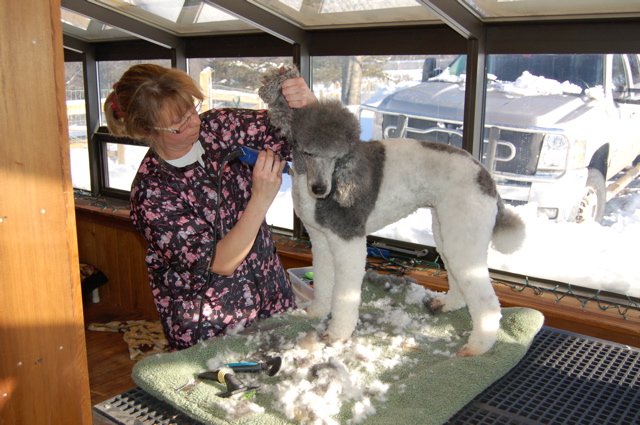
    But for close-up work like clipping around the face and ears, Lori finds the light in the solarium better, and we just happen to have a big, wide table set up in there:

    Molly with Lori 2

    It was bright and sunny outside, and the solarium heats up so much on days like this — even in winter — that we had to hit the switch to roll out the retractable awning over it.

    And finally, here's Molly, just a few minutes away from being done:

    Molly with Lori 3

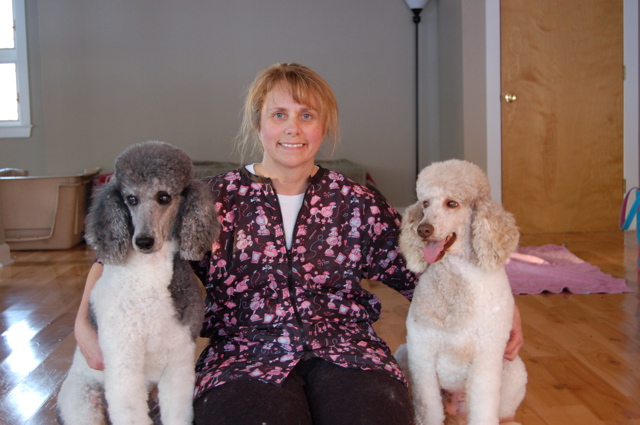
    Lori does a fabulous job with the girls, who have really taken to her.  And we really like these grooming house-calls, too — it saves us a lot of time driving  somewhere, dropping them off, and then having to pick them up several hours later.  And it's more comfortable and less stressful for the girls to have the grooming done right here at home.  (Although I'm not sure how stressful it can really be to have someone pamper and fuss over you for hours on end, you know?  Don't women pay big money to go to spas for exactly this sort of thing?)

    Perhaps I digress. Anyway … a happy grooming day was had by all!

    Molly and Pris with Lori

    600x120_ShelterChallenge_2011_Jan

    Please Keep Voting!

    The new Shelter Challenge started on Monday, January 10th, and ends at midnight on March 20th.  Grand prize in this round is $5,000.  There are no second- and third-place prizes this time, but new categories … please see the Shelter Challenge website for details.

    And remember, you can vote every day, so consider bookmarking the voting page to make it easy.

    You can vote in the Shelter Challenge here.

    Please note:  Use Rolling Dog Ranch for our name and NH for the state and our listing will come up.

    Because of your votes, we came in 2nd nationwide and won $5,000 in the Shelter Challenge that ended in December 2010.  Please help us win this round of the contest by voting every day, and by encouraging your family, friends and colleagues to vote every day, too.  Thank you!

  • Bridger with Steve and Kate 1

    Any time Kate calls me in my office late on Fridays, I want to duck under my desk.  Normally she will text me during the day with brief updates or if she comes across something she thinks I should know about.  She saves the rare voice calls for … well, horsey disasters.  So when my cell phone rang about 3:30 p.m. Friday, I was already thinking "Uh oh…" when I answered.  It was Kate:  "Your boy Bridger has cut his face open and he's bleeding badly," she said. 

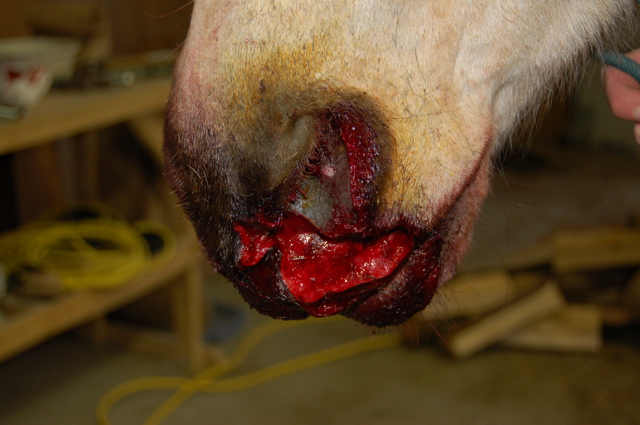
    I thought, "Well, of course, it's Friday afternoon!"  As I said in the blog post about Lena's fence wreck a few weeks ago, these things never occur on Tuesdays at 10 a.m. or at any other more convenient time.  I headed out to Bridger's corral and found him bleedly profusely, with a huge gash across his face running through his nose and down across his upper lip.  It looked like a big chunk of flesh was missing.  He was trying to eat the hay that Kate had just put out in the feed tubs, and with every bite he took, blood would squirt out for a foot or more.

    Kate and I looked around the shed and corral that Bridger shares with blind Cash and blind Hawk, yet we couldn't find any obvious place he could have cut himself on.  There was no sign of horse hair or flesh.  But cut his face open he did. This is why, long ago, I turned the common expression "If there's a will, there's a way" into the equine version "If there's a way, they will."

    I called our equine vet, Dr. Steve Levine, but found he had just had back surgery the day before and was unable to travel.  So Steve talked me through what I needed to look for and how to treat the wound, and what our options were if we decided Bridger needed emergency care at an equine hospital.  Based on my description of the wound, Steve told me he was pretty confident it would heal just fine without needing to be sutured, and that the gaping hole would begin granulating in.  The key thing was to stop the bleeding, clean it out and disinfect it.

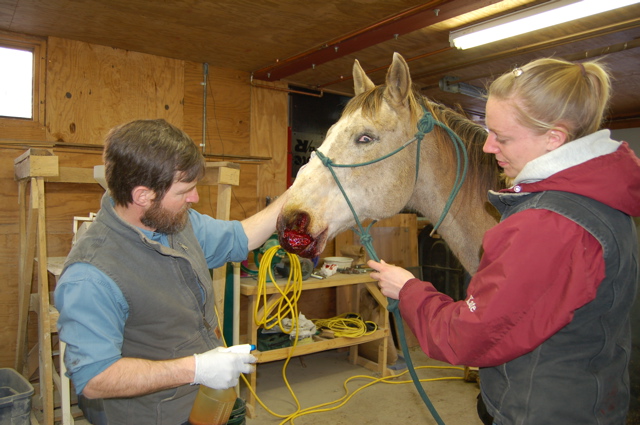
    Alayne went to find our toolbox of equine medical supplies while Kate left to bring Bridger up to the barn so we could treat him indoors.  Alayne took these photos, and in the one at top we're getting ready to clean the wound.  I'm holding a spray bottle of Betadine while Kate is keeping our patient still.

    Here's what the wound looked like after we started cleaning it (click on photo for larger image):

    Bridger cut close-up

    (I can't believe Alayne is letting me post that photo on the blog.  Over the years she's censored a number of my "medical action shots," my favorite being a post-enucleation one:  the entire eyeball freshly removed in surgery from one of our blind horses, still encased in the peri-orbital fat, eyelid and eyelashes attached.  I thought it was fascinating; she said it was "disturbing."  I conceded the point.)

    As bad as Bridger's wound looked, and as much as it had to hurt, he was a very good patient.  He became agitated only once — and understandably so — when I put my a finger in his mouth, under his upper lip, and probed to see if the wound had cut deep enough to go all the way through.  Although the remaining skin felt barely paper-thin, fortunately it was still intact across the entire breadth of the wound.

    It wasn't long before it stopped bleeding, and pretty soon we had him back out with his friends. 

    On Saturday morning, Dr. Steve called to see how Bridger was doing, and I was pleased to tell him the wound was healing just as he had predicted.  I also told him that I doubted he could have sutured the wound closed in any case, since there was so much flesh missing it would have left Bridger with a permanently curled lip.  Now that would have made for an interesting photo, eh?

    As of Sunday, Bridger continues to do well.  As for next Friday … we'll have to see what that brings.  I think I'll be out of town.

    Shelter Challenge Voting Problems

    Yes, I've been getting emails all weekend from people telling us they haven't been able to vote in the Shelter Challenge.  Not sure what the problem is, but we don't have an "inside track" to communicating with the folks who run the contest.  Hopefully it will get fixed by Monday.

    600x120_ShelterChallenge_2011_Jan

    Please Keep Voting!

    The new Shelter Challenge started on Monday, January 10th, and ends at midnight on March 20th.  Grand prize in this round is $5,000.  There are no second- and third-place prizes this time, but new categories … please see the Shelter Challenge website for details.

    And remember, you can vote every day, so consider bookmarking the voting page to make it easy.

    You can vote in the Shelter Challenge here.

    Please note:  Use Rolling Dog Ranch for our name and NH for the state and our listing will come up.

    Because of your votes, we came in 2nd nationwide and won $5,000 in the Shelter Challenge that ended in December 2010.  Please help us win this round of the contest by voting every day, and by encouraging your family, friends and colleagues to vote every day, too.  Thank you!

  • Suzette and Suzanna

    Now that more than a week has passed since I wrote the post about raising our own cattle, I wanted to follow up on a couple of questions people asked in their comments.  But first, that's Suzette above with her calf Suzanna in a photo we took late last fall. 

    I will admit, we posted that announcement about humanely raised pet food on the blog with real trepidation.  We had no idea what kind of response we would get, but we assumed quite a bit would be negative and some people would be even hostile.  Yet with very few exceptions, the response was amazingly positive.  Many of the comments on the blog were incredibly thoughtful and insightful, and it was clear in reading through them that a lot of people have been wrestling with this very same issue.  Some had found the solution (or compromise) that worked for them, others were still searching, and others were now thinking about it for the first time … and in an entirely new light.  It was, over all, a very heartening response. 

    We just had another long and very thoughtful comment posted yesterday by Marisa, a vegan, who wrote in part:

    "With all these thoughts churning through my mind, I only have great respect for you and Alayne because you don't hide from the hard facts that most of us try to sweep under the carpet. You have made the links transparent. Sebastian will be fed to Fuzzy. Sebastian must die for this to happen. Fuzzy will live.

    This is the very basic truth and everyone who eats meat or feeds meat to their companion animals needs to understand that this means the death of another animal who is just as much in love with life as we and our animals are. They frolic in the grass, they love their mothers and they enjoy basking in the warmth of the sun's rays.

    If we have cats and dogs we are complicit in the deaths of other animals and I have NEVER seen another rescue acknowledge this and take responsibility for it. Absolutely astounding. I believe there is still hope for the world yet."

    I think Marisa captured the real essence of why this is such a difficult, complicated and emotional subject for all of us who care about animals.  Thank you to Marisa and all of you who offered your heartfelt comments.

    The two questions I wanted to address were:

    1.  One person asked why we couldn't just buy the meat from someone else who was raising cattle in a humane way.  There are two reasons:  The first is that it would still be a way for us to avoid taking personal responsibility for their lives and how they were raised; the second is that it would be much, much more expensive, because now you're paying someone else to raise and feed them.  That would make it far too costly.

    2. A number of people asked if we knew about Dr. Temple Grandin, a well-known expert on humane livestock handling who is an animal science professor at Colorado State University.  Yes, we do, and we purchased a copy of her book Humane Livestock Handling back in 2008 and set up our handling facilities based on her work.  Her livestock website is here and her personal website is here.  She's an amazing person who has had a remarkable life.

    A funny story about Suzette:  She was in the original group of heifer calves we got in 2008.  One day not too long after she arrived, she was letting me scratch her back and sides (we were still very much in the 'getting-to-know-you' stage) when all of a sudden she raised up her left rear leg.  I thought she was about to kick me — cows kick slightly forward and then out to the side, kind of a fast sweeping motion, completely different from the full-on rear kicks horses do — so I jumped back.  She put her leg down.  I resumed scratching.  She lifted her leg again … but didn't kick.  She just held her leg up in the air.  I thought, well, that is odd.  This time I warily kept scratching … and started working my way down her side towards her hip.  The next thing I knew, I was scratching inside her thigh … and that's what she was trying to tell me by raising up her leg.  "See, this is where I need you to scratch me."  The more I scratched inside her thigh, the higher she'd raise her leg.  All I'd have to do is reach inside her thigh and she'd lift up her leg.  I finally figured it out.  After that day, whenever I began scratching her sides, she'd cock up one of her rear legs so I could get inside her thighs.  Go figure.

    600x120_ShelterChallenge_2011_Jan

    Please Keep Voting!

    The new Shelter Challenge started on Monday, January 10th, and ends at midnight on March 20th.  Grand prize in this round is $5,000.  There are no second- and third-place prizes this time, but new categories … please see the Shelter Challenge website for details.

    And remember, you can vote every day, so consider bookmarking the voting page to make it easy.

    You can vote in the Shelter Challenge here.

    Please note:  Use Rolling Dog Ranch for our name and NH for the state and our listing will come up.

    Because of your votes, we came in 2nd nationwide and won $5,000 in the Shelter Challenge that ended in December 2010.  Please help us win this round of the contest by voting every day, and by encouraging your family, friends and colleagues to vote every day, too.  Thank you!

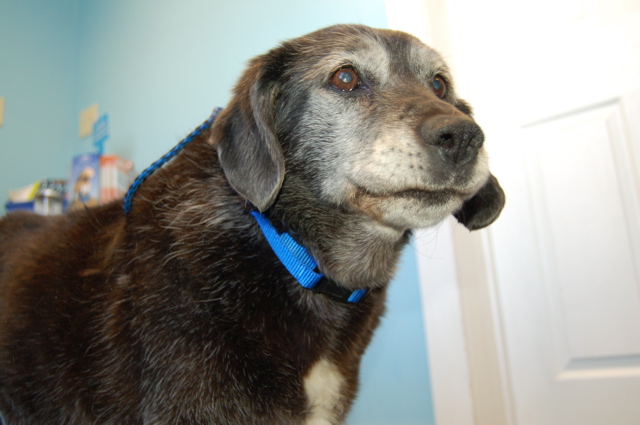
  • Sam at vet 1

    I took our little old lady Samantha to the vet clinic this morning.  Despite her age, Sam has been a pretty healthy girl in the time we've had her.  But she's started peeing while she sleeps, which is something we've seen before in younger female dogs (and is easily treated with phenylpropanolamine — which for obvious reasons is usually just called PPA for short).  Yet the incontinence could be caused by other things, too, so she needed a urinalysis and a general exam.  That was the initial reason for today's appointment, but in the past 24-48 hours she developed a hematoma in her left ear, making it look like her ear had swallowed a small balloon.  This required surgery to open it up and drain all the fluid out.

    Usually what happens to us is that a dog will develop a new problem — say, a hematoma in a left ear — 24 to 48 hours after a vet appointment, necessitating a trip back to the clinic.  We told Sam we really appreciated her cooperation in this matter by getting the hematoma a day before the vet visit.

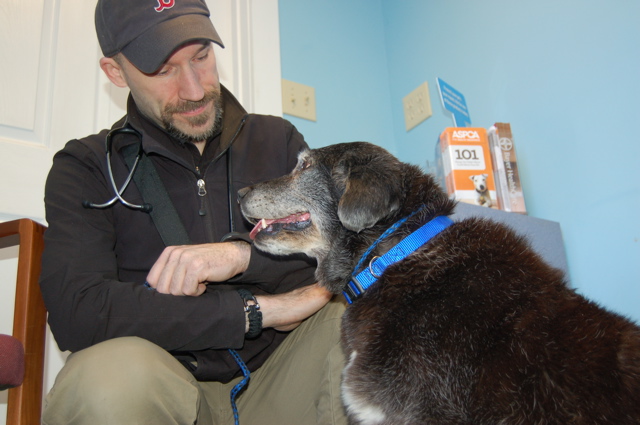
    Here is Sam with Dr. Chris Plumley, who owns the practice in Whitefield and did the exam this morning:

    Sam at vet 2

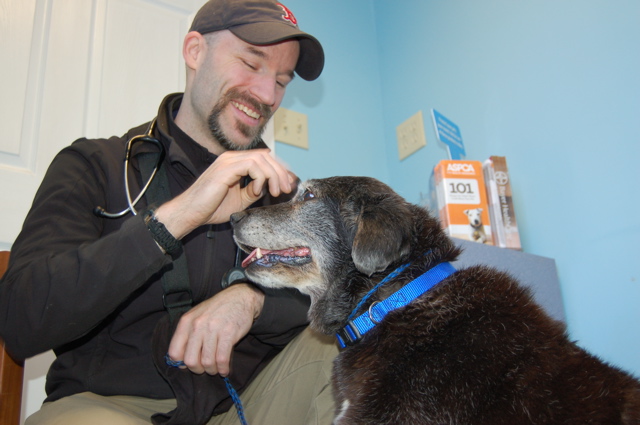
    And here they are again, with Sam clearly enjoying the attention:

    Sam at vet 3

    Our other vet, Dr. Nancy Lefavour, did the ear surgery on Sam this afternoon and she came through that procedure just fine.  When I picked up Sam this evening, the verdict was in:  we'd start her on PPA for the urinary issue and see how she does.  She came back with a deflated ear, a bit groggy still from the anesthesia, but glad to be home.

    600x120_ShelterChallenge_2011_Jan

    Please Keep Voting!

    The new Shelter Challenge started on Monday, January 10th, and ends at midnight on March 20th.  Grand prize in this round is $5,000.  There are no second- and third-place prizes this time, but new categories … please see the Shelter Challenge website for details.

    And remember, you can vote every day, so consider bookmarking the voting page to make it easy.

    You can vote in the Shelter Challenge here.

    Please note:  Use Rolling Dog Ranch for our name and NH for the state and our listing will come up.

    Because of your votes, we came in 2nd nationwide and won $5,000 in the Shelter Challenge that ended in December 2010.  Please help us win this round of the contest by voting every day, and by encouraging your family, friends and colleagues to vote every day, too.  Thank you!

  • Widget loom 1

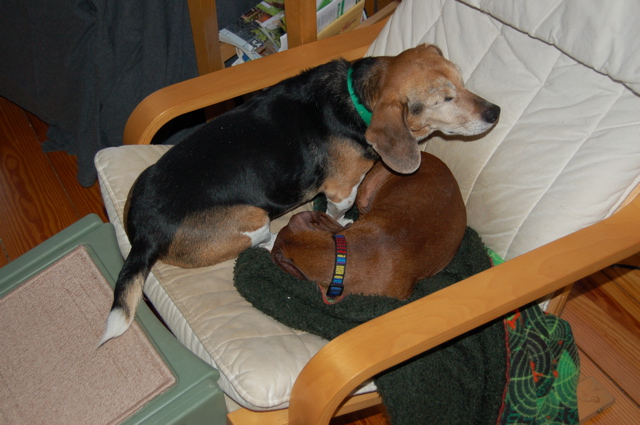
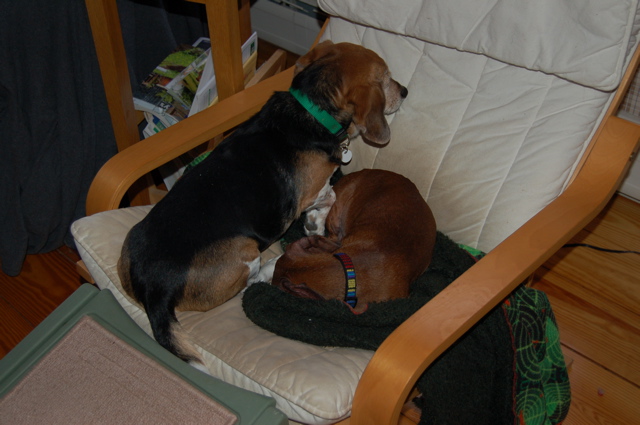
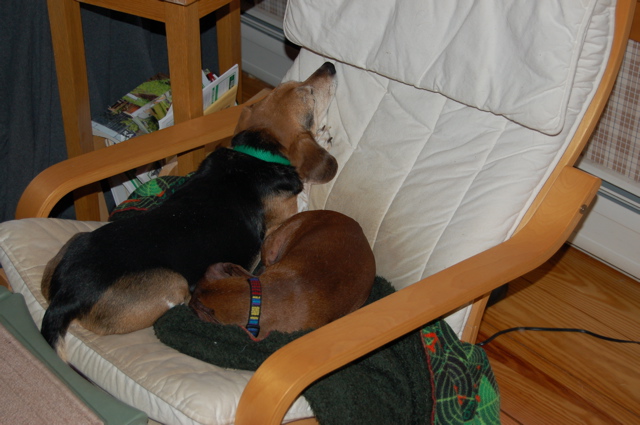
    Alayne took these photos on Friday when she saw blind Widget heading up the ramp to claim the chair Dexter was sleeping in.  As we've posted before, Widget has perfected the power of "looming," in which she hovers over the dog who is occupying the space she wants.  As she looms over them, she also stares at them.  (It doesn't matter that she's blind.)  Eventually, the tension is too much and the other dog surrenders the spot.  This usually occurs in minutes. 

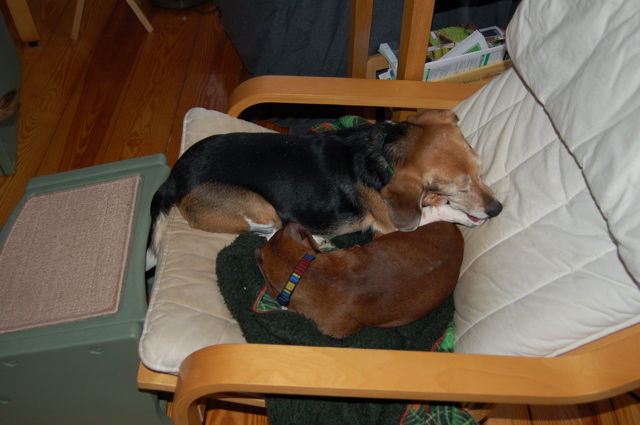
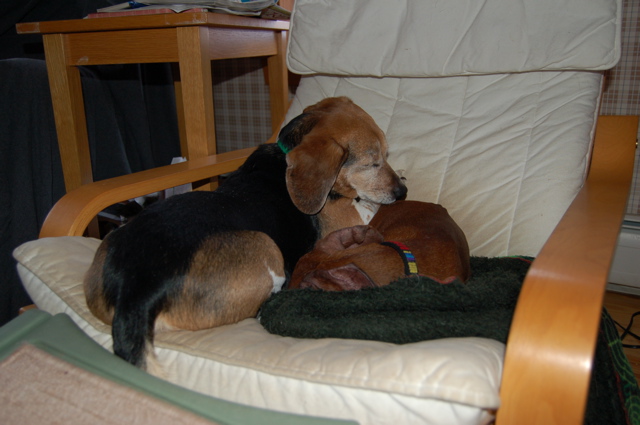
    But it would be more correct to say Widget had perfected the power of looming, because on Friday the loom failed.  Entirely.  And yet, rather than force the issue with some growling or by elbowing the offending party aside, she gave up.  That's right, she settled in right beside Dexter.  In the photo at top, she has started the classic loom posture.

    (You can see from the color we call "doggie brown" on our once pure-white Ikea chair cushions how futile our effort is to keep them covered in fleece blankets.)

    After getting no reaction from Dexter, Widget ponders what to do:

    Widget loom 2

    Before deciding to pass the time by grooming herself:

    Widget loom 3

    After a while she looks over at him with a "What, you're still here?" look:

    Widget loom 4

    This is the point where normally she would have started physically elbowing him out of the way and off the chair.  But instead, she simply sighed, put her chin on the chair and settled in for a nap … and that was that:

    Widget loom 5

    600x120_ShelterChallenge_2011_Jan

    Please Keep Voting!

    The new Shelter Challenge started on Monday, January 10th, and ends at midnight on March 20th.  Grand prize in this round is $5,000.  There are no second- and third-place prizes this time, but new categories … please see the Shelter Challenge website for details.

    And remember, you can vote every day, so consider bookmarking the voting page to make it easy.

    You can vote in the Shelter Challenge here.

    Please note:  Use Rolling Dog Ranch for our name and NH for the state and our listing will come up.

     Because of your votes, we came in 2nd nationwide and won $5,000 in the Shelter Challenge that ended in December 2010.  Please help us win this round of the contest by voting every day, and by encouraging your family, friends and colleagues to vote every day, too.  Thank you!

  • Cow herd in November

    Ever since Alayne and I started this special place over 10 years ago, we have been concerned about what we feed our disabled dogs and cats.  We learned early on how to read the ingredient labels and how to distinguish low-quality food from the high-quality brands — and the only way to do that is ignore the packaging and marketing fluff and focus on the ingredients.  We even bought the AAFCO manual back in 2002 to learn what simple words like “meat” really mean in the world of pet food — and it’s not necessarily what you think.  (AAFCO is the industry group that sets the standards for pet foods.)

    But as we focused on the quality of the food, we also began to think about the source of the food — about the animals who ended up in the food we were feeding our dogs and cats.  Alayne calls it “animal in a can" and “animal in a bag” — though most of us never think of it that way.  It’s a lot easier not to think about it … just open the can or bag and serve it up.

    For most of the past decade — until 2009 — I was a vegan, and for several years before that, a vegetarian.  It troubled me as ethically inconsistent to be so concerned about what I ate, but not to give a second thought to what our dogs and cats ate.  For a very brief period a long time ago, we even tried a vegetarian diet for our dogs, with many unhappy results.  No matter what type of vegetarian diet we put in front of them — commercial or home-made — the dogs made it very clear they were not happy helping me work through this “ethical inconsistency.”  I’d never seen dogs walk away from food before, but this they did.  Not all, but too many of them.  I quickly abandoned the effort, much to the relief of both the dogs and Alayne.

    Yet the issue remained.  Although Alayne was never a vegetarian or vegan, she always shared my concerns about the humane treatment of food animals. 

    The Animal Welfare Dilemma

    A couple of years ago I read “The Omnivore’s Dilemma,” Michael Pollan’s excellent book on America’s food system.  It seemed to me that those of us in the animal welfare movement face what I call the “animal welfare dilemma” — we focus so much on the welfare of the dogs and cats in our care, but what about the animals we feed them?  What about their welfare?

    Best Friends, the nation’s largest animal sanctuary, has a wonderful slogan:  “A better world through kindness to animals.”  I think all of us in the animal welfare movement believe in the spirit and strength of that statement.  But does it apply to the food animals we feed our pets?  If not, why not? 

    That was the central question for us.  How can we have one set of standards for the welfare of dogs and cats, and turn a blind eye to the welfare of the millions of livestock that go into our pet food?

    For us, this is the animal welfare dilemma.

    Now, there are plenty of dedicated nonprofit organizations focused on the treatment of farm animals; groups like Farm Sanctuary and the HSUS work hard to expose the cruelty of factory farming, where thousands of animals are crowded into filthy and stressful “confined animal feeding operations,” or CAFOs, and then slaughtered in high-speed assembly line fashion at the rate of several hundred a day.  These nonprofits also promote vegetarian and vegan lifestyles as the answer to factory farming, and believe that it is unjustified to kill and eat any animal, under any circumstance.  They do not seem to consider that “humane” farming is even possible.

    But again, where does that leave our dogs and cats?  Should we really force dogs and cats to become vegetarians, because that’s what some of us want to be?  Yes, there are groups and websites that promote this very thing, though even the website Vegancats.org has, “after much soul-searching,” changed its recommendations on feeding meat to cats.  (Hello?)

    The simple truth is that dogs and cats are, by their very nature, meat eaters.  To try and make them anything else is, well, downright unnatural.

    Moreover, we know processed foods aren’t good for people, and what is more highly processed than pet food?  So a few years ago, we started buying cases of ground beef from Costco and began home-cooking again.  But each case was stamped with “Product of USA, Canada, Mexico, Australia & New Zealand.”  That led us back to worrying about the conditions those cattle were subjected to in the industrial food system — and how they ended up in the big tubes of ground beef we were feeding.  (Not to mention all the “food miles” involved!)

    So, What Do We Do?

    The question for Alayne and me became, how can we take responsibility for the entire “cycle of life” here?   How could we assure ourselves that the meat we were feeding our disabled dogs and cats came from animals who were raised as humanely as possible?

    • We realized that the best way to do that was to raise them ourselves.
    • We wanted to know exactly how they were raised, what they were fed, and most important of all, how they died.
    • We were fortunate that we had the land, facilities and skills to raise cattle on a small scale, and decided this was the right thing to do.

    We began this long journey in 2008 back in Montana with several heifer (female) calves, and in 2009 we got two more heifers, along with two six-month old young steers.  Last summer here in New Hampshire our first five calves were born. 

    Why Now?

    The reason I’m writing about this now is because a couple of weeks ago I took our first steer, Sebastian, to slaughter.  I drove him over in our horse trailer to a very small, local, family-owned facility that processes three or four steers a day, not 400.  I was able to walk through the entire facility with the owner, stood on the kill floor, and examined their entire process for how they do the slaughtering.  It was quiet, clean, and as stress-free as any facility like that could possibly be.

    When I first drove up I wasn’t sure I was even in the right place, because it looked nothing like a slaughterhouse.  It was a converted barn, tucked into a residential neighborhood.  The owner’s house was across the yard.  There were no cattle standing outside in feedlots, deep in manure, bellowing with stress.  There were, in fact, no sounds at all.

    The owner, Bobby, and I unloaded Sebastian.  We watched as he walked down the outside hallway and turned to go into the stall that was waiting for him.  There, he got to touch noses with the two steers in the adjoining stall.  There were four steers total who would be processed the next morning, and Sebastian was among them.

    Was it hard to do this?  You bet it was.  When I reached through his stall window to let him sniff my fingers and say goodbye, it was really tough to pull my hand away and turn to leave. 

    But I knew what kind of life he’d had, and how his end would come.  And I knew we really had done everything we could to begin ensuring that the food we would be feeding our dogs and cats was raised as humanely as possible. 

    It obviously takes a lot of beef to feed 35 dogs and our handful of cats, and it will be another year before we will have a large enough herd to provide a year-round supply.  So in the meantime, about half of the dogs started this week on a home-cooked diet using our own beef, while the other half will continue with their current diet and transition over as our supply increases.  Because of our move last year, we gradually transitioned the dogs back to a commercial diet until we could get everyone on our own humanely raised food.  We’ve been feeding Costco’s super-premium Kirkland brand — virtually the same quality as the Innova brand we used to feed (just compare the ingredient labels) and much less expensive. 

    What else will they be eating besides the beef?  Well, we want to source as much of their food locally as possible, and this includes potatoes from Peaslee’s, a local farm just a few miles away in Vermont.  Alayne just bought 50 lbs of their potatoes to cook up with our first batch of beef.  We’re also buying carrots and other veggies that are grown locally.  This summer we will begin growing our own crops to add to the meat in their diet.  Board-certified veterinary nutritionists at DVM Consulting developed the recipes we’re using, and we’re using their Balance IT vitamin and mineral supplement.

    One objection we’re no doubt going to get is this:  “But you’re a sanctuary!  How can you be doing this?!”  Yes, we are a sanctuary … for disabled animals.  And those animals need to eat.  Is it better to just keep feeding them “anonymous” food — “animals in a bag” — and not care or worry about how those animals were treated?  Or is it better to take responsibility for what we’re feeding and know it came from animals we humanely raised ourselves? 

    Another objection we may get is that we gave our livestock names.  People will ask how we could give them each a name, only to turn them into pet food later.  We sure did name them.  As Alayne told me one day, "it’s important that they live a humane life with dignity and identity."  They’re individuals, so why shouldn’t they have names?

    I want to be clear on one thing.  We are not saying this is what everyone should be doing, nor do we think it’s somehow “wrong” to feed commercial diets.  Clearly we have been doing that for a long, long time, and still are.  It’s just that we have a unique opportunity to address our concerns about humanely raised pet food and put our beliefs into practice — and we can do so cost-effectively for this many dogs and cats because we can raise the food animals ourselves.  Few people, and few shelters and rescue groups, have that opportunity. 

    However, if you are interested in purchasing humanely raised food for your pets, one option would be to contact small farmers in your area about buying directly from them.  If you don’t have enough freezer space for a whole or a side of beef (and most people don’t), you might round up some friends with pets and do a group purchase.  Consider locally raised lamb, chicken and turkey, too.  You can find small farmers near you on Local Harvest, or go to your local farmer’s market.   Be sure to ask them about their animal welfare practices; ask if you can visit the farm to see for yourself.  Third-party certifications like Animal Welfare Approved and Certified Humane can give you some assurance of humane practices, but bear in mind that plenty of small farmers can follow these practices and not be certified.

    And, if you want to do home-cooking for your pets, there are lots of books on the subject, as well as resources on the Web, that will help you get started.  There are too many to list here, but do a search on Amazon and you’ll see plenty to choose from.

    A couple of other resources:

    What’s Really in Pet Food by the Animal Protection Institute (now BornFree USA)

    Meat: How alternative protein is going wild.  Bark Magazine, Summer 2010 Issue.

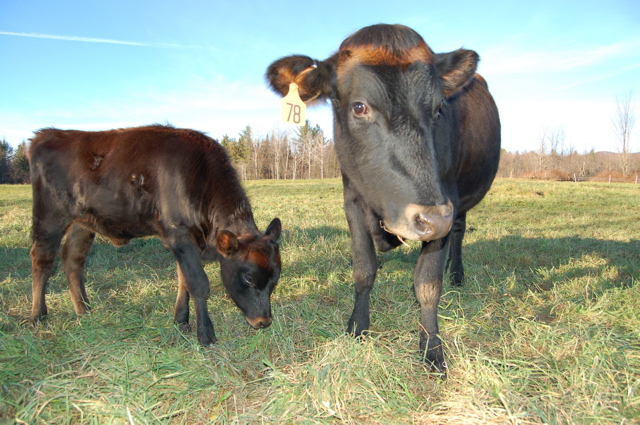
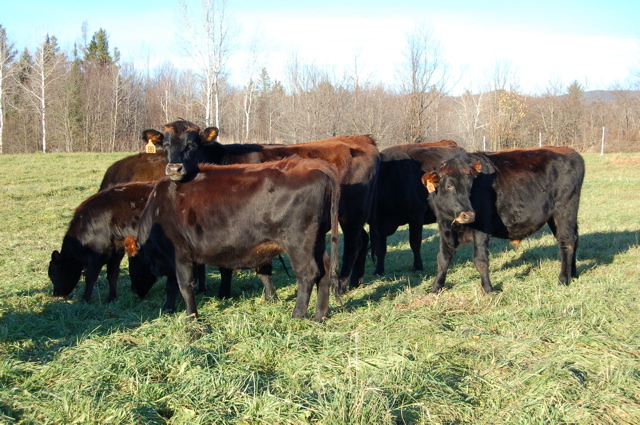
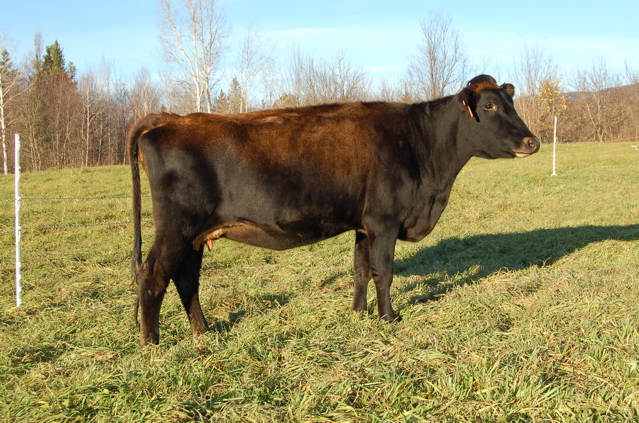
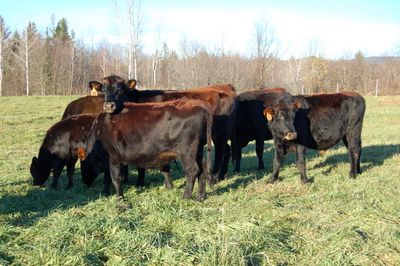
    The photo at the very top of this post is part of our herd that was still out grazing in late November here in New Hampshire.  This next photo is Suzette, our queen bee and boss cow:
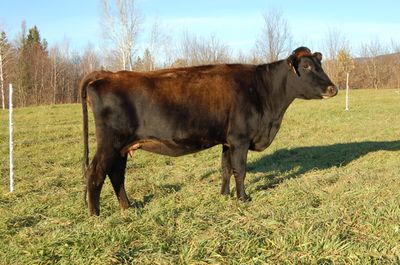
    Suzette

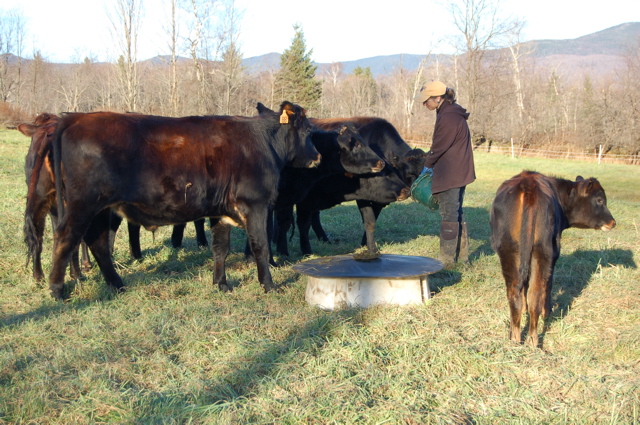
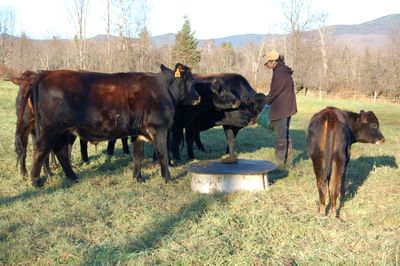
    Here's Alayne feeding a treat to some of them … that's Suzette's calf on the right, Suzanna:
    Alayne with herd

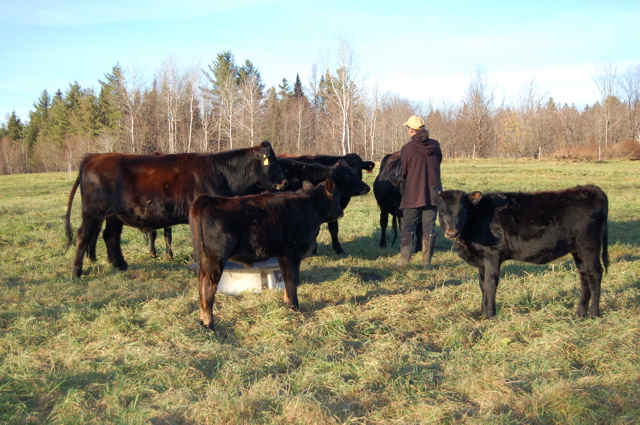
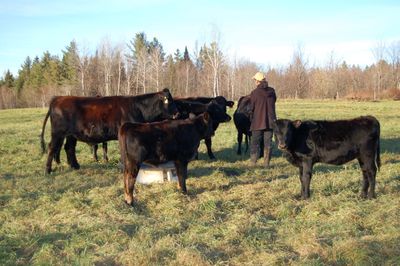
    Another view, with calf Sophia on the right joining Suzanna:
    Alayne with herd 2

    I will write more about our herd in future posts, but for now I thought you would like to see some photos of them.