• Truck fueling July 16

    I know this is a pretty boring photo of one of our trucks at a gas pump.  But there's a little more to it.

    Back in early April, when we first announced our impending move to New Hampshire, I mentioned that a major reason for relocating was to be closer to services so we could reduce our operating costs for increasingly expensive things like gas.  In Montana, we were 70 miles from anywhere, so it was a 140-mile (225 km) round trip to take an animal to the vet clinic or to get supplies and groceries.  Even though we tried to be very efficient and disciplined about going to Missoula or Helena only once a week — we'd pack as many as 8 to 10 stops into a single day in town — it was still a pricey fill-up-the-gas-tank trip.  Plus, we'd be on the road most of the day.  Of course, if an animal needed to see a vet outside that once-a-week schedule, off we'd go to the clinic.

    So once I got to New Hampshire, I kept an eye on the gas tank in the truck I drove out from Montana.  I had filled it up the day I arrived in Lancaster, eight weeks ago last Friday.  I was amazed as I made trip after trip into town that the gas gauge hardly budged.  I'd call Alayne back in Ovando and say, "Hey, I'm still at three-quarters of a tank!"  And this was making many more trips into town than I usually would — we still intend to consolidate multiple errands into single trips, as we did in Montana — but in the first several weeks of trying to get settled, it was harder to be quite as organized and efficient.

    Well, two months later to the day, on Friday, it was finally time to fill 'er up — and that's what you see in the photo above.  It was hard to believe one tank had lasted that long, given the number of trips I'd made, but that's what being 3 miles (5 km)  from town will do for you.  It was satisfying to know that this part of the plan was already yielding results. 

    Alayne and I have discussed trading in one of the trucks for a smaller, more fuel-efficient vehicle at some point, but we want to get a routine established here and see how much we'll use both trucks before making that decision.  (Both trucks are also completely paid for.)  We haul a lot — whether horses, hay or other heavy, bulky loads — and there have been plenty of times when one of us has been on the road hauling horses to the vet clinic or loading up the truck with supplies while the other has needed the second truck back at the ranch.  So we'll see how we end up.  

    But in the meantime, it was good to see the first direct cost savings we anticipated as a result of moving to New Hampshire.  In fact, eight weeks between fill-ups is even better than we had expected!
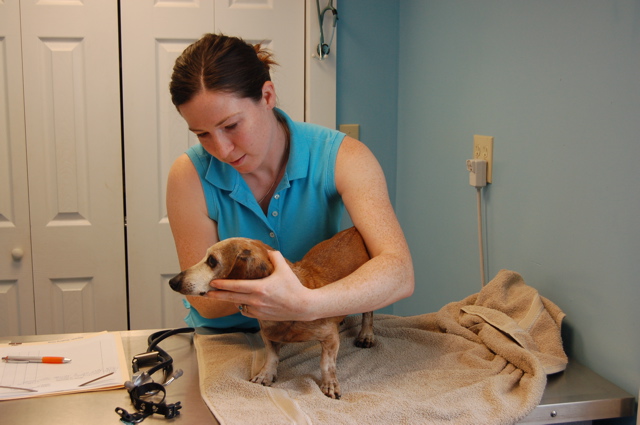
  • Bailey with Dr Lefavour

    Apparently just the sight of a veterinarian can provide magical — and instant — healing powers.  Or so little Bailey would have us believe. 

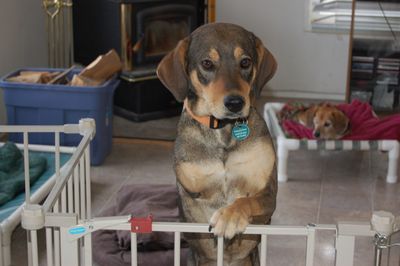
    On Tuesday afternoon, Bailey began yiking when he moved his head in a certain direction.  Over the years, we've often had these kinds of episodic neck and back issues with the Dachshunds (most of whom are here because of spine-associated neuro problems), and our vets would typically prescribe prednisone to reduce the inflammation and provide quick relief.  Usually these were fleeting, quickly resolved things that responded beautifully to the pred, and then we'd begin to taper down the dose after several days.  So we immediately put Bailey on pred and confined him to a puppy pen in the living room.  Within a couple of hours he was comfortable, and we figured we'd continue the treatment protocol like we had before on previous occasions.

    But on Wednesday morning, when I went to get Bailey out of his "boat" — the bottom half of a big dog crate where we put his bed for the night — he looked up at me and then yiked again.  And again.  Whenever he tried to look up, he yiked, and he held his head in way that indicated the problem was in his neck.  We gave him his morning dose of pred and kept him confined in the living room puppy pen, but by mid-morning he was still painful and seemingly getting worse.  Alayne called our new vet clinic, the Whitefield Animal Hospital, and got an appointment for late afternoon.  As the morning wore on, though, Bailey became more vocal, so Alayne called the clinic and asked if we could get him in earlier.

    Shortly after 2 p.m. I bundled him in his "pee towel," put him in a crate, and drove down him to the clinic to see Dr. Nancy Lefavour.  (She is one of the two excellent veterinarians on the staff, along with Dr. Chris Plumley, and they have a wonderful support team of vet techs and front office people as well.  We're lucky to have them so close.)  As I explained to Dr. Lefavour the symptoms we'd seen, I carefully placed Bailey on the exam table … and noticed that he was looking around the room, moving his head, seemingly without any discomfort.  Hmm.  

    Dr. Lefavour listened to his heart and did a physical, then began a neuro evaluation.  She palpated his spine and found no signs of pain down his back.  Then she began working on his neck, trying to pinpoint the problem.  She slowly and gently moved Bailey's head to the left, then to the right, so he was almost touching his shoulder with his nose.  No response.  Then she flexed his head down so his nose was near the exam table.  No response either. 

    I stared in disbelief.  But I thought, well, she's going to raise his head up next and that will be the trigger.

    Ever so gently, she started coaxing his head upwards … and his nose went higher and higher.  It was finally pointed at the ceiling.

    But not a peep from the pipsqueak. 

    She did the range of motion again, with the same result:  no reaction at all.

    I told her, "I know you must think we're crazy, but he was yiking in pain two hours ago, just from raising his head up to look at me."  I was incredulous.

    We put Bailey down on the floor so she could watch how he moved, and he got around just fine.  

    Bailey wondered why everyone was staring at him.

    I wondered why I had brought him.

    The only thing we could conclude was that his morning dose of pred had finally kicked in.  Either that, or Dr. Lefavour indeed has some magical healing powers!

    She recommended we continue with his pred and add a muscle relaxant, methocarbamol, and some pain medication, tramadol, to the mix, keep him confined and see how he does.

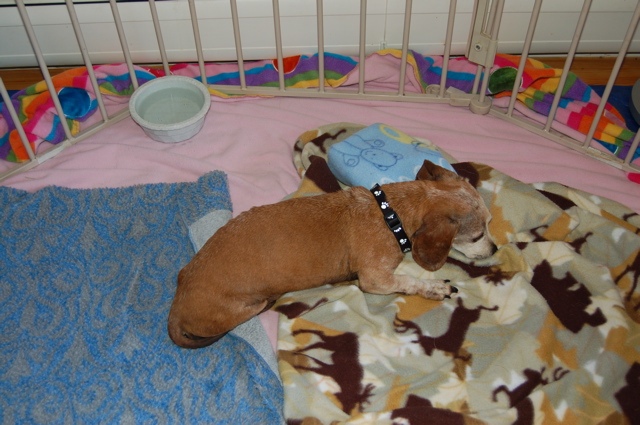
    As I write this Thursday afternoon, Bailey is resting comfortably in the puppy pen next to my desk:

    Bailey in pen July 15

  • Steve putting on NH plates

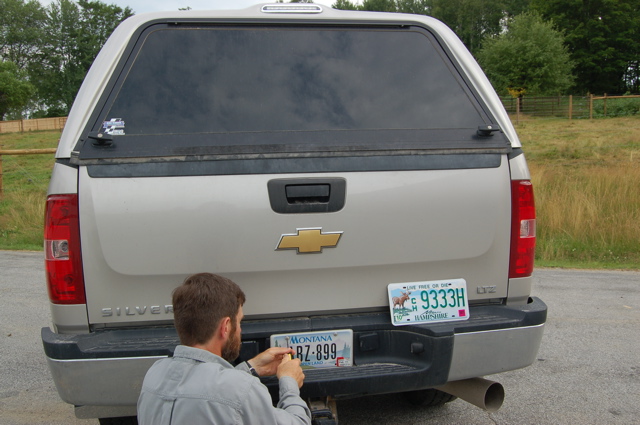
    You can sign all the documents, record the deed, pay the first property taxes, and submit the change of address forms to the Post Office … but nothing seems to make a move finally and completely "official" until you change the license plates on your vehicles.  At least that's how it seems to us.  I registered both trucks last Friday and this afternoon put the New Hampshire plates on the trucks.  We purchased New Hampshire's conservation fund plates, commonly referred to as the "Moose Plate".

    There you have it:

    Moose plate

    I think we're here to stay.

  • Widget in front of fan

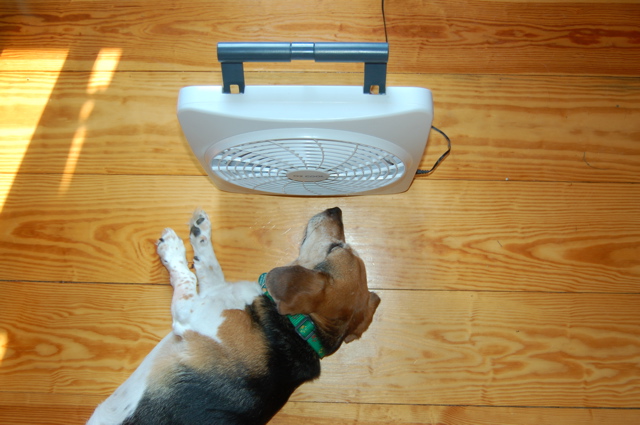
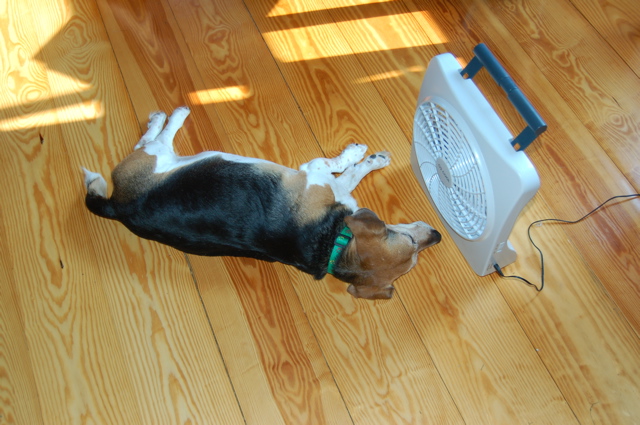
    During last week's blistering heat wave, there was another favorite spot in the house: in front of the fans.  I took this photo of blind Widget in the living room, who managed to get her nose within an inch of that fan.  A day or two before, Alayne had seen Widget this close in front of the same fan, but lying on her chest rather than her side — and in this position her ears were flying out and backwards with the wind tunnel effect.  Before Alayne could get the camera off the desk, Widget heard her walking by and sat up.  Hopefully we'll get another chance to get the flying Widge on camera.

    Here's another view:

    Widget in front of fan 2

    A number of people asked why we didn't have the hay wagon with us here.  For one thing, it belonged to our neighbor in Montana who grew our hay.  Unless you're growing a big crop of hay — and he had more than 200 acres in hay — you don't need … and can't afford to invest in … a big piece of machinery like that.  Second, you drive it into a hay barn — and the trusses need to be about 18 feet high to accommodate the height of the wagon when it tips the wall of hay all the way up.  Alayne and I were unloading hay into a hay loft, which is on the second floor of a shed. 

  • New Gabe on chair

    No, not that blind and deaf Gabe, this one is the blind and deaf Gabe we first mentioned on the blog in early May.  This sweet older boy just arrived yesterday from Pennsylvania, where he had been fostered by longtime friends and supporters of the ranch, Barb and Jerry W.  For the history on this Gabe, please check out that previous post. 

    Barb and Jerry had been kind enough to not only foster Gabe for us for several weeks, but they took him to the vet multiple times, including a veterinary ophthalmologist, and paid all those medical bills, too.  All we had to do was arrange with Gale Lang of TLC Pet Transport, who brought all the dogs and cats out in late May, to pick him up for us.  

    Gabe has settled right in, adding yet another set of paws to what once was — however briefly — "the people wing" of this house and is quickly becoming "the dog wing annex."  Yesterday he spent the afternoon just wandering around the living room and kitchen, exploring the front porch and yard, and generally getting his bearings.  It was simply amazing to see how fast he figured out where the ramp up to the front porch was.  Yesterday evening, as I was writing the blog post on the hay, Gabe was lying by my feet underneath the desk.  Last night, as we were dishing out dinner into food bowls, he got so excited he let out a little yip bark in the living room — just like the other blind and deaf Gabe used to do!  He seems to have taken the move in stride.

    Thanks to Barb and Jerry for all their wonderful help with Gabe.  He's one lucky boy because of them!

  • Hay elevator July 7

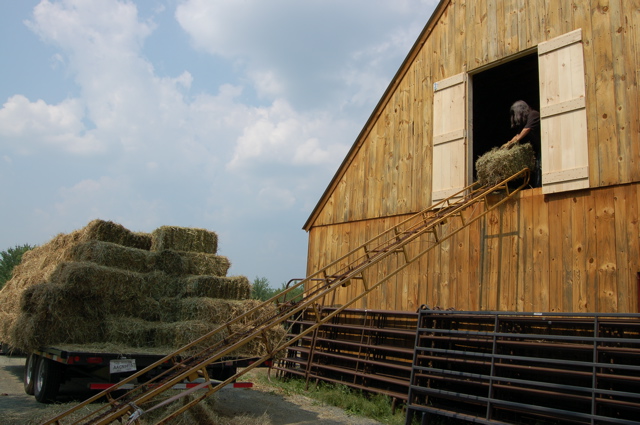
    Once upon a time, we used to be able to put hay up without having to touch it.  Yep, the amazing hay wagon that would pick up 6 tons of bales straight from the field, bring the load into our hay barn and mechanically stack it into a vertical wall of bales.  Here in New Hampshire, we still have a little mechanical help, but we're back to stacking the bales by hand.  Today Alayne and I unloaded a 24' long (7.4 m) trailer of hay we'd bought from a neighbor.  It was 93° outside (34° C) and a lot hotter upstairs in the hay loft!  The mechanical help is the hay elevator you see in the photo; it carries the bale up a moving chain and dumps the bale off the end at the top.  That's Alayne in the loft grabbing the bale.  We took turns between being up in the loft stacking and down below feeding the hay elevator, the latter being a lot easier and cooler!

    One thing that made this easier is that the bales we bought are only about 30 to 40 pounds (13 to 18 kg), versus the 70 pound bales we're used to lifting in Montana.  We still can't get over how light they are!

  • Ella on gate

    I came across this story below in Science Daily over the holiday weekend, and thought it was worth sharing.  People have often asked us whether we thought it was harder for a dog to lose a front leg or a rear leg.  This was always difficult to answer, because it sometimes seemed to depend on the dog's size, build, and agility.  But one thing we could answer was this:  Later in life, it is definitely more difficult to be missing a rear leg, because when an old dog develops hip dysplasia, having just one rear leg to use for getting up and down is a real challenge.  Having said that, here's a study that answers the first question quite definitively.  The photo above is Ella, a beautiful three-legged model if there ever was one.

    Three-Legged Dogs Boost Robot Research

    Science Daily (June 30, 2010) — The new research looked at walking and running techniques in dogs with fore-limb or hind-limb amputations, using a treadmill and a set of high-tech infra-red cameras.

    The scientists found different coping techniques or "compensation strategies," depending on which limb was missing, with absent fore-limbs proving more complicated.

    The study, part of an EU project to improve robot efficiency and usability, is intended to help develop robots that can adapt in the event of an "injury."

    The research is being presented at the Society for Experimental Biology Annual Meeting in Prague on Thursday 1st July 2010.

    "Natural terrestrial locomotion is designed for an even number of limbs. After limb loss (e.g. by an injury) a reorganisation of the locomotive system is required," explains Martin Groß, who is carrying out the research at the University of Jena in Germany.

    Adjusting to missing a fore-limb is more difficult for the dog to deal with than for a hind-limb, according to the researchers.

    If a fore-limb is missing, the remaining limbs must undergo careful adaptation to co-ordinate with each other, a process known as "gait compensation."

    With a hind-leg amputation, the scientists found that the fore-limbs continue to act as they would normally in a four-legged dog, showing little or no compensation strategy.

    The scientists think the reason for the difference is due to the higher loading of the fore-limbs in comparison to the hind-limbs, because of the distribution of body weight.

    During the study, dogs with fore-limb and hind-limb amputations ran on a treadmill for 2 minutes at a time, which was synchronised to a set of 10 high-speed infrared cameras.

    Reflective markers positioned on the skin allowed the scientists to follow the movement of separate parts of the body through time, tracing out a trajectory. They then made complex comparisons of the characteristics of movement, known as kinematics, between dogs with different limbs missing and also with the "normal" movement of four-legged dogs.

    This research is currently ongoing and the scientists hope to make considerable further measurements to consolidate their findings so far.

    To develop a more comprehensive understanding of locomotive activity, future work under the EU Locomorph project will examine voluntary and involuntary changes to body movement in a wide range of different animals including humans.


  • Bailey and Helen on deck

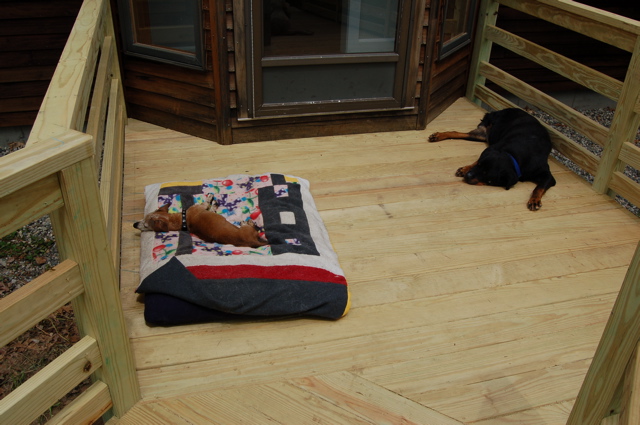
    The other morning after we put the dogs out, I set up a big, fluffy bed for blind Helen on the deck outside the front door.  This is where the double ramps come off the house.  After she did her business out in the yard, I walked her back up the ramp and guided her to the bed.  She laid down on it and settled in for a nap.  Helen loves this spot and this is "her" bed, the one she sleeps on at night in the dog wing. 

    Well, less than ten minutes later, I was walking down the hall and looked outside, only to see that somehow Bailey the Dachshund had commandeered the bed and Helen was now lying on the deck.  I don't know how this happened … whether the 12-pound munchkin pestered the 90-pound Rottweiler into giving up her bed (likely), or whether Helen had lumbered off the soft, comfy bed on her own accord to lie on the hard, wooden deck (unlikely).  

    However it happened, in the end the switch was made and the Dachshund got the bed.  We've since sent a memo to our bedding and accommodations manager, Mr. Smith, asking that he place more beds on that deck in the future.

  • Rosie with Dr Levine

    On Saturday morning, as we were taking horses out to pasture, we found blind Rosie could barely walk.  She looked so painful we suspected she was beginning to founder, a terrible and often life-threatening condition in which the coffin bone in the hoof rotates downwards.  Rosie has always had foot problems; she has very thin soles, so she has had to wear shoes, boots, and pads at various times, and requires special trimming.  After cleaning her hooves to make sure there wasn't a stone or pebble lodged inside that might be bruising her soles, I took her heart rate (elevated) and temperature (elevated), and then called our new equine vet, Dr. Steve Levine at Northern Equine.  

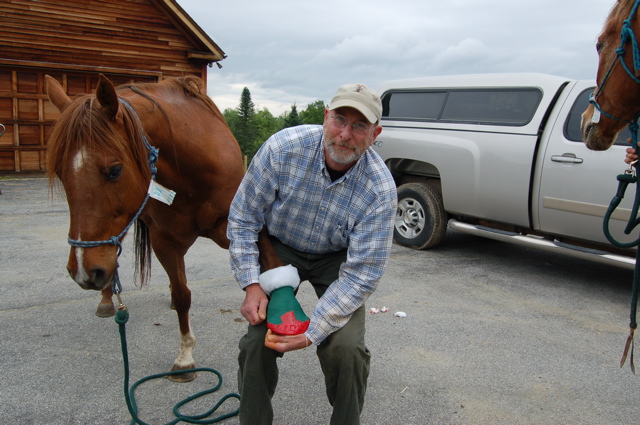
    Steve happened to be out on Saturday rounds that morning and was over here a short while later.  After doing an initial exam, he ruled out founder and believed she might have an abscess in her left front foot.  But at first there was no visible sign of an abscess.  After paring back her hoof tissue, though, Steve found it — and that was a relief.  The last thing we wanted was a case of founder.  

    Once he drained and treated the abscess, he proceeded to wrap her foot.  When he got done, I looked down and saw Rosie was now wearing a beautiful bandage in perfect Santa colors!  Out of season, perhaps, but very stylish nonetheless!

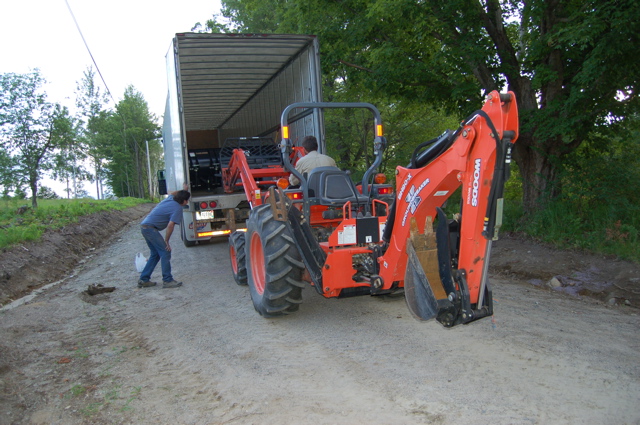
  • Unloading moving van

    Alayne took this photo of me bringing out the very last item from the moving van that arrived on Friday.  This was the snowplow, which was strapped onto a pallet that I'm lifting with the pallet forks on the tractor's front loader.  I wish I had thought about taking a "before" photo, but when the driver opened the back door — very slowly and carefully, because Alayne said she had crammed that van full all the way to the doors — I looked up and the last thing I was thinking about was getting a photo.  I was thinking, oh my Lord, how much is in there?  Well, according to the weigh station's record, the driver said there was 30,000 pounds (13,608 kg) of stuff. 

    We had arranged with MTS Freight in Helena for the moving vans, and I would like to say they were fabulous to work with.  We clearly did not have a typical household move, nor could we simply have a team of movers show up one day, pack everything, load it in a van and drive off.  That's because most of it was not the kind of stuff that would fit neatly into moving boxes, and also because we had to stage the move to time it with the shipment of the animals.  So some stuff we could pack ahead of time, other stuff had to wait until the animals left.  MTS Freight was very flexible and accommodating, willing to work around our unique needs and schedule.  They dropped the first moving van at the ranch back in early May, left it there for us to load over the space of a few weeks, then came back to pick it up when it was full and dropped off the second van.  (Yes, we have one more van coming!)  Then they were willing to hold on to both vans until Alayne could get out to New Hampshire to be here to help me unload.

    MTS Freight contracted with an independent driver to bring the van out, and here again we were very fortunate — and grateful.  Dave H., who you see in the photo directing me as I guide the pallet forks in, offered to help us unload … and he spent the rest of the day working side-by-side with us.  This was not part of his job at all — he was contracted by MTS only to deliver the van — but he was kind enough to spend the day helping to schlep stuff from the van.  We had an 8' x 4' platform for the pallet forks that we used to ferry the loose items from the van to the barn and house; the big things, like the snowplow, were already on pallets.

    Now, I know many folks will wonder why we didn't hire a bunch of high school kids or round up some new volunteers to help unload.  The reason is liability.  If someone had fallen off the back of that van, for instance, we would have been liable.  In Montana, we had a worker's comp policy that covered volunteers; we don't have that policy in place yet here (it's in process).  And waivers aren't sufficient; you can't waive your health insurer's right to sue someone else to recover the cost of medical care, for instance.  Unfortunately, in today's litigious society, it's not worth taking the risk if you don't have the insurance in place.  (As an independent owner/operator who delivered the load, Dave was in a different position.)

    Once we got underway, we also realized there was only really enough room for the three of us inside the van anyway; any more people and we would have been elbowing each other out of the way!

    It was 7 p.m. when we finally finished, and this was a welcome sight indeed:

    Moving Van Empty