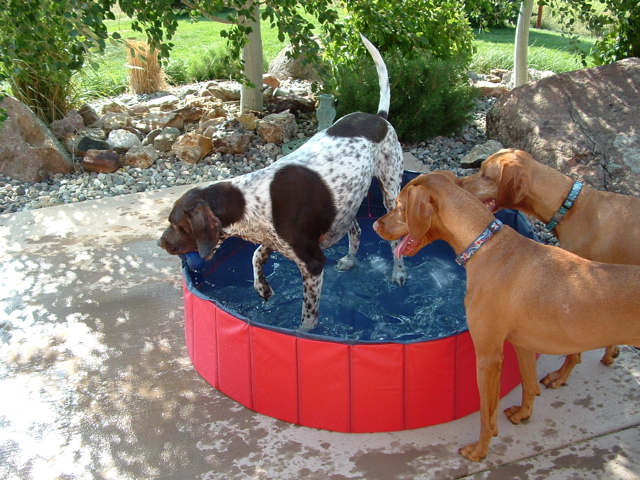
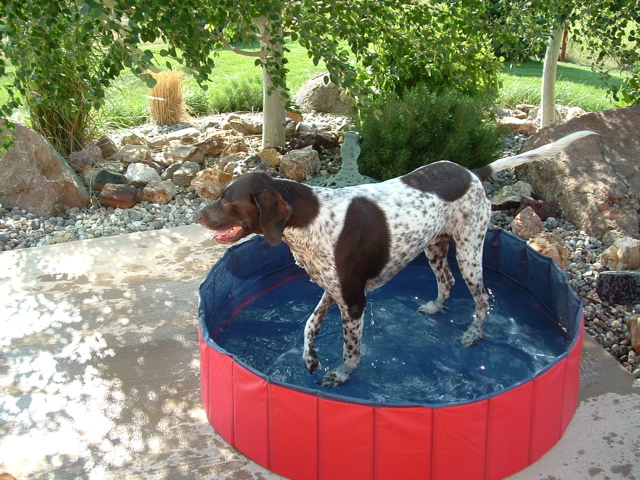
• Jasper in pool

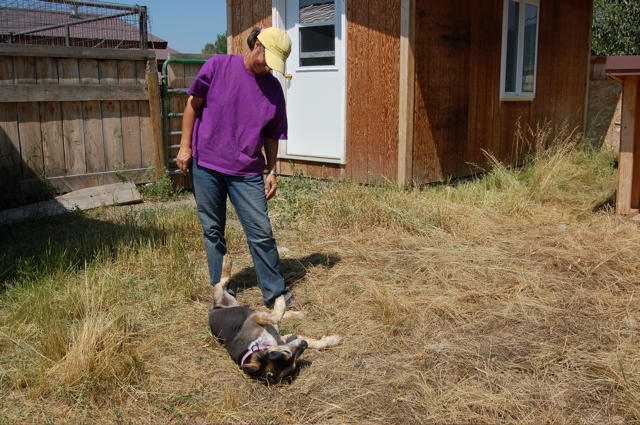
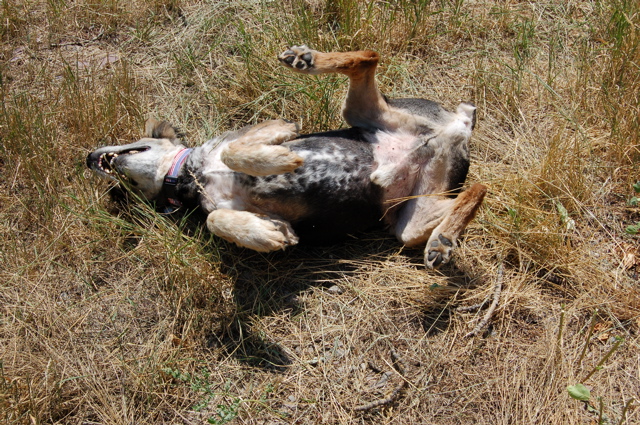
    Now here's a boy you may not recognize unless you've been reading the blog for a long time.  This is Jasper, a German Short-haired Pointer who came to us in 2002 with a crippled front leg.  Fast forward to 2006, when Jasper was adopted by Laurie B. from Bozeman, Montana.  Laurie had two young Vizsla girls and was looking for a companion for them.  It turned out to be a perfect match, and since then Laurie has sent us occasional updates on Jasper.  I recently received an email from Laurie with these photos and the latest on Jasper:

    "It’s been awhile since we gave you an update on our ole Jasper.  Thought you might get a smile seeing these, as we got a new pool for the pups and Jasper sure enjoyed cooling off.  He’s such a wonderful guy and we feel blessed every day to have him in our lives!

    "We can always rely on him to be the goodwill ambassador for the occasional foster Vizslas we care for, he’s like our Walmart greeter.  His leg is still doing just fine and when he runs it’s amazing how fast he is and keeps up with the other 4-legged able pups.  He’s also quite the hunter in the yard.  One day a grouse must have flown into the yard and didn’t realize Jasper was there…we found Jasper happy as can be with a deceased grouse in his mouth, which he reluctantly gave up.  He’s also been good at catching the occasional mouse, gopher, and ground squirrel — quite the stealthy character, must be the speckles against the white coat that gives him a good disguise."

    Here are the two girlfriends admiring the hunk in the pool:

    Jasper in pool with friends


    Thank you, Laurie!

  • Helen chemo 1

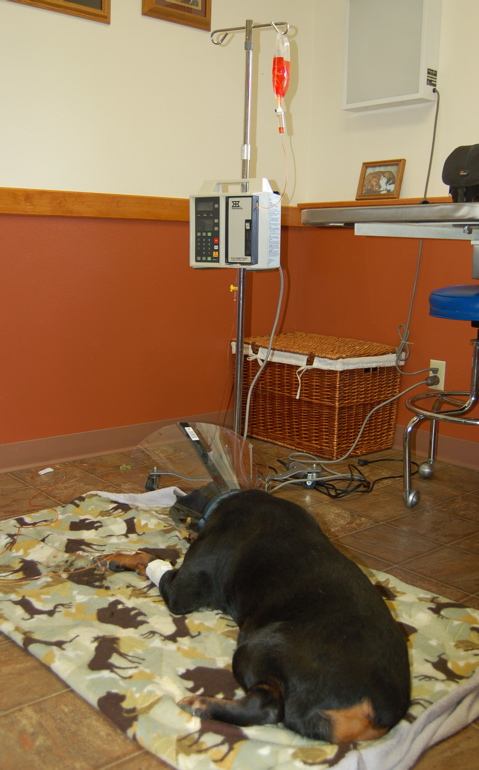
    Last Thursday I took blind Helen over to our vet clinic in Helena to start her chemotherapy.  We had waited an additional week for one more lab report to come back — an immunohistochemistry.  Because Helen had lost a leg last year to fibrosarcoma, and the initial pathology on one of the growths our vets removed a couple of weeks ago indicated it was an anaplastic sarcoma, the immunohistochemistry would tell us the "cell of origin" to see if there was a common link between the two.  This would help the oncologist select the best chemotherapy drug.

    Well, the report came back and only served to complicate matters — the pathologists believed that one of the other growths our vets removed was actually a melanoma … so we had a veritable menu of cancers.  Based on that information, the oncologist at Washington State University, Dr. Janean Fidel, recommended that our clinic administer the chemotherapy drug adriamycin to Helen.  

    We had used the same chemo drug for Shiloh, one of our personal dogs who had developed hemangiosarcoma in 2007.  It was pretty rough sledding for Shiloh after each treatment — about 24 to 48 hours later he'd get sick from it — but so far Helen has tolerated her initial course just fine.  

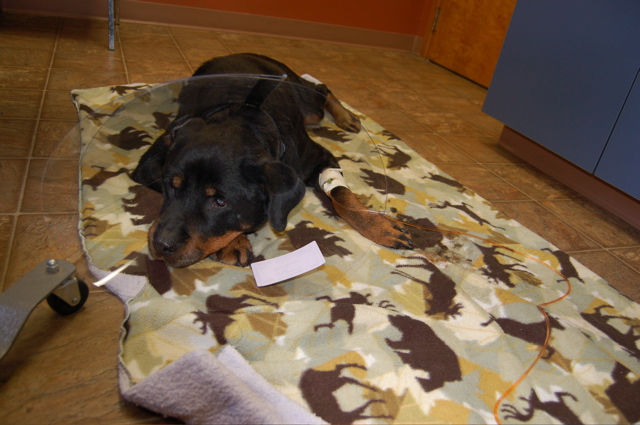
    I took these photos of Helen getting her chemo at the clinic.  I think she actually fell asleep during much of it.  An hour later, she was back in the truck — along with Gabe — and we were headed up MacDonald Pass on the way home to the ranch.

    Helen chemo 2

  • Gabe on bed Aug 16

    Well, it could have been worse.

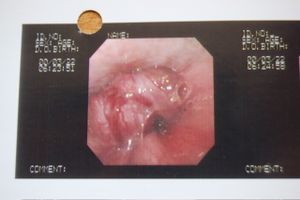
    Our internal medicine specialist in Helena, Dr. Britt Culver, last Monday put a scope down Gabe's throat to see what was causing his breathing problem, and quickly found the answer:  A tumor in his nasopharynx region, where the nasal passages enter the throat.  Essentially his nose is blocked at the back end, so not only can he barely breath through his nose, he can't drain any nasal fluids either.  And try eating and drinking with your nose closed.  Here's what the tumor looks like:

    Gabe's tumor 

    You can see what appears to be a small dark hole remaining near the center … we think he can still get a tiny amount of air through that, but it's very difficult and judging from the sounds he makes, the little hole seems to close up on him frequently.

    When our primary care vet, Dr. Jennifer Rockwell, called with the news early last week, she said Britt had indicated that something like 99% of these tumors are cancerous and of those, about 85% are adenocarcinomas.  That was very bad news, because the adenocarcinomas are very aggressive, spread quickly, and thus make the prognosis very grim indeed.

    So all week we braced for the worst as we waited for the pathology report on the biopsy sample Britt sent in to Colorado State University.  On Friday, Jennifer called with the results.  It turned out to be better than we were anticipating:  His tumor is a fibrosarcoma — a less aggressive cancer.  More good news:  It's a Grade 1 tumor, the lowest of three grades, so it isn't growing and spreading as fast as a Grade 2 or 3 tumor.  And finally, Jennifer said our radiologist in Spokane found no evidence in the X-rays of the cancer spreading to his chest or abdomen.  (Our clinic electronically sends the digital X-rays to the radiologist for review.)

    During the week Jennifer had been in touch with our oncologist at Washington State University, Dr. Janean Fidel, who had treated blind Callie for her brain tumor.  With the pathology results, Dr. Fidel told Jennifer on Friday that she believed a combination of surgery and radiation could give Gabe a few more years of life.  But … but … they'd first need to do a CT scan or MRI to get a better idea of the location of the tumor to see how viable surgery was as an option and how they would do the follow-up radiation.  Thus until we do the advanced imaging, we don't know for sure what our treatment options are.

    So this week I will be scheduling an appointment for Gabe to see Dr. Fidel at WSU … and we'll go from there.  All in all, we have reason to hope for a more positive outcome than we did a week ago — but please keep your fingers crossed. 

    Meanwhile, Gabe is delighted to be back home.  I took the photo this morning of him in our living room.  Like Teddy, it looks as if Gabe got to us just in time.

    Speaking of Teddy, he's doing okay.  I'd like to say he's doing "great" but we don't have his glucose level regulated yet.  He's all over the map, like he was at the vet clinic, so we have been adjusting his insulin doses to try and hit the magic number.  He's been as high as 505 and — as of this afternoon — as low as 230, so we are still quite a way from the target 100.  But he's eating and drinking well, and in the best sign of all, he's starting to get bossy again.  [Imagine a tiny, high-pitched "Woof! Woof!"]

    Since I mentioned Callie in this post, I'd better say right now that she is — finally — really starting to become her old self again.  It's been a long slog but she's coming back, which is such a relief.

  • I'm going to take a blog break for the remainder of this week and will resume posting for Monday the 17th.

    Hope you have a wonderful week!

  • Teddy on cot 1

    On Friday I drove to Helena to pick up blind Teddy at our vet clinic, Montana Veterinary Specialists.  After nearly three weeks in the hospital, he was finally ready to come home.  I took the photo above of Teddy on the cot in our living room Saturday morning.  He's been sleeping a lot, and that bed is now his favorite place.  He seems worn out, which is understandable given what he's gone through.

    While he came through his surgery with flying colors, our vets are still struggling to get his diabetes fully under control.  His glucose level has recently been as low as the 100s (normal is about 100) but hasn't stayed there, and instead has been back in the 300s and 400s, then down again to the 200s.  So we have our work cut out for us in getting him stable.

    At the clinic on Friday, our vet Dr. Jennifer Rockwell and vet tech Rick showed me how to use the glucometer to test Teddy's blood for glucose levels:

    Teddy with Jennifer and Rick

    We're using an AlphaTrak blood glucose monitoring system made by Abbott Labs.  Teddy is getting insulin injections twice a day.

    Although he's been eating like a pig, he remains so thin it just takes your breath away when you see how bony he still is.  I took this photo later on Saturday, and with the light coming in the window from behind him, it really shows you how his spine and ribs stick out:

    Teddy on cot 3

    He had been starved for so long, and with his untreated, run-away diabetes making it even worse, his little body had just about consumed everything it had left.  It can take a long time to reverse the effects and get significant weight on an animal in this kind of condition.

    Teddy's vet bill came to $2,784.74, and Alayne and I are incredibly grateful to everyone whose gifts helped pay for the intensive care this tyke needed. Thank you!

    We're just glad he's finally home, bless his little heart.  Hopefully we'll be able to regulate his diabetes successfully over the coming weeks.  In the meantime, he enjoys his naps in the living room, all snuggled with his fleece blanket:

    Teddy on cot 2

  • News01

    Yesterday we hosted wildlife expert Jack Hanna, his wife Suzi, and their film crew who were here to do a story on our animals for their TV show 'Into The Wild.'  The local paper, the Missoulian, sent a reporter and photographer out to the ranch to interview the Hannas about their visit with us and the other Montana topics they're going to be covering on this trip. 

    Jack and Suzi were absolutely delightful, and they were very taken with the animals at the ranch.  The Missoulian interview was conducted at the start of their visit, so they hadn't met many of the animals yet, but as you can see from the photo, the Hannas had already met blind Callie — who fell in love with Suzi and vice versa.

    The original plan was to do a short 3-minute segment that would air during one of their Into The Wild programs.  But after less than an hour here, the Hannas and their producers were so amazed at everything they saw that they decided on the spot to turn this into a full 30-minute program.  As a result, they ended up spending more than four hours at the ranch yesterday filming.  The story will air sometime this fall, and we will post the program date as soon as we find out.

    You can read the Missoulian story here.

    The article, titled Backyard Explorers, ran on the paper's front page today.  Here's what it looked like:

    Missoulian front page

  • Barbarians at the gate

    As I mentioned in yesterday's post, Alayne and I have been hounded (literally and figuratively) for years by dogs insisting on sharing our meals with us.  We have — yes, it is true — aided and abetted this culinary extortion.

    Each of the dogs has his or her own unique way of pressuring us to give them something from our plates.  Bailey a.k.a. Bugsy's technique is the laser-like stare I discussed yesterday.  Blind Goldie's approach is purely physical — she'll paw at us and our chairs relentlessly until we surrender some food.  Blind Widget combines multiple techniques — vocal, physical, and her own version of "the stare" — into one sure-fire interrogation method to get what she wants.  She will stand up on her hind legs, put her little front paws on the edge of my chair, stare intensely at me, and then let loose with some loud woo-woo-woo's.  Very effective technique, that one.

    (Have I mentioned what it's like to try cooking in the kitchen with this crowd?)

    So Alayne and I decided it was time (um, after how many years?) to regain control of our dining room and kitchen and drive the little barbarians out.  The answer was a doggie gate with extra panels from Foster & Smith. 

    Now whenever we are ready to cook or eat, the Huns are placed on the other side of the gate in the living room.  In the photo that's Widget on the left, Goldie, and Dexter on the right.  Daisy is in the back behind Goldie.  (Blind Callie is conked out on the bed and doesn't care.)  Bailey had somehow managed to stay in the dining room for this photo but was soon placed on the other side. 

    Of course, the gate doesn't stop them from standing there and continuing to stare at us, but it just isn't as intense — and thus as effective — as when they're swirling around our chairs at the table. 

    They also know that once we are done eating, Alayne always manages to bring them some saved morsels from our plates.  So in the end, they still get what they want — and isn't that the only thing that matters to a barbarian?

  • Baily Bugsy

    One of the things I find powerless to resist in life is this face, staring at me intently while I try and enjoy a meal.  It doesn't matter that he has already been fed.  No, sir.  He looks up at me from the floor with his adorable bug-eyes, beseeching me for a morsel from my plate.  I call him Bugsy when he does this, though you know him as Bailey.  The photo is the view from my dining chair.  (If you click on it for a larger version, you'll get an even better idea of what I have to endure.)

    He knows I can't stand the pressure, and he doesn't avert his gaze until I give him something.  Alas, this mollifies him only briefly.  Bugsy scurries back to his bed on the other side of the dining table to eat whatever I gave him, then quickly returns to zero in on me again.  The photo really doesn't do justice to the intensity of his stare.  He bores down on me relentlessly, and I feel like a suspect undergoing a painful interrogation.  "Okay, okay, I'll say anything you want, just stop!"  Except he doesn't want me to say anything, he just wants me to turn more of my meal over to him.  "Here, take this, now stop staring at me!"

    Every interrogator has his or her favorite technique, and Bugsy's is "the stare," conducted in absolute silence.  Because of his size, his face and those eyes, it is incredibly effective.  There are, of course, other ways of extorting food from humans at their dining table.  In tomorrow's post, I'll show you what we've come up with to deal with the torment.

  • Helen Aug 3

    I was in the Widget's House yard this morning scooping poop when the phone rang at 8:30 a.m.  I pulled the phone off my belt and saw it said "MT Vet Specialists."  I wasn't expecting an update on Teddy until late today, so I thought, uh oh, something happened.  I answered, and on the other end was Dr. Jennifer Rockwell, one of our primary care vets at the clinic in Helena. 

    "How are you?," she asked.

    I said, "Um, I think that all depends on what you're about to tell me…."

    Jennifer said, "Well, I have good news and bad news."

    Now, I am the kind of person who always wants the bad news first, right up front, so I told her, "Let's go with the bad news, please."

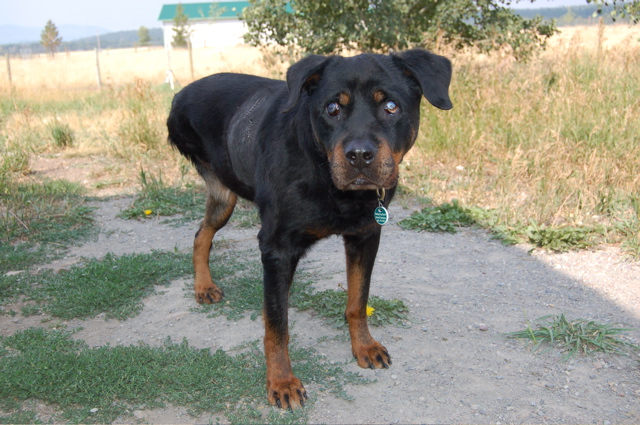
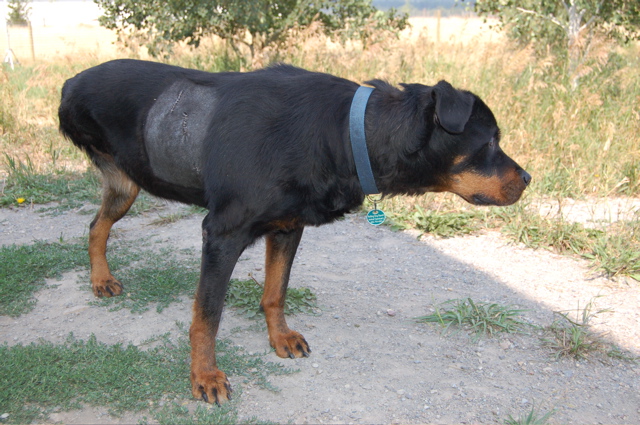
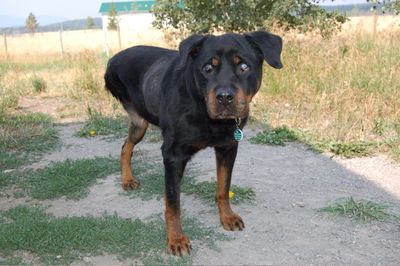
    Jennifer told me they had just received the pathology report from Colorado State University on a couple of growths they had removed from Helen, our blind Rottie, last week — and the lab results show they were cancerous.  Specifically, anaplastic sarcoma, a very malignant form.  Here's a side view showing her surgery incisions (click on photo for larger image):
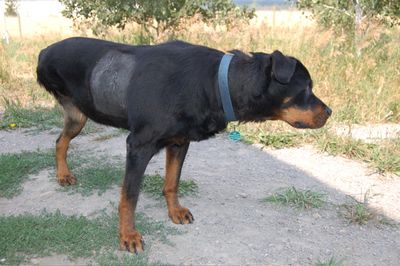
    Helen's surgery incisions

    On Friday, Jennifer had called with our radiologist's report on Helen's chest X-ray, which showed a nodule in her lung.  At that point the radiologist didn't know what it was, and the plan was to do radiographs again in two weeks to see if there were any changes in the nodule.  But with the pathology report today, it seems pretty likely the nodule is the sarcoma that has already spread to her lungs.

    Last year in July, Helen had lost her rear leg to fibrosarcoma, so we always worried about a recurrence of cancer — even though we had clean margins and the entire leg was amputated.  And now here we were.

    I asked Jennifer if the anaplastic sarcoma was directly related to the fibrosarcoma, and she said, "Good question.  We don't know based on the pathology we have, but there's another test they can run that could tell us if there's a relationship."  She also said this additional information could help better determine which type of chemotherapy the oncologists would recommend.  I asked her to have the lab run that test. 

    Of course, my very next question was how much time Helen had.  Jennifer said that while it's always hard to predict life expectancy with any precision, this type of sarcoma is very aggressive.  With the cancer apparently already spreading to her lungs, Helen probably only has months to live — even with chemotherapy.

    Jennifer is going to contact CSU's oncology department today to have them review the pathology reports and then determine which chemotherapy protocol we should follow with Helen.  We'll begin her treatment this week. 

    As I've mentioned before on the blog, Helen is a wonderful ambassador for her breed.  She is sweet, loving, and gets along great with everyone.  Her only aggressive impulse is to lick you to death.  When she approaches with her tongue out, our best advice is to take cover.  She has been with us for years, and is one of the "house dogs," having decided to make Alayne's office her home.  (Maybe she thought Alayne needed more supervision?)

    When I had absorbed Jennifer's sad update on Helen, I asked for the good news.  Jennifer said, "Well, on the bright side, Teddy is still doing fine, and he should be able to go home this week."

    On a day like today, we'll take some good news.
  • Gabe on cot

    An animal rescue group in Pacific Grove, California, contacted us a week ago today about a senior blind dog they had seen in the Monterey County animal control shelter.  Carie B. from the Animal Friends Rescue Project emailed me to say the dog had been picked up as a stray and that the shelter planned to euthanize him because he was running out of time.  She attached a photo of a thick-coated dog with a happy, smiling face … and very blind eyes.  We asked her to have the dog tested with other dogs to evaluate his social skills, and when he proved himself to be an amiable fellow, we agreed to take him.

    Carie's group arranged for a number of volunteers to drive the dog out to us last week from California.  Somewhere along the trip someone named him Gabe.  The final leg of the trip was driven by Vicki M. from Victor, Montana, who drove down to Idaho Falls to meet the transporter on Thursday.  Vicki was concerned to see that the dog's coat was matted and flea-infested, and especially alarmed that he seemed to have breathing difficulties.  Vicki and her friend Hanna shaved his coat off and bathed him Thursday evening, then took Gabe to Vicki's vet Friday morning before bringing him out to the ranch.

    The vet determined he has a sinus blockage of some sort, but also found he has severe periodontal disease and that he was reluctant to move his head in certain directions.  Indeed, when Vicki and Hanna arrived with Gabe Friday afternoon, we could hear his snuffled breathing … almost like he has a hole from his mouth into his sinus cavity somewhere.  And the poor guy's teeth are terrible, and thus we wonder if there's a connection there.  He is also mostly deaf — he can hear high-pitched noises like a whistle and loud noises like a clap, but not normal voices.  So he will be going to our vets in Helena next week for a full medical work-up. 

    But what a sweet, happy boy he is!  I took these photos this afternoon of Gabe in our isolation yard.  (Because we have no vaccination history or health history on him, we'll keep him quarantined until he gets to our clinic.)  He absolutely adores people and will try to crawl into your lap … and if he doesn't succeed, he'll paw at you for some more loving:

    Gabe with Alayne

    Alayne was trying to get him over to the cot for these photos, but he was insisting on a tummy rub before going:

    Gabe with Alayne 2

    And as we were leaving the yard, he wanted to show us just how well he would fit in here by doing a little "rolling dog jig":

    Gabe rolling

    By the way we count it, Gabe arrived at the ranch on the day he would have been euthanized.  Thanks to everyone who helped get this boy out of the shelter and on his way to us!

    Update:  Teddy is doing well at the hospital.  His glucose levels got back to the 500s in the aftermath of the surgery — our vets expected to see a spike so are not surprised — but are starting to come down again.  All of his catheters are out and he is eating and drinking normally.