• Travis leaping fence

    I was over at Widget's House scooping poop on Friday and watched Travis racing back and forth between the yards, literally leaping over the fences as he went.  He was showing off for me, and how better than to take advantage of the deep snow to run a steeplechase course around the building?  Travis is an exceptionally athletic and agile dog, and having a fused jaw doesn't slow him down one bit.

    I set the pooper scooper shovels aside and went into Widget's House to get the camera.  Outside, I called Travis over, pointed to the nearest fence, and said, "Okay, go for it!"  And he did.  He'd take off on a dead run for the fence, leap over it, hit the snowcover, run about 20 more feet, then stop and spin around to look at me.  His face had an expression that said, "Well, how was that?"  As he cleared the fence, I'd click the shutter.

    Not sure if I got the photo I wanted, I'd say to him, "Okay, let's do it again!" and he'd zoom back over the fence for me.  I had him do this four times until I was satisfied I had the photo, though he was happy to keep obliging.  Yes, he likes to show off!

    His ability to leap fences when the snow is this deep is clearly a "confinement issue" in winter, since he does like to get out and take off if he sees an opportunity when unsupervised.  In tomorrow's post, I'll show you our current "confinement solution" for this boy.

  • Alayne and I are just blown away by the outpouring of support for Callie.  Oh my goodness!  As of this afternoon, between donations that have come in online and from checks we've received in the mail already this week, and from commitments we know about for gifts coming next week — we now have enough funds to pay for all of Callie's radiation treatment at WSU! 

    That is amazing.  It is hard to express just how incredibly grateful we are for all of these generous gifts for our little blind girl.  We are so touched.  Thank you!!!

    Callie is now scheduled for her initial consultation at WSU on Monday, April 13th, with her first radiation the following day.  The delay is because the oncologist who does the radiation treatment is out of the country until then, and there is no one else at WSU who can do it besides this one person.  But our internal medicine specialist, Dr. Dave Bostwick, believes there is no harm in waiting until then since we are currently treating her with the phenobarbital and prednisone.

    On behalf of Callie, thank you so much!

  • Bunny 1

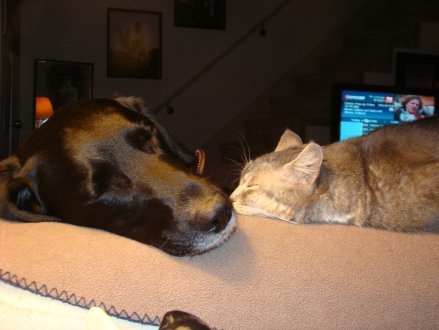
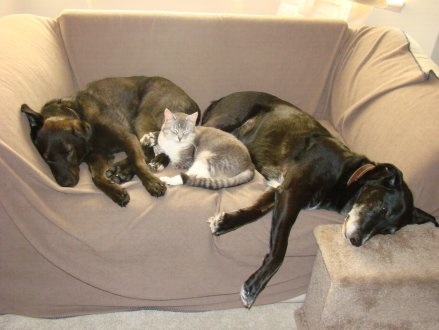
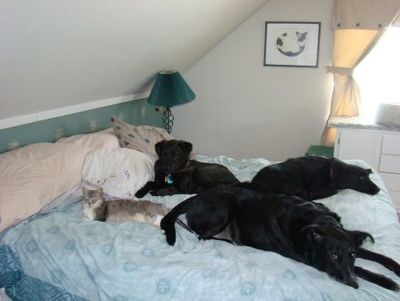
    We just received a wonderful email update with these photos from Tia and Karl M., who adopted Bunny our three-legged cat last summer.  They have taken to calling Bunny their "4th dog," for reasons that are clear from the photos.

    Tia wrote, "Shadow, our 10-year old, was playing in the yard and tore his doggy ACL.  He had surgery 2 weeks ago and with a lot of babying, is recovering nicely.  Needless to say, Bunny likes to mother him and lay on him whenever she gets the chance.  She thinks she is a dog…really!  She lays with our other dogs too.  They are her "pack."  Never has she ever laid next to any of our other 2 cats, at least not very close!  But she has started cleaning Mia, our little kitty with cancer, since she's been sick…but, just like a cat, only when Mia allows her to!  Bunny…always the doting mother!"

    I think these pictures tell the full story of Bunny the dog:

    Bunny 2

    Tia reports that Bunny — or Little Bun-Bun, as they also call her — always sleeps with her feet pointed out:

    Bunny 3

    Apparently there's no such thing as too much togetherness:

    Bunny 4

    This is Bunny sleeping under the lamp with one of Tia and Karl's other dogs:

    Bunny 5

    Why not share yourself with two dogs:

    Bunny 6

    Okay, how about three:

    Bunny 7

    Thank you, Tia and Karl!

  • Herbie in enclosure

    It was finally warm enough the other day to open the cat house window to let the adventuresome ones wander out into their enclosure.  It was the first time in months they'd had a chance to go outside.  Blind Herbie, as usual, heard the window open and zoomed right out.

    But then, almost immediately, he realized the enclosure was still packed with snow.  Lots of it.  So he sat on the outdoor cat trees and pondered the situation.  And pondered some more.  He went from one cat tree to the other, sitting on each in turn, trying to decide whether he really wanted to wade out into all that mushy white stuff. 

    You can see in the photo how the weight of the snow sliding off the roof has pushed the fencing down that seals off the top of the enclosure.  Fortunately that back section of fencing overlaps with the front section by a few feet — it's hard to tell from this angle — so Herbie the climber can't take advantage of the gap to get through it, but it's one of those maintenance jobs we'll have to do once it stops snowing.

    After taking this photo, Herbie realized I wasn't going to dig my way into the enclosure and then shovel out all the snow for him, so he zipped back through the open window and called it quits for the day.

  • Big Melt

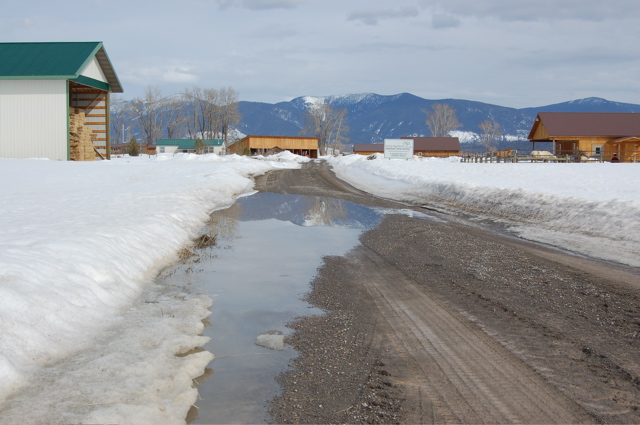
    Our snowpack is finally starting to melt — we call this time of year "The Big Melt."  I took this photo of our drive on Sunday afternoon, and then we woke up Monday morning to three inches of new snow on the ground and a drive that had disappeared.  But the three inches has melted away, the drive is visible again, and that pond is even bigger today. 

    The Big Melt happens in fits and starts, because new spring snowstorms keeping adding some new stuff on top … like the three inches yesterday and the three to five inches of snow we're forecast to get tomorrow.  How fast it melts depends not just on daytime temperatures but also on how cold it gets at night.  We're forecast to be at 13 degrees tomorrow night (-10 C) and 7 degrees (-13 C) Thursday night.  When it gets that cold, it obviously takes longer to warm up enough the following day to resume melting.

    By the time we get to this point in late March, we are really, really ready for spring.  The songbirds have returned, the geese are flying north overhead, the days are getting warmer, and the evenings are staying lighter longer — but there's still almost two feet of snow out there.  Scooping poop right now is also rather annoying, since we're often sinking down up to our knees — and sometimes to our thighs, if a dog has helpfully pooped on top of a snowdrift — because the snow is all mushy and still deep.

    At the same time, the later the snow stays on the ground, the better it is for the pastures.  But while the grass farmer in us appreciates a long, slow melt, the other part of us would really like it to hurry up!

  • Fox at dawn

    I got this shot out the dining room window at breakfast a couple of days ago — that's "our" fox in the process of making her morning rounds. (To be honest, we don't know her gender but for some reason we've decided she's a she.)  Just about dawn, she emerges from somewhere and heads down the drive towards our house, goes around the barns, comes through the corrals, then loops behind the vehicle shed and back through the pastures behind our house and Widget's House before disappearing again.

    A few months ago we were distraught to see her limping and holding her left rear leg up in the air.  Even with the binoculars we couldn't tell what the problem was — whether she'd had it caught in a trap, been shot at, or suffered some other kind of trauma.  Of course, our instinct was to do something to help her, but Fish & WIldlife Department regulations don't permit that sort of thing, and you have to accept that nature is going to run the show. 

    As it turned out, as the weeks went by her limp began to decrease and she started putting her leg down, though it's clear she still has a leg problem of some sort because of her gait.  But her life will get a lot easier once the snow is gone.  Every year we have a family of fox kits born on the property, and we hope this year is no different.

    ———–

    Callie Update:  As of this afternoon, we've received $1,695 in online gifts towards Callie's medical fund, and we've heard from a number of folks who have put checks in the mail for her — wow!  Thank you!

  • Callie before ultrasound

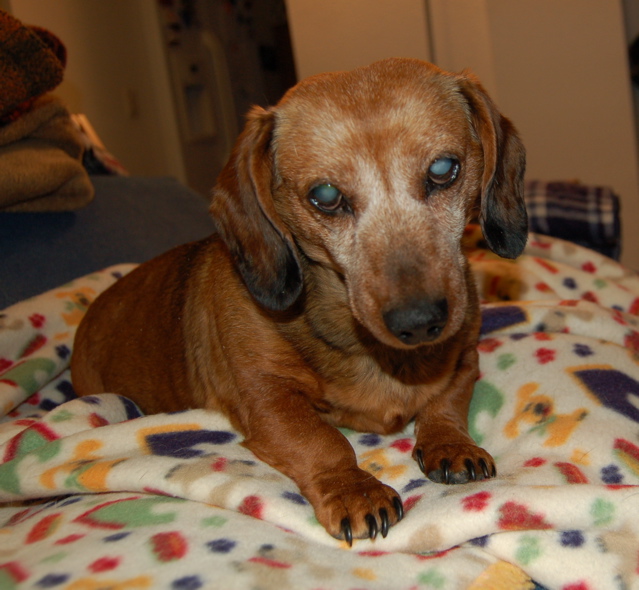
    Our internal medicine specialist, Dr. Dave Bostwick, heard back from the oncologist at Washington State University's veterinary teaching hospital on Friday afternoon.  The cost of the radiation treatment for her brain tumor is steep — the oncologist estimated it would be in the $3,800 to $4,200 range — and it would take a total of 18 to 20 "fractions," or doses, spread over a three-week time span.  Because the radiation doses are administered every other day or so, we would leave Callie at the WSU vet hospital for the three-week duration.  It would be early April before they could take Callie, although Dave was not concerned about the wait because we are managing her seizures in the meantime with phenobarbital and prednisone.

    If we can give this little girl an extra three years or more, we think it's worth doing, so Alayne and I decided we're going to proceed with the treatment.  Some people have already made donations towards her care in the past few days, and others have offered to help — and for all of which, we are so incredibly grateful!  If you'd like to make a gift towards Callie's treatment, you can make an online donation at our secure Web page here or by mailing a check to the ranch at 400 Rolling Dog Ranch Lane, Ovando, Montana, 59854.  Please mark your donation for Callie so we can put it towards her medical fund.

    Thank you!

  • Callie3

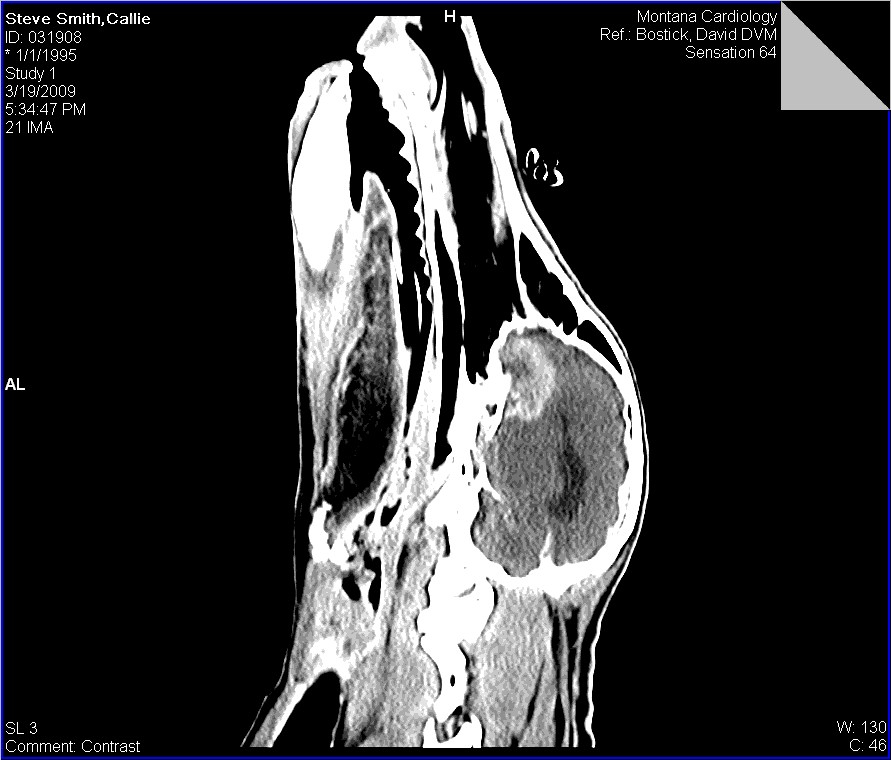
    We found out yesterday evening that blind Callie does indeed have a brain tumor.  A large one.  In this vertical view of her head from the CAT scan image, it's the bright glowing thing at the base of her brain at the front end.  (The dark area in the center of her brain is the cerebral fluid.)

    That's the bad news.  The good news is that our internal medicine specialist, Dr. Dave Bostwick, believes radiation therapy offers some real hope.  When I drove back into Missoula late yesterday to pick up Callie after the scan, Dave told me, "Her blood work is perfect, she's in otherwise excellent health, and given her breed, she could easily live another three years.  So I think she's an excellent candidate for radiation therapy."  (We don't know how old she is, but our working assumption is that she may be around 12.)

    Dave said that her tumor is most likely a meningioma, which are generally benign — and if you can shrink it down with radiation, you relieve the pressure inside the brain that is triggering the seizures.  He said that oncologists generally have a high success rate treating these kinds of brain tumors with radiation. 

    So Dave has a call into the oncologist at Washington State University's veterinary teaching hospital this morning to find out about the cost and other details of the treatment.  We'll keep you posted.

    In the meantime, after I got home last night with Callie, she ate her dinner and then methodically began going around the house, grooming her "clients" like blind Briggs.  She was a little put-out with us because she had all these grooming appointments scheduled for yesterday but spent the day in the clinic instead.  She tried to make up for it after dinner with some "speed grooming."  (I think that's like speed-dating, just different.)

    To see a larger version of the scan, click on the image.

  • Callie upside down at clinic

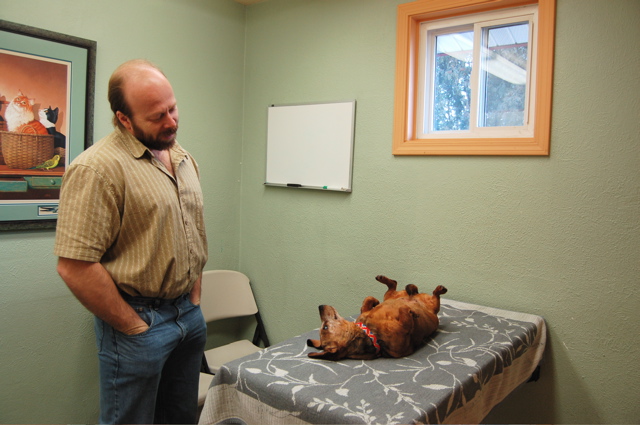
    Blind Callie was obviously quite comfortable at the vet clinic this morning after her neurological exam and ultrasound.  Our internal medicine specialist in Missoula, Dr. Dave Bostwick, had just put away the ultrasound probe when Callie — who prefers sleeping upside down much of the time as it is — decided she would stay this way.  She was clearly expecting Dave, me or anyone else in the building to come over and start rubbing that rather expansive tummy of hers.

    Her bloodwork was normal, which ruled out metabolic problems as the cause of her seizures.  This now points to a brain tumor, which Dave said is usually what they find in about 90% of these cases in dogs of Callie's age and with this type of onset.

    Dave had done an ultrasound of her abdomen because a fairly high percentage of brain tumors (as much as 30%, according to one study) are caused by other organ tumors metastisizing and spreading to the brain.  But the ultrasound showed no evidence of tumors in her abdominal organs.

    That leaves us with the CAT scan of her brain, which Dave will do this evening.  A cardiology clinic in Missoula lets Dave use their equipment and technicians after-hours.  The imagery is electronically transmitted to a veterinary radiologist in Seattle, who will send Dave a report tomorrow morning.  Depending on what the images show on the screen, Dave may be able to get a pretty good idea this evening of what we're dealing with prior to getting the radiologist's report.

    We brought Callie into our bedroom last night to keep an eye on her in case she had an another seizure.  She did, at about 1:20 a.m.  It was an episode very much like her other two.  So in the space of about 36 hours, she's had three seizures.  Not good.

    Dave said that if it does indeed turn out to be a brain tumor, treatment options are either medical management to control symptoms or radiation to shrink it.  He said radiation has a pretty good success rate.  But much will depend on the type of tumor.  In any case, we are starting her on phenobarbital today to begin getting control of the seizures.

    I'll post an update on Friday with the latest news.  In the meantime, thank you to everyone who has posted such wonderful comments or sent us supportive emails.  We appreciate it so much!

  • Callie post-seizure

    I was sitting in the living room about 8 p.m. last night, working on my laptop, when I suddenly heard a furious scratching noise coming from the couch.  I looked over and saw blind Callie paddling her feet like crazy, her body trembling and quivering.  She had been sleeping soundly just seconds before.  I jumped up and put my hands on Callie to keep her from rolling off the couch.  I called out to Alayne, who was in her office, and told her Callie was having a seizure.

    We watched as the seizure increased in intensity, her plump little body going stiff, her legs outstretched, then pulled back again as another short-circuit sent tremors though her body.  She rolled over on her side, gasping.  We could tell quickly that this was definitely a grand mal seizure from the duration and the severity of it.  She had peed on the couch, was foaming at the mouth, and towards the end of the seizure, she pooped.

    After two minutes — which seemed like an eternity, it always does when you're watching a seizure — she started to quiet down.  Finally she came out of it, but she was disoriented and exhausted from the physical exertion and stress of the episode.

    Alayne cleaned the couch while I held Callie, and then we cleaned her up.  We put her back on fresh bedding on the couch, and that's when I took the photo of her above.  You can see how droopy she is from the experience.

    We had never seen Callie seizure before, and given her age — we suspect she's around 12 or so — we were instantly worried about what this meant.  Still, we have seen older dogs start seizuring later in life — like blind-and-deaf Spinner, whose seizures are thankfully very infrequent … while other dogs, like our blind Goldie, began having seizures early in life but then "grew" out of them.  The real key is the frequency of the seizure episodes, and only time will tell.

    Well, time told us this morning. 

    Callie had another violent seizure about 10:30 a.m., a repeat of last night.  This, we instinctively knew, was a terrible sign:  far too close to the first one.  While Callie was in the middle of today's seizure, I called our vet clinic and talked with one of our primary care vets, Dr. Jennifer Rockwell.  Jennifer asked if we had valium on hand, which we do — an emergency stash of valium syringes for Spinner.  She told us what dose to give Callie if she had another seizure today and it became uncontrollable.

    Jennifer said the first step would be blood work to see if there was some kind of metabolic disturbance that could be causing these seizures.  If the blood work was normal, then there might be an intercranial cause, i.e. tumors or growths.  Jennifer explained that an onset in young dogs frequently pointed to epilepsy, but that was typically not the case in a dog of Callie's age.

    Since I was already scheduled to head to Missoula tomorrow, Jennifer suggested I have our internal medicine specialist there, Dr. Dave Bostwick, look at Callie.  As luck would have it, Dave had an opening tomorrow morning and was going to be doing CAT scans in the afternoon, so if her bloodwork is routine, we can proceed straight to a CAT scan to look for intercranial causes.

    I'll post more tomorrow evening.  In the meantime, please keep your fingers crossed for Callie.