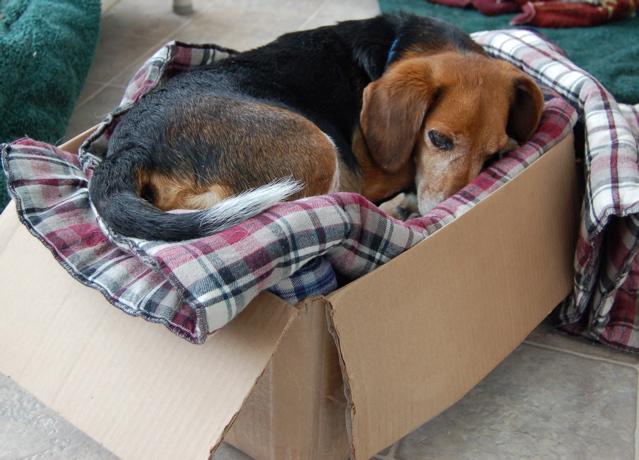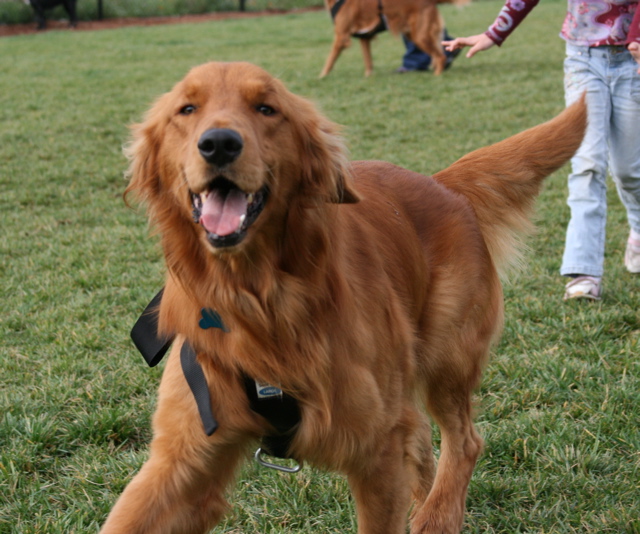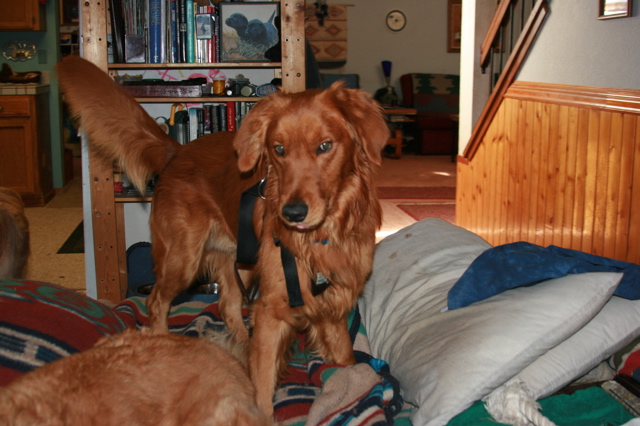
• Briggs in blanket box

    There are times we wonder why we buy expensive beds and cots for the dogs when … well, when a box is all you need!  Anita M. from Texas kindly sent us a shipment of blankets a couple of weeks ago.  We opened the box, left it on the living room floor to unpack later, and lo and behold, there's been a dog sleeping in it ever since.  Really.  As in, all day long, we have an ever-changing parade of dogs who settle into the box for a nap.  It's almost like they're taking turns.  That's blind Briggs above.

    Here is blind Goldie:

    Goldie in blanket box

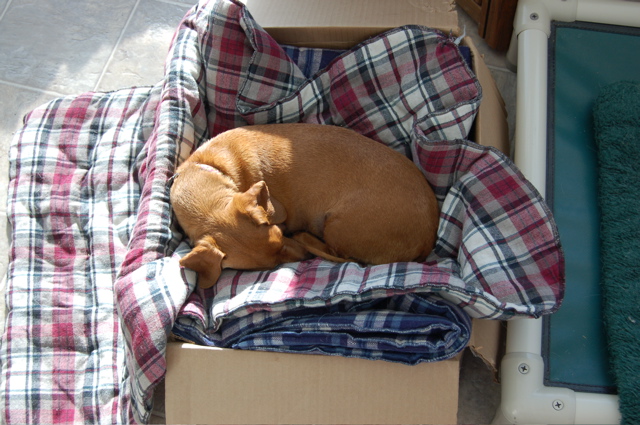
    Daisy the Dachshund isn't even burrowing in it, just curling up on top:

    Daisy in blanket box

    And of course, no blog post on the subject of sleeping dogs would be complete without an appearance by The Honorable Miss Widget of Ovando:

    Widget in blanket box

    Notice how the dogs and blankets change but the box remains the place to be?  Some of the dogs like to rearrange things and will pull a blanket or two out to get it just so, or they will try to fluff up a blanket and end up knocking it out of the box.  But at the bedtime, we fold up whatever blankets have fallen on the floor, put them back in the box, and it's ready for another hard day's sleeping.

  • Evelyn with Dave 1

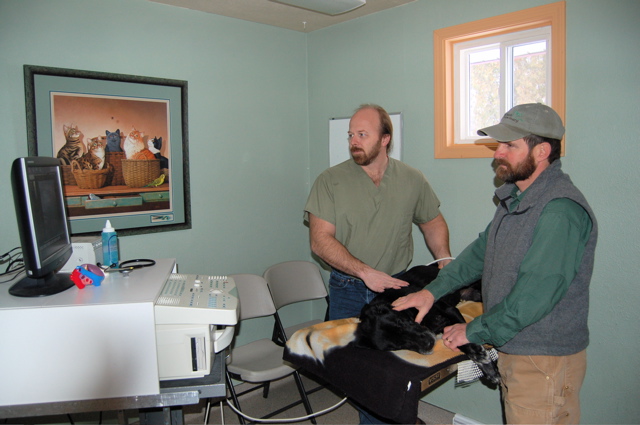
    I took two of our blind girls, Evelyn and Penny, into Missoula with me today to see our internal medicine specialist there, Dr. Dave Bostwick at Missoula Veterinary Specialty Clinic.  Evelyn has been losing weight, and no amount of adjusting her diet has seemed to make much difference.  She has lost 11 pounds, though she seems visibly (to us, at least) to have lost more than that.

    In the photo above, Dave is listening to her heart during the physical exam.  Dave's vet tech, Alex, thought it would be a better idea if she took the photos instead of me, so I was assisting today.  Next came the ultrasound:

    Evelyn with Dave 2

    The good news is that her internal organs looked fine, which is a real relief.  I still am not good at reading the grainy ultrasound images, and every time I see something suspicious (to my untrained eye), I pepper Dave with questions like "What's that?" or "Uh oh, what's that?"  Usually it's something harmless like, well, a gas bubble in the colon, for instance, or simply my imagination running amok.

    So on both her physical exam and ultrasound, Evelyn looked okay.  The blood work results won't be back until tomorrow, and those will tell us whether she's got something like chronic renal failure.  Please keep your fingers crossed for Evelyn.

    The news on Penny was much more definitive.  She had just recently developed a small white growth on a toe on her front right foot … it looked almost like a wart.  It was pretty unremarkable and it didn't keep growing.  But then, all of a sudden, her toenail completely broke off, leaving a stubby red patch of flesh.  Oh, no.

    It turns out that Penny has a nail-bed tumor — either a melanoma or sarcoma.  X-rays this morning revealed that the tumor was eating away at the bone in that toe, but so far it hadn't appeared to spread beyond the first joint.  These nail-bed tumors, particularly the melanomas, metastasize or spread very quickly.  So Dave scheduled surgery for next Tuesday to amputate that toe up to the first joint.  He will take biopsies at that point (she'd need to be sedated for a biopsy anyway) so we can find out which type of cancer it is, but the results won't change the need to remove the tumor surgically.

    In the meantime, Dave sent in the pre-operative blood work on Penny, and here we are drawing the blood from her:

    Penny with Dave 

    Both girls enjoyed driving around Missoula today while I ran errands.  They were especially happy after the very last stop when I loaded the groceries from the Good Food Store into the truck and handed them a couple of chewy oatmeal cookies for a treat!

  • Leo1

    Another installment in our series of posts on other folks' disabled animals … this one from Europe!

    One of the sanctuary's wonderful friends and supporters, Carla P. in Italy, had rescued a tiny disabled kitten in September 2007.  Carla named him Leo, after another beloved family pet, their dog Lea, who had just died the previous month.

    Carla had written:

    "I found Leo on my way to the grocery store.  He was missing his left front leg, with the gaping wound still bleeding.  I rushed him to our vet who, after removing dozens of maggots, treated Leo's wound with Betadine and put him under antibiotic therapy.  Thankfully, he had an extraordinarily speedy recovery.  His disability does not slow him down in the least!  He runs and jumps all over the place, enjoying life to the fullest.  He's very cuddly and always purring, even when he's eating or snoozing.  He's such a sweetheart and certainly keeps us entertained with his antics!  After the heartbreak caused by Lea's death, we sorely needed the joy and laughter Leo has brought into our lives."

    Just a few months later, you can see what that tiny kitten was growing into — a big, handsome boy!

    Leo4

  • Cats in front of heater

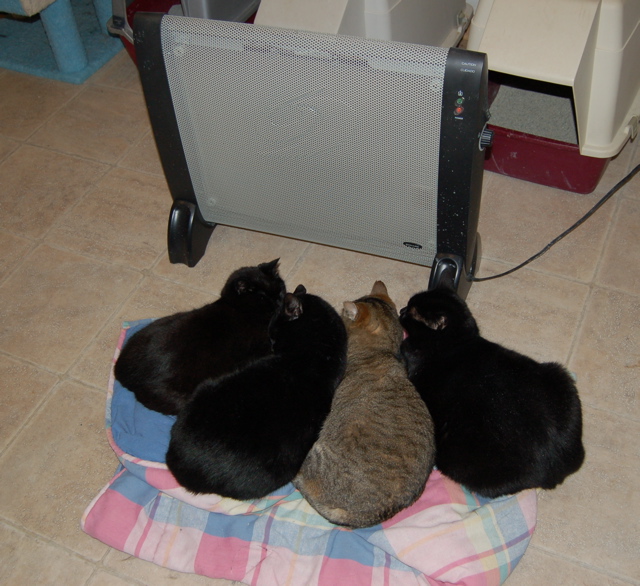
    Speaking of warmth seekers, this was the scene in the cat house the other night when I went to check on everyone for bedtime.  Back in late December I posted a photo of Tibby, Fibby and wobbly Mink, squished like sardines in front of that heater.  This time Mink has a new crew of friends to enjoy the warmth with.  That's one-eyed Lulu on the left, then Mink, next is three-legged Molly the tabby, and on the right is blind Cinder.  Blind Herbie was trying to climb up my pant leg as I took the photo.

    It looks like they're watching something off to the left, but really, there wasn't anything going on over there!

    When we built this cottage we're using for the cat house, we used a different type of construction that is supposed to be super-efficient:  the walls and roof are made out of a "sandwich" of OSB wood panels with a thick sheet of styrofoam insulation in between the OSB panels.  The entire building was literally six pre-built slabs — four walls and two half-sections for the roof.  It went up in one day.  It is incredibly well insulated, and actually makes the building a bit too warm for my tastes … but the cats love it.  Even if, as you can see in the photo, they can never get quite enough heat!

  • Daisy in front of wood stove

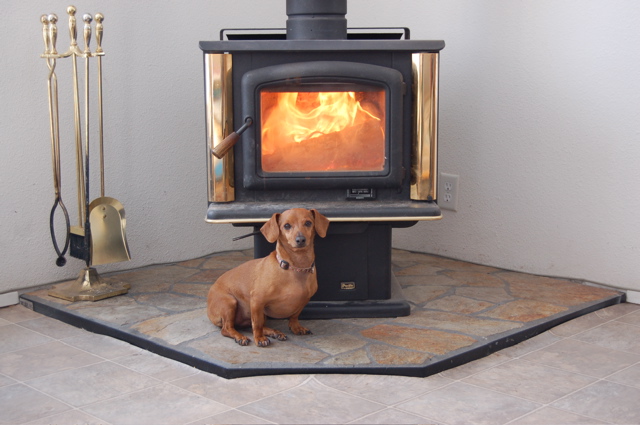
    We're in another cold spell — last night was 26 below zero (-32 C), tonight we're forecast to be 28 below — which means keeping the wood stove going during the day.  I took the photo above of Daisy the miniature Dachshund trying to get as close as she possibly could to that stove.  I had just started the fire not long before, which is why it's blazing away, but it hadn't really started radiating out a lot of heat yet.  Before I got there with the camera, she had been staring intently at the glass door of the stove, as if she were encouraging it to heat up faster.

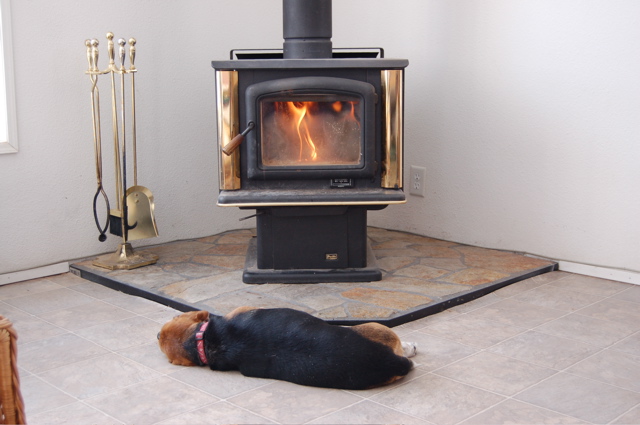
    An hour or two later, the stove is now putting out a lot of warmth and blind Widget has found just the perfect spot to lie down and soak it all in:

    Widget in front of wood stove

    Some folks have asked how Beaver is doing without his brother Rooster.  We were worried at first, given how intensely they were bonded, but after a couple of days of constantly looking out across the pasture for Rooster, Beaver finally re-focused on our small group of sighted horses.  It helped that two of our sighted mares, Blueberry and Patches, were in heat that week.  Having the two girls constantly coming on to him — tails raised, bumping up against him, nickering at him — diverted his attention away from his missing brother and towards the two shameless tarts.  Yes, Beaver is gelded, but it doesn't mean he isn't going to notice that kind of behavior!

  • Beaver with belly band

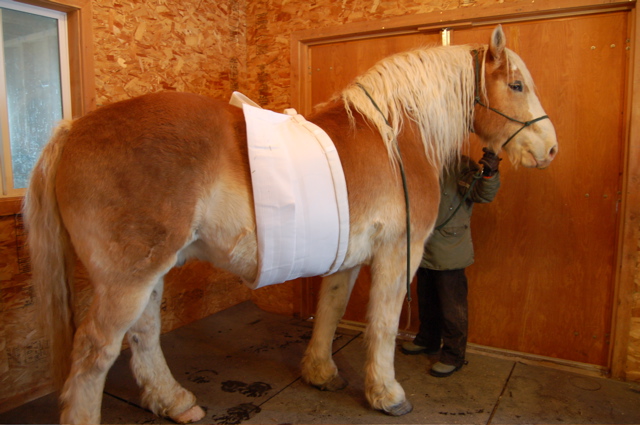
    Well, Beaver the Belgian turned out to be too big for the "XX Large" belly band designed for a Clydesdale.  I took this photo on Friday, after I applied the Aldara to his sarcoid for the first time.  We needed another, um … 8 to 10 inches to comfortably close the top of the band over his back.  The cinch strap was long enough, and the breast collar harness (not shown here) was workable, but the band itself was just too short.  I called Suzanne at Equus Therapeutics in Virginia, who produces the belly band, and she is making us a 12-inch "extender" with velcro to close the top.  We should have that later this week.

    That's Cindy holding Beaver.  As I mentioned in an earlier post, she doesn't want to appear in the blog photos except "hidden" like this.  I told her she's going to end up being our version of Wilson, the neighbor of Tim the Toolman whose face you never saw in the TV show Home Improvement.  She liked that idea. 

    I heard this crack from a draft horse person a while ago:

    Q.  Do you know why Budweiser needs eight Clydesdales to pull their beer wagon?

    A.  Because they're Clydesdales.  They'd only need two Belgians to get the job done.

    (Clydesdale people:  That's a joke.  Please, no calls or emails.)

    Beaver is big, even for a Belgian, at 18 hands high and 2,000 lbs.  But
    I figured if the belly band was sized for a Clydesdale, it should fit
    him okay.  Not so.  It's hard to appreciate just how big he is until you get right up next to him.  Cindy took this shot of me waving from the other side of Beaver as I was trying to adjust the band:

    Beaver with hand wave

  • Luke in laundry basket

    Kate W., who adopted blind Luke from us in 2007, emailed me last week to say Luke "was jealous of all the Baron action on the blog lately.  So he thought he'd send you some pictures of him sleeping … just in case you wanted to make him famous."

    As you can see, our former residents carry their antics with them to their new homes.  In keeping with the theme of big dogs in small beds, that's Luke amply filling out a laundry basket.  It doesn't exactly look comfortable, but it provides a nice chin rest, apparently.

    And then, while Kate was cleaning out and re-organizing the garage, Luke decided a box of blankets was just the place to take a nap while his Mom was working.  Kate said he was even snoring when she took this shot:

    Luke in box

    Now, it's not always easy to tell when a dog who doesn't have eyes in his head is actually sleeping, so the snoring is a helpful clue!

  • Koda the wobbly Golden

    This is the third in our series about other folks' disabled animals — and that's Koda, a Golden Retriever who has cerebellar hypoplasia.  Koda belongs to Garry P. in northern California.  Garry recently wrote us to say:

    "I work with a Golden Retriever Rescue Group in northern California and I just recently adopted a 2-year old male Golden who came to us with CH.  He's like your Allie in spirit and will be a wonderful companion for me and my other Goldens.

    I've only had him since just before Thanksgiving but he captured my heart the moment I saw him and has continued to be just a wonderful fella, full of life and fun.  As he's become more and more comfortable in my home and become used to daily exercise and activity and joined my crew in play and walks, he's stronger and more stable and gets around much better than when he first arrived — as you noted with Allie.

    He's become the wrestling partner for one of my other female Goldens who loves to mix it up with him."

    Here is another photo of Koda, who is about to steal Garry's spot on the bed:

    Koda stealing bed

    I think I've seen that sly look before somewhere.  Hmm.

  • Blanca headless

    Now this is what we'd call a disability!

    Just kidding.

    That's Blanca,
    our blind-and-deaf Great Dane from Mexico, doing her usual weird
    sitting thing in the front yard of Widget's House.  For some reason
    this is characteristic of how she often likes to sit.  We're not sure
    why, but it seems to work for her.

  • Beaver in surgery room

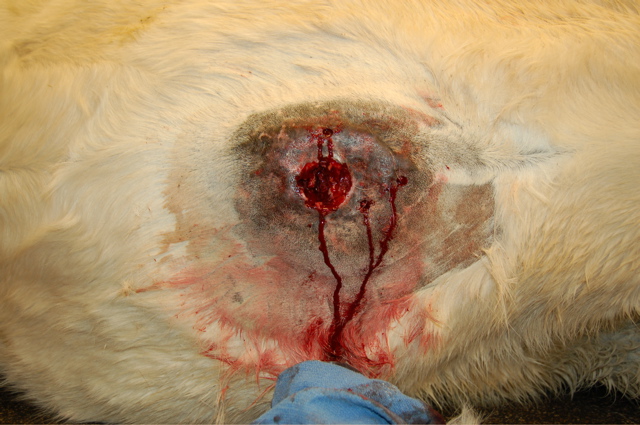
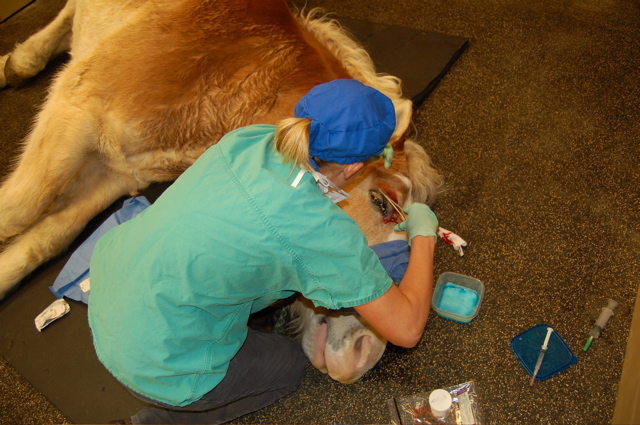
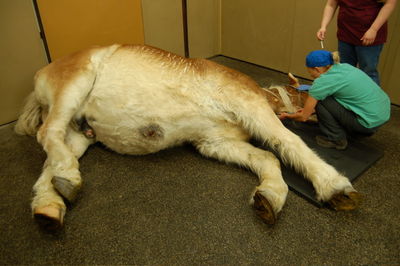
    I took our draft horse Beaver in to Missoula to see Dr. Erin Taylor this morning to begin a new treatment for his sarcoid tumor.  That's Beaver above, right after we anesthetized him at the clinic.  You can see the tumor in the center of his belly.

    This will be the third form of therapy we've tried over the past two years, not counting the recurring antibiotics and anti-inflammatories we give him when he has flare-ups.  This past fall the tumor had seemed pretty quiet and we were growing optimistic that the last treatment had finally worked and made the tumor shrink.  Alas, in the past several weeks it had started growing again and had become infected and inflamed.  The usual antibiotics and anti-inflammatories hadn't seemed to make much headway this time. 

    Sarcoids by themselves are not usually fatal, but as a form of skin cancer they are chronic, very difficult to get rid of, and carry with them the ever-present risk of infection.  In Beaver's case, as I mentioned in yesterday's post, this is compounded by the tumor's location:  on his belly, right at the lowest point, so it bears all of his weight when he lies down, and comes into contact with the ground each time.  So it is constantly aggravated.

    There have been a lot of different therapies for treating sarcoids over the years, all with only limited success.  Surgery has a pretty significant failure rate (higher than 50%) and often causes the tumor to grow back even more aggressively.  And the more treatments that have been tried on an individual sarcoid, and the larger it is, the less likely other therapies will succeed.  (For a scientific overview of sarcoids, read this paper from the Journal of General Virology.)

    But researchers from the University of Minnesota's Veterinary Medical Center found that a human topical medication called imiquimod — trade name Aldara — showed remarkable (though not 100%) success in treating sarcoids.  After completing a pilot study, the researchers posted information for horse owners and equine veterinarians here.

    Of course, this being a patented human medication, it is incredibly expensive just to treat a person, let alone when you scale up for a 2,000 lb draft horse like Beaver. 

    This tiny box of the medication is supposed to cover Beaver for two months of treatment … and cost $515.  Yikes.
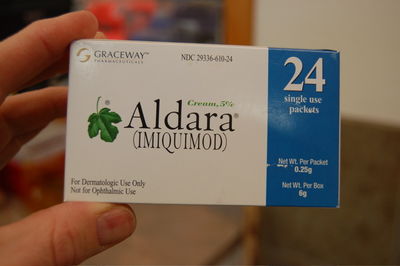
    Aldara box

    However, when we opened it and found these tiny .25 gram pouches of the stuff, we became more than a little skeptical that this would really last anywhere near the two months' worth of treatment for Beaver's giant sarcoid.  You can see that each pouch isn't much bigger than a quarter:
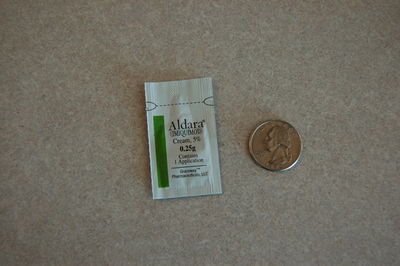
    Aldara with quarter

    And a quarter is actually thicker than the pouch!
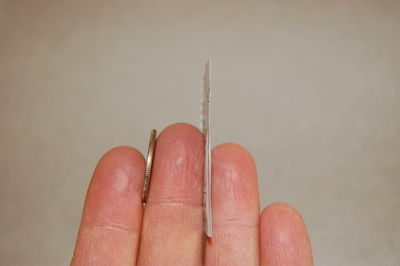
    Aldara and quarter thickness

    Today's exercise was to clip and clean out the tumor site, take new biopsies for pathology tests, and get it prepped for the first application.

    It looked like this afterwards:
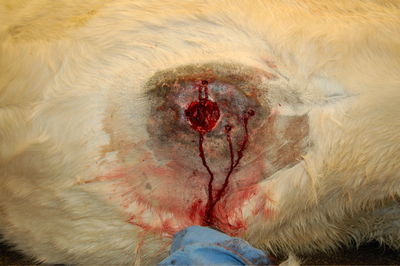
    Beaver sarcoid close-up

    Because sarcoids have a tendency to multiply on a horse, Beaver has developed a new one on his upper eyelid, which Erin is removing in this shot:

    Beaver eye tumor

    Erin had located a lady in Virginia who makes custom belly bands for equine hospitals, and I ordered a giant one for Beaver this afternoon.  When it arrives later this week, I will clean out the tumor site again, apply the Aldara for the first time to both his belly tumor and his eyelid tumor, and then put the belly band on him to keep the tumor site as sanitary as possible.  Wish us luck!

    Ironically, Beaver was the healthy one of our pair of Belgian draft horses.  He came to us only because we had agreed to take his brother Rooster, who had a spinal condition.  Sadly, Rooster's back problem significantly deteriorated last year, and we ended up having to euthanize him late last fall.