• Kasha_on_arnolds_bed

    I received a wonderful update on three-legged Kasha yesterday from her new Mom, Cristene J. in Idaho, along with these terrific photos.  (Read the blog post about Kasha’s recent adoption here.)  Here’s some of what Cristene wrote in her email:

    "As for Kasha, she makes my heart happy everyday.  She has adjusted so well and is so full of life.  She is a true testament to the great work that you two do with these animals.  After all of the trauma she suffered through before you took her in, you would never know it spending time with her.  She is trusting, loving, has respect for us and she always has a smile on her face.  She learned the invisible fence very quickly and is ready to please at all times."

    Cristene added, "Kasha is here with me right now (see picture above).  She has her own ‘big girl bed’ but for some reason prefers to curl up on Arnold’s small coolaroo bed!  See how happy she is!  Thank you for her, we just love her."

    [Comment from Steve:  Arnold is the miniature Dachshund in the family, and in a mysterious phenomenon we have frequently seen here at the ranch, big dogs often do prefer small dog beds!]

    Cristene then sent a separate email with additional photos, and wrote: "I thought you might enjoy these pictures of our dog walk this afternoon with Kasha, Jasper, Asa and Lola.  I am telling you, that girl can run like the wind…."

    Here’s Kasha running through their fields:

    Kasha_running_in_field

    And taking a break:

    Kasha_in_field_2

    Here she is, deciding what to do next:

    Kasha_in_field_1

    Finally, Kasha with her new friends:

    Kasha_and_friends_in_field

    I think Kasha is now in true doggie paradise.  Thank you, Cristene and Duane, for giving her this fabulous new life!

  • Daisy_and_spinner_october_1

    I was heading out the door this morning for Missoula when I saw this pairing in the living room.  That’s Daisy on the left and blind-and-deaf Spinner on the right.  Daisy has spinal issues that leave her incontinent, while Spinner could easily win the World Bladder Endurance contest.  However, that particular difference between them is not what caught my eye this morning.  I just thought it was an interesting visual contrast, the two-tier arrangement with the little dog down below, the big dog up above … while one is brightly lit up in the early morning sun and the other is still in the shadows.  As is often the case around here, part of the dog bed had slipped off the cot overnight and onto the floor, where someone — in this case Daisy — quickly commandeered it for herself.

  • Jeff_spraying_for_cheatgrass

    Back in July, I wrote a blog post about how we have to work every year to control the noxious weeds that are all too common in the Rocky Mountain West.  In that post I mentioned we are also now dealing with another nasty invasive plant called cheatgrass, which technically isn’t listed as a noxious weed — and isn’t even included in Montana’s official list of noxious weeds.  Nor is cheatgrass mentioned once in Montana’s 2008 State Weed Plan.  (You can download the 98-page document here as a PDF.)  Yet in many respects cheatgrass is a worse problem than the "usual suspects" in the noxious weed universe, so the lack of official attention is very frustrating. 

    For one thing, cheatgrass is a grass — it’s a member of the brome family of grasses, which are widespread and provide excellent forage for livestock and wildlife.  It’s also called downy brome.  But because of this genetic link, the only herbicides specifically designed to kill cheatgrass also suppress or kill other desirable pasture grasses, including smooth bromegrass and timothy.  The other option is to use Roundup to kill live stands of cheatgrass, but of course you end up killing every plant in the immediate area.

    This is why it is, in fact, much easier to control all those other noxious weeds, because they are broadleaf plants and the herbicides that kill them don’t harm the grasses.

    Cheatgrass is extremely aggressive, outcompeting other plants because it is often the first to come up in spring.  How aggressive?  Would you believe it can produce up to 10,000 plants per square yard?  A single plant can generate 1,000 seeds, and these seeds have wedged awns that can puncture the skin in animals’ mouths if they eat the plant.  The seeds also work their way under the skin of other animals, like our dogs, and lurk for months until they rupture into an abscess. 

    Once cheatgrass goes to seed, the dried, dead plants form a mat that is incredibly flammable and greatly increases the fire danger.  Here is what a mound of cheatgrass — the taller, lighter plants in the middle — looks like on our property:

    Cheatgrass_mound

    Because cheatgrass looks very much like a grass, many landowners don’t even realize what they’ve got, and thus don’t do anything about it.  It is possible for livestock like cattle to graze this plant very early in the spring, before it goes to seed and becomes harmful to their mouths, but it’s tricky timing the grazing … and if other grasses are available, the animals will often prefer those anyway.  You can disk it up (plowing, in effect) early in the year, but you end up disking up all your other grasses, too.  Hand-pulling, given the number of acres we have and human resources required, isn’t really feasible.

    The best control strategy is spraying in the fall, before the cheatgrass germination cycle.  That’s what our weed expert, Jeff Campbell of Blackfoot Weed Control, is doing in the photo at the top of this post.  Jeff started spraying for cheatgrass today, and it will probably take him three days to find all the pockets of cheatgrass scattered across the ranch.  (Margaret says, "This is a job for man, not goat.")  He is using a one-two punch for a treatment:  a mixture of Roundup for the living cheatgrass and the herbicide, Plateau, for the pre-emergent seeds.  In the spring we will then disk up these areas and plant new pasture grasses.

    Although we didn’t even have a cheatgrass problem on the ranch until last year, you can see this stuff everywhere now in our part of Montana.  It’s expensive and time-consuming to control, but we’re going to do all we can to get rid of it from our own 160 acres.   

  • Austin_in_igloo

    With the days getting crisper, we’ve started plugging in the heated beds in the dog igloos we have on the various porches.  The weather is generally warm enough that the dogs still prefer to stay outside during the daytime, but some of the cuddle-bugs like blind Austin love curling up in the igloos to nap.  And a heated bed inside makes it all the better on a cool fall day!

    Austin looks so peaceful because we haven’t told him about the stock market today.

  • Kenai_closeup

    This was a photo I took last week when our small animal vet, Dr. Brenda Culver, was here at the ranch for her annual check-up visit.  She was doing a physical exam of our old girl blind Kenai, who had come to us many years ago from an animal control shelter in California.  Kenai has definitely been showing the signs of her advanced aging in the past couple of years, but I hadn’t realized until I uploaded this photo onto my computer just how gray her face had become.  It’s funny how you don’t always notice the gradual changes of the aging process until one day, bang, the cumulative effect is suddenly very apparent.  In this case, I was struck by all the gray she now has.  She looks different, I thought … very, very old!  Bless her heart, Kenai is still holding her own.  She gets a bunch of daily meds like any elderly lady, continues to have impeccable potty habits, and has a hearty appetite.

    Besides her grayness, the only real physical signs of her aging are creaky hips that we are treating her for.  We are beginning to see some odd behavior that we attribute to aging, though.  For example, she sometimes gets confused when she comes into the house and gets "lost" trying to find her favorite cot next to the living room windows, so we have to take her by the collar and lead her over to it.  Other times she will lie on her cot and start barking for no apparent reason … she’s had dinner, been out to potty, had water, etc., so her physical needs have all been taken care of.  We don’t know why she’s barking and we don’t think she knows why she’s barking, but a gentle tap on her head usually brings it to an end.  Sometimes she will mill around on her cot, get down and mill around on the floor, then get back on the cot and do it again.  We know what this means:  She needs to go outside to potty, so we lead her to the door. 

    We don’t know how old she really is, but we figure somewhere north of ancient.  She already had a gray muzzle when she came to us, and that was at least five years ago.  It can be both sad and endearing to watch a dog getting old, and heartbreaking knowing the day is coming.  But right now Kenai is still enjoying her life here, and this afternoon she is snoozing happily on her cot as the fall sunshine streams through the window. 

    Note on the ‘America’s Favorite Animal Shelter’ contest:  Some of our international friends said they couldn’t cast votes, and so I looked up the official contest rules and found they are limiting participation to residents of the United States only.  Sorry! 

  • Care_2_animal_shelter_contest

    Some of the sanctuary’s supporters alerted us a couple of days ago to a new contest for animal shelters held by the organizations Care 2 and Adopt-a-Pet.com.  We signed up and are now participating.  Called "America’s Favorite Animal Shelter," the shelter getting the most votes will win $10,000.  Second place wins $3,000 and 3rd place wins $1,000.  And there’s also a random $1,000 prize each week for 5 weeks.  In addition, the top 20 "recruiters" who get the most friends to vote for their favorite shelter will win $50 gift certificates for pet products.

    You can vote for the sanctuary by clicking here to go directly to our page on the contest site.

    Unlike some of the other online contests, this one is simple … you don’t have to create an account and they don’t ask for birth dates or any other extraneous information, so it’s fast and easy.

    Thank you!

    P.S.  Margaret urges you to ask all your family and friends to cast their votes for the ranch, too!

  • Margaret_closeup

    Yes, I thought I’d sneak a photo of Margaret in yesterday’s blog post and see if anyone noticed.  Many did.  So apparently I’ve got some explaining to do.

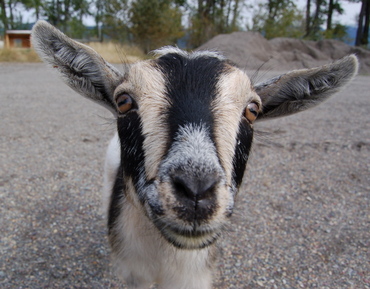
    First, I will confess:  I’m smitten.  With a goat.  She’s the cutest thing on four hooves I’ve ever seen, and she’s got a personality to match.  More to the point:  She loves me.  I’m not sure why, but she does.

    A few months ago, we got Margaret, her twin sister Scarlet, and their half-sister Daisy to help us with weed control around the ranch.  Margaret and Scarlet are four months old, and Daisy is a yearling.  They are Nigerian Dwarfs, a miniature dairy goat breed.  (Pygmy goats are a different, distinct breed.)

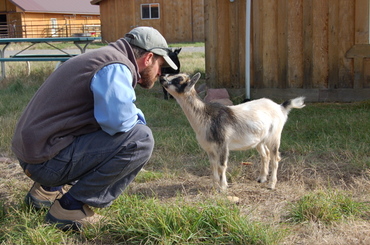
    Somewhere along the way the three goats — Alayne prefers to call them "go-ats," using two syllables to say it — became pets, not just weed control specialists.  I’m not sure how this happened, but it had something to do with Margaret deciding to adore me, and I couldn’t resist her charms.  She bleats whenever she hears my voice, then comes running over to say hello.  She follows me everywhere … down the drive, into the barns, and occasionally, into the house.

    Yesterday, while our vet Dr. Brenda Culver was here, Margaret tried to climb into the tractor with me as I set off on a chore.  I had to take her back and leave her in the welcome center with Brenda until I got out of sight with the tractor. 

    This morning, as I was getting in the truck to head into Missoula, Margaret tried to climb into the front seat.  I had to hand her to Alayne to hold until I was well down the drive.

    Here she is greeting me when I returned this evening:
    Margaret_greeting_steve_2

    By the way, Margaret won’t let Alayne catch her.  She always stays one step ahead, just out of reach. 

    That’s because Miss Marker has spent the last several weeks chasing the go-at sisters away from our young aspens and cottonwoods in the yard around the house.  Goats are browsers (no, not Web browsers but the kind that will eat just about any tree, shrub or plant), and one thing they love are aspen and cottonwood leaves.  They’ll trim the limbs to the height of about three feet, which is about as high as they can reach standing on their hind legs.

    After many episodes of Miss Marker running out and chasing them away from the trees, she no longer lets the go-at sisters have the run of the yard.  She has revoked their privileges and denied them all rights, leaving one observer (no, not me) to describe this place as Goatanamo Bay.  So now the girls have a fenced yard to themselves, but often during the day I will tie Daisy up on a harness and long lead outside our welcome center or by the corrals, and the three of them graze and hang out there.  Having their big sister tied up will keep all three in the general area.  At night they sleep in a barn stall.  When we put them out on pasture on weed duty, we use electric fence netting to keep them confined and to keep them safe.

    Now, you’re probably wondering, "But what about the dogs?"  The dogs were at first fascinated when the go-at girls arrived, and yes, a few of them wanted to chase the sisters, but we handled it like any other introduction and taught the dogs not to bother them.  Soon the goats realized that the dogs were either all blind, or wobbly, or so small, that they need not worry in any case.  And now if a dog gets too close, the girls will simply head-butt them … gently but firmly, and sometimes rearing up on their little hind legs before they drop down to thrust their heads at the dog.  When I say it’s gentle, it really is … they actually are only pressing their heads against the dog’s head.  But the dog gets the message and backs off.

    How confident is Margaret?  Yesterday afternoon we went back to Widget’s House so Brenda could load blind Patti in her car to take back to the clinic for a follow-up procedure.  Margaret walked down the drive with me, stayed at my side while I opened the gate to the dog yard so Brenda could drive through, and then walked along as we threaded our way through all the dogs.  Travis, Trooper, Penny, the whole crew … they ignored her.  "Oh, it’s that goat again."  I often take the goat girls with me when I close up Widget’s House for the night, and they’ll stand in the middle of the floor, watching as I let dogs in and out of the building.   

    Margaret’s two sisters are sweet little things, too, don’t get me wrong, but they see me mostly as a provider of food, security, and a back scratch.  For Margaret, I am all those and more.  She will run over and look up at me like this:
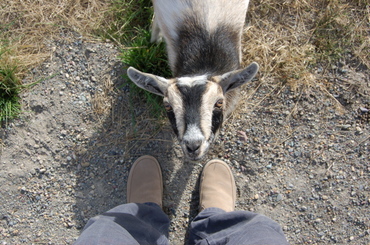
    Margaret_looking_up

    I mean, how can you resist that?

    Here’s Daisy, wanting to sample my hat this evening:

    Daisy_eating_hat

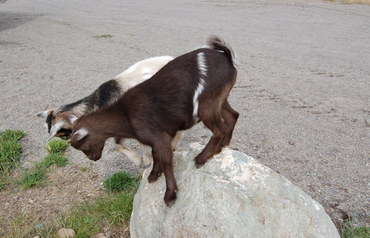
    And here is a shot Alayne took earlier today, of Margaret and Scarlet being goats-on-a-rock:
    Margaret_and_scarlet_on_rock

    These two are so cute together, and they go hopping and skipping and leaping through the air when they get excited and happy about something.  It’s a routine I have to get on video one of these days!

    So that’s the whole story.  I heart Margaret.
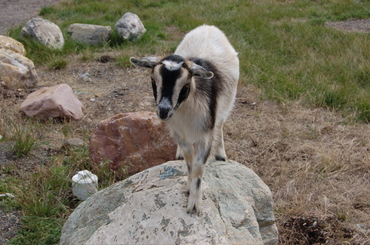
    Margaret_on_rock


  • Brenda_with_ellie_may

    Today our small animal vet, Dr. Brenda Culver from Montana Veterinary Specialists in Helena, came out to the ranch for her annual visit to give all the dogs their medical exams and vaccinations.  It was a long day indeed — Brenda and her vet tech, Heather A., arrived about 9 a.m. and left shortly after 6 p.m. — but everyone got done.  In the photo at top, Brenda and Heather are with my minion, blind-and-deaf Ellie May.

    Here they are with blind Widget, still showing her new, svelte figure:

    Brenda_with_widget

    Blind Helen, who recently had a rear leg removed because of cancer, got her check-up, too:

    Brenda_with_helen

    And here Brenda is doing an eye exam on Margaret, who can see:

    Brenda_with_margaret

    Finally, here’s deaf Stuart getting his exam:

    Brenda_with_stuart

  • Bailey_and_belvie_sept_22

    Here was the scene this afternoon in our living room … Dachshunds Belvie (at top) and Bailey busy eviscerating stuffed toys.  What better way to spend the first day of fall?

    (Pssst … notice the T-bone shape here, too?)

  • Lena_nikki_and_cash_sept_20

    Yesterday was our final visitor day of the season, and as the last visitors drove off down the drive, Alayne and I headed out for the afternoon chores.  We hadn’t gone far when I looked over and saw this interesting T-bone shape out in the pasture.  That’s blind Lena on the left, blind Nikki in the middle, and blind Cash on the right.  Lena and Cash were lined up perfectly, both perpendicular to Nikki, who was facing straight ahead … and all three were snoozing. 

    Alayne zipped back to the house for the camera, and then I tip-toed into the field to get this shot.  You can tell Nikki had started to hear me because by this point she had raised her head, but the T-bone configuration held long enough for the photo.

    This trio of horses is the group we bring over to the gate to meet our visitors.  It’s typically the first stop on their tour,  and this seems appropriate because Lena was the very first animal to arrive at the sanctuary … and she’s the entire reason we ended up "doing" blind horses.  Had it not been for Lena, we probably would have stayed with the original plan of just running a sanctuary for disabled dogs and cats.

    It’s dark in the distance in that photo because of an approaching front, which brought us plenty of heavy rain last night.  It’s still raining today, in fact.  We can’t remember ever having as much rain in August and September as we’ve had this year — and these are typically two of our driest months.  That’s a very welcome change, since we’re in a region that is still recovering from drought.