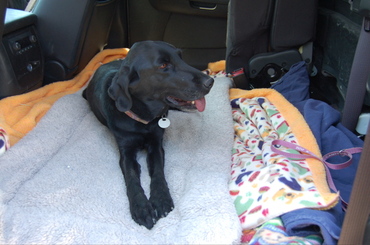
• Stuart_with_briggs_1

    Back in April, I wrote a post ("Lend Me Your Ear") about how deaf Stuart the Beagle loves to groom other dogs’ ears.  He offers this service free-of-charge to anyone who will stand still for him.  In fact, it’s often how he greets dogs, by rushing up to start cleaning their ears.  For some, it’s a bit off-putting for a first greeting ("You want to do what?") — perhaps a canine social faux pas — yet for others it’s a great way to get acquainted.

    Whether it’s a "hi-my-name-is-Stuart-can-I-please-clean-your-ears?" introduction or a casual after-lunch grooming session, rarely does any dog refuse to let Stuart do this.  When that rejection does occur … as it did last week, when I heard a brief ruckus from the hallway, and I looked out my office door to see an upset Stuart scurrying away after blind Evelyn, hackles up, sent him packing — Stuart is dejected.  Yet only momentarily, for there are more than 40 other sets of ears to clean around here.

    But on Friday evening we learned Stuart was expanding his portfolio of grooming services.  I was in the process of feeding the dogs when I walked around the kitchen aisle on my way to the fridge to get some canned dog food.  I rounded the corner and when I looked down, there was Stuart deftly cleaning blind Briggs’ eyes.  First one eye, then the other eye.  Back and forth Stuart went, left eye and right eye.  Briggs just sat there, clearly enjoying getting his eyes washed.  Alayne brought me the camera from my office, and I took these photos as Stuart continued to groom away.

    Stuart_with_briggs_2

    Just to make sure everyone understood that the eye wash is simply a new addition to the grooming menu, Stuart finished up with some determined ear cleaning as well:

    Stuart_with_briggs_3

    Two happy Beagles, one cleaner than the other.

  • Shasta_with_steve_july_31

    One of the interesting things about this line of work is the sheer variety of what we do — and we just never know what opportunities we’ll get to enjoy on any given day.  This morning I was on a conference call working on donor database migration issues and this afternoon, I was … well, I was cleaning a horse’s sheath.  (Um, that’s a veterinary euphemism for "horse pee-pee.")  I had noticed our old, blind Appaloosa Shasta out in pasture swishing his tail and stamping his hind feet, acting downright uncomfortable.  I knew it wasn’t flies because our horses are fly-sprayed, and based on prior experience, I knew this suggested a sheath problem of some sort.  I asked our employee Cindy to bring Shasta in from pasture so I could take a look at him.

    Now, before you can grab a horse by his (irritated) penis and start poking around up in there, it’s always wise to have the animal thoroughly sedated.  Even a gentle old soul like Shasta might finally end up kicking you into the fence if what you’re doing to him is uncomfortable enough.  And sedation is also very important to get these geldings to "drop it" so you’ve got something to work with.  Thus this morning I had called our equine vet and surgeon, Dr. Erin Taylor, to get the correct dosing for a horse of Shasta’s considerable size.

    After giving Shasta his IV injections, I went to work with warm soapy water and a wash cloth.  Cindy was helping me and took these photos.  Erin had explained that these old male horses can get big and pendulous "down there," and their prepuce becomes heavier and fattier.  This means more folds in the skin to trap sweat and the urine that can back-splash if they don’t extend all the way before they pee.  Add summer heat, and it can become a bacteria hothouse.  The fact that Shasta is light-skinned with a lot of pink also predisposes him to skin problems in the first place. 

    I started cleaning on his right side and found plenty of red, raw tissue.  On his left side I was scrubbing away when … a wriggling maggot fell out of a fold of skin.  Ick.  I moved my (gloved) fingers around deep inside his prepuce and more maggots came out.  Eeeeeeew.  We had one other horse, blind Domino — also a light-skinned Appy with pink pigmentation — develop a similar problem a couple of years ago.  This was what I feared was happening when I saw Shasta out on pasture swishing his tail and stamping his hind feet.

    Knowing I was in over my head at this point, I called Erin for on-the-spot advice, which is what I’m doing in this photo:

    Shasta_with_steve_2

    Erin sees my number on her caller ID and answers.

    Erin:  "Hey."

    Me:  "Maggots."

    Erin:  "Really?"

    Me:  "Lots of ’em."

    Erin:  "Okay, here’s what you do…"

    Then she walked me through it:  A repeat dose of the sedatives to keep him under for a while longer.  Rubbing alcohol in a spray bottle to kill the maggots.  (I didn’t have her preferred maggot-killing solution.)  Continue to thoroughly wash and clean.  Rinse.  Apply Morusone ointment, a steroid cream in a jar helpfully still labeled "For Domino’s P.P." (our earlier maggot case).  Give 2 grams of bute, an anti-inflammatory, and continue with the bute tomorrow.  Monitor.

    The whole process out there in the corral took over an hour.

    Meanwhile, I am emailing Erin this afternoon the graphic close-up photos so she can decide if we need to do more.  (Alayne won’t let me post those photos on the blog.)

    And that was just another day at the office here at the Rolling Dog Ranch.

  • Blanca_with_priscilla

    While Cindy was taking photos of Trooper and the Poodle sisters roughhousing on the Widget’s House porch last week, she also managed to get this interesting shot of blind-and-deaf Blanca standing completely on top of blind Priscilla.  You can see that blind Molly is still playing with Trooper, while Priscilla apparently is trying to understand how she ended up coming out backwards underneath the towering Dane.

    I thought about sending this photo to the National Enquirer so they could run it with the headline, "Dog Mystery!  Great Dane gives birth to Poodle!"

    Actually, it’s not at all unusual to see Blanca standing on top of the other dogs, even good-sized ones like these standard Poodles.  There’s a lot of room underneath that frame of hers!

  • Callie_at_cat_enclosure

    Last month, I posted a photo of blind Callie the Dachshund trying to work her way under the door into the cat house.  As I pointed out then, Callie is crazy about the cats.  Yesterday morning, when I was taking the photos of blind Briggs parading around with the tennis ball, Callie was right behind me at the cat’s outdoor enclosure, shuffling back and forth trying to figure out a way inside it, barking as she went.  Although she would be harmless with the cats if we let her in, they would not be the same with her, and we can’t run the risk of her getting her eyes scratched. 

    The cats are rather amused by her antics, and will often paw at the plump Dachshund through the fence to taunt her.  Three-legged Honey Girl (that’s her in the corner) will lie on her back at the edge of the enclosure, look right at Callie, and then casually toss her one front-leg back over her head, as if to say — imagine a Zsa Zsa Gabor voice here — "Really, dahling, you are so annoying."

    Stuart the deaf Beagle is on the left.  He isn’t very interested in these "domestic" cats, since they are already contained.  Stuart only gets excited over our barn cats when they go walking by outside the dog yards, and he races up and down the fence barking at them.  What he would actually do with the barn cats if he managed to get close to them, Lord only knows, although I think I know what they would do to him.  Since the barn cats are wandering freely, maybe he thinks they’re more like wildlife and thus worthy of pursuit.

    Callie, on the other hand, is very content to focus on the domesticated version of felines.  (It helps she can’t see the barn cats walking by.)  One day we just might put a Dachshund-sized football helmet with visor on her and send her on in there!

  • Briggs_with_tennis_ball

    I mentioned in yesterday’s sad post about dear Birdie how she loved to grab a toy on the way out the cottage door in the morning and wave it at the Dachshunds to try and get a game started.  Somehow this morning it was as if blind Briggs realized something was amiss and decided to fill Birdie’s role.  Just minutes after letting them out, he found this tennis ball and started parading it around, taunting the others to just-try-and-take-this-away-from-me.  Watching this blind, wobbly Beagle strut his stuff did indeed help cheer us up.

    Blind Austin soon realized what was going on with Briggs and rose to the challenge.  We still think of him as a baby because he’s so small, but in reality he’s probably full grown by now — yet he doesn’t let his diminutive size get in the way.  Here he’s coming up to make a grab:

    Briggs_and_austin_3

    Then he makes another pass, getting closer:

    Briggs_and_austin_1_2

    But, alas, as the saying goes, it’s close-but-no-tennis-ball:

    Briggs_and_austin_2

    A minute or so later, after breaking off the pursuit, Austin comes in from a different direction and almost makes a clean snatch:

    Briggs_and_austin_4

    Being blind, of course, means that sometimes you lose sight (so to speak) of your quarry and have to stop and regroup, which is what seems to be happening in this photo:

    Briggs_and_austin_5

    And when it’s clear you’re not going to steal the ball after all, it’s best to give up and have a drink while the victor waltzes (or wobbles) off the field:

    Briggs_with_tennis_ball_2

    —-

    Thank you to everyone who has posted or emailed us their condolences about both Laddie and Birdie.  It is so comforting to know how many people care about these animals and are thinking of them, and us, during these difficult moments.  We really appreciate it.

  • Birdie_on_july_25

    This one … this loss was devastating.

    On Friday morning when we went to let the dogs out of Kelly’s Cottage, we found some diarrhea and chewed grass thrown up on the floor.  We watched the dogs file out to see who it might be, and quickly realized it was Birdie.

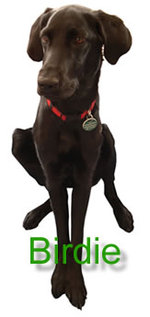
    She had a form of muscular dystrophy unique to Labs called centronuclear myopathy, and as a result she walked with a hunched back and short, stiff gait.  Her exterior muscles had atrophied, leaving her thin looking, but she was smart, funny, talkative, and otherwise very healthy.  Birdie was the kind of girl who was always the life of every party.  Indeed, on our visitor weekends, Birdie was convinced that everyone had come from far away just to see her, and she did her best to steal the show.  She greeted visitors when they arrived by sitting up like a seal and making high-pitched seal-like barks to draw people over to her … and yes, it worked.  I would always tell Birdie:  if you want to look like a seal and sound like a seal, you need to learn to balance a ball on your nose like a seal. 

    But on Friday morning, there were no entertaining antics.  She wasn’t her usual, happy, bouncy self.  She walked over to a water bowl and started drinking.  And drinking.  Then she got up, walked behind a cottage and tried to poop … but couldn’t.  She repeated this cycle of copious drinking and unsuccessful efforts to poop.

    A short while later we loaded her in the truck and I was on my way to our vet clinic in Helena with her.  I took the photo above of Birdie just before taking her into the clinic.  I figured she had some kind of intestinal problem — perhaps colitis — and would be back home soon enough.  I had no idea how wrong I would be.

    X-rays showed an intestinal blockage, and she needed surgery right away.  Our internal medicine specialist, Dr. Britt Culver, operated on Birdie Friday afternoon.  From "skin-to-skin" — initial incision to final suture — Britt had Birdie in and out of surgery in under 45 minutes.  He called to say everything had gone well, and he didn’t have to resect, or remove, any part of her intestine.  That speeds up recovery and reduces the risk of complications.

    On Saturday morning, our primary care vet, Dr. Brenda Culver — Britt’s wife — called to say Birdie was doing well and that she was up and walking.  Overnight, Britt had added some support therapy to help strengthen Birdie’s heart because of her myopathy.  Any time you have a systemic disease like this, the body is more compromised and thus the risks are higher, hence the precaution.  Brenda said they had Birdie on a bed on the floor of the surgery area, and whenever they talked to her or petted her, Birdie would wag her tail and thump it on the ground.

    When we signed off the call Saturday morning, Brenda had said the next time she’d call would be with the ‘Sunday morning report’ unless anything changed.

    Alayne and I had been in bed for a short while Saturday night when the bedside phone rang.  I looked over at the clock and it was 11:08 p.m.  The screen on the phone lit up with the clinic phone number and name.  My heart sank.  I knew something terrible had happened.  I grabbed the phone.

    It was Brenda.  Birdie had just died.

    I was stunned as I listened to Brenda describe what happened.  She had been making the late-night rounds at the clinic, looking in on all the patients, and was doing a TPR check (temperature, pulse, respiration) on Birdie.  She was listening to Birdie’s heart with a stethoscope, and her heart sounded fine.  As she pulled the stethoscope away and was about to stand up, she looked at Birdie and suddenly sensed something wasn’t right.  Brenda put the stethoscope back on Birdie’s chest, and as she did so, Birdie took a breath and rolled over, dead.  Just like that.  She couldn’t revive her.

    Brenda said there was no seizure, no vocalization, and no struggle.  It was quiet and peaceful and instantaneous.  Brenda told me she had called Britt, who was at their home, to tell him what had just occurred, and he suspected a blood clot had caused a stroke. 

    As Alayne began piecing together what had happened from overhearing my end of the conversation, she started crying, and I couldn’t hold it together much longer myself.  I told Brenda I would call her back today after we had a chance to come to grips with the news.

    Both Alayne and I were in tears by then, and we got up and walked down to the living room, where we sat for hours, crying and telling Birdie stories and hugging some of our other dogs.  We weren’t prepared for this at all.  Birdie was only about 5 years old, and she was right up there with Widget and a few others as among the most-special dogs we’ve ever had in our lives.  Birdie was the kind of animal who brings you joy every day, who makes you laugh, and for whom a ‘day-without-Birdie’ isn’t a complete day at all.  She was so smart I was convinced she understood every word I said.  I could say, "Birdie, get on the cot," and she would climb right up on it.  She had long ago mastered how to read people and their emotions, and thus how to get people to do her bidding.

    In many respects, Birdie was an icon for the ranch — she’s even the centerpiece of the ‘Meet the Animals‘ page on our Web site — and to lose her was to lose a part of ourselves.

    It was a long, sleepless, emotional night.

    Britt and Brenda were shocked by what had happened, too.  Britt drove over to the clinic late last night so he and Brenda could do an immediate autopsy on Birdie.  What they found was that the intestinal surgery had held up fine, no sutures had dehissed, and everything was intact.  This supported Britt’s view that Birdie most likely had thrown a clot that either caused a stroke in her brain or shut her heart down.  It was also consistent with how quickly and quietly she died. 

    Brenda explained to me today that clotting is always a risk during and after operations because the body reacts to surgery — having tissue cut open and thus bleeding — by trying to clot and stanch the blood loss.  When a major clot is produced somewhere in the bloodstream and causes a stroke following surgery, it’s called a ‘thromboembolic accident.’

    This morning, Birdie’s cottage seemed strangely sad and empty without her.  There was no hunched-over black Lab bounding out the door, grabbing a toy in her mouth to wave in front of one of the Dachshunds — she was always trying to get some kind of game started first thing in the morning.  There was no Birdie at the breakfast table, trying to get a biscuit from us. (We called her ‘Biscuit Birdie’ on these occasions and in general, ‘Bossy Birdie’ because of her talkative, demanding ways.)  With only one dog missing, it was suddenly a very lonely day. 

    I think the worst part is simply that we never had a chance to say goodbye to this dog we adored so much.   

    So this will have to do.  Goodbye, Birdie.  We will always love you.
    Birdie_main_2

  • Idaho_statesman_screenshot

    The Idaho Statesman, Boise’s daily newspaper and the largest in the state of Idaho, carried a front-page feature story today on the terrible problem of blindness in Appaloosas.  It is a very well-done piece.

    The reporter, Tim Woodward, first called us about a week and a half ago to interview us for the story.  One of the other people he had already interviewed for the article had told him about our BlindAppaloosas.org Web site.

    As you’ll see, the Appaloosa Horse Club — the official breed registry — is still in denial about the problem.  Read the article here.

  • Molly_and_priscilla_at_troopers_thr

    Our employee Cindy was over at Widget’s House the other morning when she saw the usual start-of-the-day antics beginning.  Most mornings when we let the dogs out, Trooper — the hound mix from Louisiana with a twisted front leg — goes dashing out the door, closely followed by his girlfriend, Priscilla the blind Poodle.  Priscilla chases Trooper around the yard, romping and roughhousing with her hound dog of a boyfriend.  Often Priscilla’s sister, blind Molly, joins in the fray.  (Molly is increasingly showing a lot of, um, special attention towards Trooper.  It’s like she wants a boyfriend, too, and doesn’t care that her sister is already dating him.  These girls just seem nutty about this Cajun boy.) 

    Now, I have tried to capture these antics before, but whenever Trooper sees me with a camera, he stops playing with the Poodle sisters, so I’ve never been able to get photos of these morning games before.  This time, when the threesome started up their routine, they did so on the front porch of Widget’s House, and Cindy was able to get the photos through the screen door.  They didn’t even realize she was there photographing.

    Molly_and_pris_with_trooper_upside_

    Here Molly is giving Trooper a right-hook, while blind Brody on the cot realizes mayhem is nearby and is doing his best to stay clear:

    Molly_giving_right_hook_to_trooper

    In this one it looks like Priscilla and Trooper have teamed up to get Molly by the ears (not nice!):

    Molly_getting_ears_nibbled

    But just moments later, Priscilla has the hound by his ear while blind-and-deaf Blanca looks on (sort of):

    Trooper_getting_ear_nibbled

    Finally, when it’s all over, Trooper makes nice with sister Molly, who is clearly relishing the affection:

    Trooper_making_nice_with_molly

    Hard to believe both girls are completely blind, isn’t it?

  • Wendy M. of Missoula, who adopted blind-and-deaf Baron and blind (and mostly deaf!) Stoney from us a few weeks ago, took her two dogs camping last weekend.  She emailed us a really funny set of photos of Baron at the campsite … and after yesterday’s sad blog, I thought you — and we — could enjoy something lighthearted.  Wendy said both dogs did great, and they enjoyed the attention they received from the other campers.

    At the campsite, Baron developed an entirely new routine.  This is how Wendy described it, along with the photos she sent:

    Here are Baron’s five steps to a great campfire meal

    Step 1 — Dig giant hole with front feet and put bone inside:

    Step_1_2

    Step 2 — Push dirt in hole using nose:

    Step_2

    Step 3 — Wait 15 seconds:

    Step_3

    Step 4 — Remove dirt also using nose and find bone again:

    Step_4

    Step 5 — Eat bone:

    Step_5

    [Comment from Steve:  Please note how his pink, pig-like little nose remains clean at all times!]

    Thank you for sharing these photos, Wendy!

  • Laddie_with_steve_july_22

    This was one of those days we had dreaded for a long time.

    Laddie was our blind Arabian who had lived with a major orthopedic problem for years.  His left front knee was very arthritic and swollen, and he walked with a limp.  Laddie had required regular cortisone injections in his knee and daily anti-inflammatories for comfort.  Back on May 7, I had posted a blog update on Laddie and a corrective shoe our farrier was fitting on his left hoof to help with the knee problem.

    I said in that post, "…Laddie is a case where every week we assess his quality of life.
    These amazing animals can be so stoic that it is hard sometimes to tell
    just how much pain they’re in and whether it’s time to make the
    ultimate decision.  We only get one chance to get it right, and we sure
    don’t want to make it too soon … or wait too late."

    Alayne was taking Laddie and his buddy blind Shasta out to pasture Saturday morning when she noticed Laddie walking with more effort — his left leg seemed stiff and bowed out to the side a bit.  We upped his dose of the anti-inflammatory, but it didn’t seem to make much difference.  Over the weekend he didn’t wander around the pasture to graze very much and began hanging out in the same spot, a sure sign that it was painful to walk.  Shasta, ever the faithful friend, stood right by him. 

    When I examined Laddie again yesterday, his knee was more swollen than usual, puffy with fluid.  When I made him walk so I could watch his gait, he was so stiff he was almost walking as if he had a peg-leg.  His knee barely flexed.  Worse, now he was dragging his front left hoof.  Oh, no.  When he wasn’t walking, he stood still, eyes half-closed, looking miserable. 

    I took Alayne out to see him and show her the changes I was seeing.  We both realized the time had come.  I called our equine vet, Dr. Erin Taylor, and asked if she could come out today.

    Back in May, Erin thought we could buy some more time for Laddie with the corrective shoeing.  Today, she saw the continued deterioration in his knee and agreed that there was nothing more we could do for him.  It was time to let this wonderful boy go.

    This one really hurt, because Laddie was the sweetest, gentlest, nicest horse we have ever known.  Truly.  We adored him.  He was a once-in-a-lifetime horse.  To make this even more tragic, he was also relatively young (only in his late teens) and otherwise very healthy.  Except for that blown-out knee, he looked great.

    Alayne took the photo at the top of this post just after Erin had sedated him but before she injected the euthanasia drug.  At that point, we were saying goodbye to this gentle soul.  Fortunately, you can’t see the tears running down my face.  Less than a minute later, Laddie was gone:

    Laddie_with_erin_and_steve

    While I was bent over Laddie, Erin said to me, "This was the right decision at the right time."  And I knew that was the case, but it doesn’t do anything to help with the grief.

    And then, in an end-of-life ritual that Erin started us doing last year to help these closely-bonded horses understand that their friend is gone, Alayne brought Shasta over to say goodbye to Laddie:

    Shasta_with_laddie_july_22

    We will be pairing Shasta up with another of our blind horses this week.  I buried Laddie this afternoon here on the ranch. 

    Goodbye, you sweet boy.  We love you.

    One final note:  Lots of people have forwarded to us in the past couple of months the story of "Molly the Amazing Pony," who was outfitted with an artificial leg at LSU’s veterinary teaching hospital.  So in case you’re wondering why we didn’t try something similar with Laddie:  Molly was a very small pony, not a full-sized 1,000-lb horse, and her prosthetic device was fitted below the knee.  Laddie’s problem was his knee.  A prosthesis was not an option for him.  We only wish it were.