• Buddy71808

    Last Friday we received a wonderful update on blind Buddy, a delightful hound mix adopted from the ranch by Susan S. in Missoula two years ago.  Buddy had come to us originally from a shelter in Spokane, Washington.  He was then just a big, goofy blind puppy who liked to carry a toy hedgehog around in his mouth all day long.  Buddy went blind from progressive retinal atrophy, and his eyes remain as clear today as they were when he first arrived.  That photo above is what Susan just sent me.  In her email, Susan wrote:

    "Buddy couldn’t be better….  He’s five years old now, which I suppose is middle-aged for a big dog like him.  Last month he had his scheduled checkup and shots, and the vet said he’s in great shape, and his weight was almost exactly what it was when we adopted him.  He has never been sick a day, and is still the best watchdog (no pun intended) in the world."

    Susan continued, "He’s always happy, always on an even keel.  It’s like that dog in the joke:

    Time to eat?  Yay, my favorite thing!!!
    It’s sunny?  Yay, my favorite thing!!!
    It’s snowing?  Yay, my favorite thing!!!
    We’re going for a walk?  Yay, my favorite thing!!!
    We’re going for a ride in the car?  Yay, my favorite thing!!!
    Time to go in my crate?  Yay, my favorite thing!!!

    And so on.  He’s just happy all the time.  Well, maybe not so much when the Evil Garbagemen appear and "steal" our belongings or when strange dogs come around.

    Anyway, just wanted to say hi and thank you again for letting us adopt him."

    Thank YOU, Susan, for giving this handsome boy such a wonderful home!

  • Levi_at_stream

    Blind Stoney is not the only adopted resident of ours who has a thing for water.  Our fabulous volunteer Laura W. from Helena, who adopted blind Levi a few months ago, yesterday emailed me photos and some video of Levi enjoying his walks with her in the countryside outside town.

    Laura wrote, "Levi is a very confident dog.  He loves going for his walks.  He walks off leash and runs around smelling everything.  He flushes out the birds and loves to run after the antelope if they have been in the area recently.  I can’t imagine him not in my life."

    And like Stoney, Levi has a favorite stream he likes to wade into.  If you just watched this video and didn’t know anything about Levi, you’d have no idea the dog you’re seeing in it is totally blind:

  • Alayne_with_hay_stack

    After posting the video of the amazing automated hay wagon and the 14-foot high wall of hay it stacks, some of our blog readers asked:  Well, how do you get bales out of that thing?

    The answer:  Carefully!

    Vanna White was busy this evening, so I asked Alayne to come out and demonstrate how we break into one of these solid walls of hay.  Here she is doing her best Vanna impersonation.

    We pick up one of the poles we use to help hold the front of the stack in place, then pry off the very top bale in the corner of the stack.  We knock that one down to the ground, then the next one over, and so on … but we do this in a stair-step fashion, so this is the one and only time we ever have a solid vertical wall.  In other words, we remove bales from the top down while leaving a few lower tiers of bales in place … and work our way backwards into the stack.  That stair-step configuration helps keep the entire stack more stable.  It allows us to then climb up on the hay stack safely and knock down more bales by hand as we need them.

    Once we’ve chewed into the stack several bales deep, we remove some of the rows of bales forming the lower tier in front — or the bottom step.  The best way to describe it is as a moving stair-step, eating into that giant stack of hay.

    Yes, you’ll notice we couldn’t quite fit all of that last load completely inside the hay barn.  We still had some hay left over, which is why it didn’t make it all inside … but it will be gone soon enough!

  • Jeff_weed_spraying

    With 160 acres here, a significant part of what we do is taking care of the land.  Most of it — about 140 acres — is kept in pasture for the horses, while the rest has the barns, animal cottages and other buildings on it.  But with that much land, there is a lot of work to ensure healthy soils and healthy grasses.  We’ve always wanted to be good stewards of the land, and that means making continued investments in caring for it.  I just had our county extension agent out here yesterday to help us with a pasture grass "census," soil analysis, and recommendations for improving our forage quality. 

    Our biggest challenge is noxious weeds, which is a huge problem not just here in Montana but across the Rocky Mountain West.  (See Montana’s noxious weeds list here.)  As rich and thick as much of our grass is, these noxious weeds still crop up in our fields, with persistent, deep root structures and seeds blown in on the wind.  Although "integrated weed management" is the preferred approach — using a combination of herbicides, biological control (beneficial insects targeted for specific weeds), grazing, and mechanical means (mowing and pulling) — it is much more difficult to achieve in practice.  Different weeds respond to different control methods, and they also come up at different times, all of which complicates efforts to get rid of them. 

    We use all those "tools" in the integrated weed management toolbox, with varying degrees of success, but at the end of the day we still need to have the fields sprayed to control the worst weeds.  The three big noxious weeds for us are leafy spurge, knapweed, and Dalmatian toadflax.

    We are also now dealing with a nasty, invasive plant called cheatgrass, which is actually a member of the bromegrass family.  As a grass, this means a different approach to controlling it than the noxious weeds — including a different herbicide, which happens to kill your other brome grasses!  As one report says, "Cheatgrass invades rangelands, pastures, prairies, and other open areas. Cheatgrass has the potential to completely alter the ecosystems it invades. It can completely replace native vegetation and change fire regimes."  Cheatgrass also has barbs which are a painful problem for dogs as well as livestock.  So for right now we are mowing the cheatgrass stands and then we will spray those sites in the fall, which is the optimum time.

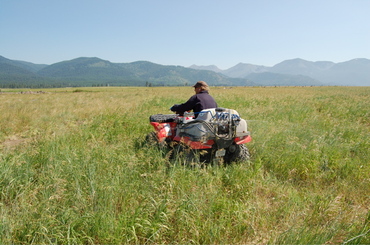
    For the past several days our weed expert, Jeff Campbell of Blackfoot Weed Control in Seeley Lake, Montana, has been at the ranch spraying the pastures.  I took the photo above of Jeff on his ATV spraying in one of our paddocks at the northeast corner of the ranch this morning.  Jeff is a retired forester with the Montana Department of Fish, Wildlife & Parks, so we know we’ve got one really knowledgeable guy helping us take care of this problem!

    When I took that photo of Jeff, I was standing right next to this fencepost:

    Grass_and_fence_july_16

    That field looks lush, doesn’t it?

    But now look at ground level, and what you see in this one spot is a nice, thick patch of young toadflax:
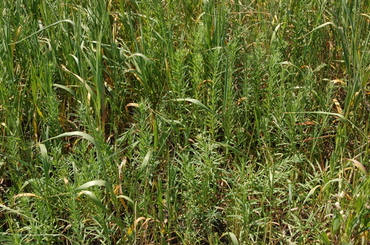
    Toadflax

    And by the way, we had sprayed the entire property last year, too.  That’s why they call these weeds "noxious" and "invasive."  You can’t ever let up.

    As much as we don’t like applying the herbicides — and it means taking the horses off the pastures for days — there isn’t much choice.  We had long-time supporters of the sanctuary staying at the ranch last weekend, and they own an organic lawn care business in Washington state.  We asked them if there was any way we could manage these weeds using organic methods.  Their immediate answer:  "No.  Not for these kinds of noxious weeds, and not for a property this size."  They thought if we had 5 or maybe 10 acres we might be able to stay on top of it using organic methods, but it would be incredibly labor-intensive and we couldn’t "scale up" to cover the rest of the ranch.

    Still, our long-term goal is to minimize the use of herbicides and convert as much of the ranch as possible to organic pasture management. 

  • Because of our climate here in the Northern Rockies, we have to feed hay to our horses from November until June … and given the number of horses we have (about 30), that means we buy a lot of hay — 125 tons this year.  Like everyone else with large animals, our hay costs have skyrocketed … from $95 a ton a couple of years ago to $140 a ton last year to … ouch! … $210 a ton this year.  Fuel and fertilizer costs are the main culprits.

    Our next-door neighbor grows the hay we buy, and bales it in small square bales weighing about 75 pounds each.  Until we built our own hay barn last year, we had to store our hay purchase in our neighbor’s barn and make weekly trips to pick up hay.  This meant stacking two or three tons at a time by hand on a flat-bed trailer and driving the load back over to the ranch.  Then we’d unload it and stack it in the various horse barns.  Needless to say, that was a very time-consuming and labor-intensive task every week, and although it made for great muscles, it was a chore we could do without.

    Building the hay barn last year meant we could store the entire purchase right here at the ranch.  These past two days our neighbor has been bringing over this year’s hay crop, and by this evening, all 125 tons — that’s about 3,300 bales — should be in the barn.  And thank heavens, we don’t have to stack them by hand!  He uses an automated hay wagon that scoops the bales right up out of the field, shuffles them onto the bed of the vehicle, and builds a 6-ton load that can be mechanically raised to a vertical position until it forms a 14′ high wall of hay bales … no human muscle applied.  (Unless, of course, a wall collapses, as it did yesterday on us — and then human muscle is again pressed into service!)

    I thought you might be interested to see how this works, so I shot a video of one of the wagon loads being stacked in the barn yesterday evening about 7 p.m.  I edited down the video into a short clip of the highlights:

  • Herbie_climbing

    This is blind Herbie, who I photographed this morning climbing in the cat house’s outdoor enclosure.  Herbie is the original lovebug, but he is also one intrepid little guy.  There is much in the American Kennel Club’s description of the breed standard for Dachshunds (of all things!) which would apply to Herbie the cat, including "courageous to the point of rashness" and "any display of shyness is a serious fault."  (For those of you who have met Herbie, you know what I mean about that second attribute.)

    As for the courageous part, well, we discovered that not only does Herbie love to climb up the sides of the enclosure, but he also figured out how to get out of the enclosure!  Do you see the mesh wire that goes across the top of the enclosure?  Until recently, there was a two-inch gap between the edge of the mesh and the wall, and for years no cat had ever figured out how to work his or her way through it.

    Then, a couple of weeks ago, we found blind Herbie wandering in the yard around our house one day.  He didn’t have a care in the world.  It’s not like he doesn’t know there are 24 dogs milling around out there — it just doesn’t occur to him that he should be afraid of them or anything else.  (The other dogs are over at Widget’s House.)  In truth, we don’t have any dogs who would ever harm him or any other cat, but still! (Does the expression "courageous to the point of rashness" come to mind?)

    No one had seen him get out, so our first thought was that someone had accidentally left the cat house door open.  But, we have some visual cats who would have been out exploring, too, so that didn’t seem to make much sense.  Then, a day later, he was out again.  Finally, on his third escape, it was our employee Cindy who saw how he was doing it.  He simply climbed up the enclosure fence, worked his way over to the wall, and then squeezed through that narrow gap at the top … and climbed all the way down to the ground.  Off he went to explore again. 

    Not bad for a cat with no eyes in his head, huh?

    Of course, at that point we ‘re-engineered’ the top mesh and moved it over to be flush with the wall.  No more escapes since then … but he still loves to climb.

    And here he is after his climbing expedition this morning:

    Herbie_postclimb

  • Carmel_suture_removal_1_2

    Alayne took this photo of me removing the sutures from Carmel’s eyes this morning.  Carmel had gone blind from a corneal dystrophy that destroyed the corneas in both eyes.  The condition was extremely painful.  After consulting with a number of veterinary ophthalmologists, our vet Dr. Brenda Culver learned there was nothing we could do to eliminate the pain but remove her eyes.  The operation was a couple of weeks ago.

    After coming home from the hospital, she’s become a different dog.  She is playful, carefree, and clearly enjoying being pain-free for the first time in a long time.  Before, she would walk around the house, blinking and cringing because she was afraid she was going to bump into something with her throbbing eyes.  Now she bounces up and down and twirls, and she doesn’t worry about it any longer!

    There’s something else that’s different about her, too.  Our suspicions are growing that she has decided to become my minion — my second one, after Ellie May!  She has started following me around everywhere, and hanging out in my office when I’m in here — often curled up right next to Ellie May on a dog bed.  Alayne reports that Carmel now gets upset when I leave the house and she’s left behind inside.  (Carmel must have realized early on that the minion-quota for Alayne was already way oversubscribed by Dachshunds and other assorted camp-followers and now exceeded safe levels.)

    I suspected something was going on because of what Carmel had started doing these past few evenings.  After dinner I often sit down in a comfortable chair in the living room with my laptop to get some more work done.  Carmel has started coming over, standing up on her hind legs with her front feet on the chair, and tries to climb into my lap.  Now, there just isn’t enough room for both laptop and Beagle on one lap, so I had to choose: computer or dog.  Carmel thought the choice was a clear and simple one.  So yes, I’d set the laptop aside and scoop up the Beagle for some loving.

    Speaking of blind Beagles, look who was sleeping on the couch next to us while I was removing Carmel’s sutures (do you think Widget looks comfortable enough?):

    Carmel_suture_removal_2_2

  • Molly_and_priscilla_after_groomin_2

    Our two blind Poodle sisters, Molly and Priscilla, were due for a trip to the groomers, and I took them to Missoula today for an appointment I had scheduled a while back.  (Do you know it’s easier to get in to see a doctor or dentist or mechanic these days than it is a pet groomer?)  After I dropped Molly and Priscilla at the groomers — it takes up to four hours before the girls are ready — I raced around Missoula, running errands on our once-weekly trip to town.  We’re trying to stretch these out to once-every two weeks (and I grocery shop accordingly), but it seems an unexpected veterinary issue inevitably makes for weekly trips to either Missoula or Helena.

    The groomers called just as I was making my last stop to say Molly and Priscilla were all done and could be picked up.  I wished I had taken a "before" photo, but suffice to say they looked very much like ranch dogs (well, as much as a Poodle can look like a ranch dog) before their new hair-do.  Given the heat and the kind of coats they have, we decided to get them closely cropped this time and let their hair grow out over the summer.  Alayne took the photo above this afternoon, right after I got home.  That’s Molly on the left and Priscilla on the right.

    After our little photo session, we walked the girls over to the Widget’s House yard and led them through the gate.  Of course, who leaped to his feet back on the porch and raced out to meet them but our local hound-about-town, Trooper. 

    Here he is checking out his girlfriend Priscilla … notice that hound dog tail sticking straight up in the air:

    Trooper_checking_out_priscilla_2

    Is that a "Whoa, what happened to you, honey?" expression or a "Darling, you look absolutely stunning!" reaction?

    And here’s Trooper checking out Molly’s hair-do (and apparently something else, too):

    Trooper_checking_out_molly

  • Dusty_july_9_3

    A wonderful friend of the animals at the ranch, Anne G. from Seattle, emailed me this morning to ask about Dusty.  Her note reminded me that I was overdue on an update on how blind Dusty was doing after his spinal stroke a few weeks ago.  Well, recovered he has — completely!  We were nothing less than incredulous at how fast he bounced back from the blood clot in his spinal cord that left his rear legs almost paralyzed.

    I took this photo of Dusty in the Widget’s House front yard this afternoon, and you can see he’s fully upright on all four legs.  In fact, getting the photo was a bit difficult because Dusty kept trying to walk away from me and the camera.  He had no problem loping off to avoid getting his photo taken!

    The spinal stroke is called fibrocartilaginous embolism, or FCE for short, and we know others have not been as fortunate to see their dogs recover from this condition as well as Dusty has.  So we are very, very thankful for his happy outcome.

  • Austin_in_hole_4

    Last Saturday night about 9:30 p.m., Alayne and I were putting the dogs up in the various cottages. This is quite the process, since there are 44 dogs, multiple buildings, and each dog needs to "do their business" before bedtime.  Typically we empty out our house first, then the smaller cottages next to the house, making sure that everyone has adequate potty time outside.  (This is strictly a notional exercise for the incontinent ones!)  While Alayne is riding herd on the gang over here, I head over to Widget’s House to start putting those guys up.

    I was finished at Widget’s House and moving on to the horse barns when I heard Alayne calling for blind Austin the Beagle.  Austin loves his doggy buddies and is always at their side, so he follows along at night when Alayne calls everyone to the cottage for bedtime.  Not this night.  He was nowhere to be seen.  I hurried over and started searching with Alayne.  By now it was getting dark and we were getting nervous.  This was totally unlike Austin to not be with the other dogs.  He also isn’t an explorer, and with sheep fencing layered with chicken fencing and topped with electric fencing, it was most improbable he could have — or would have — gotten out of the yards and wandered off. 

    We searched and searched the dog yards, our house, and the other buildings.  There was no sign of this small blind Beagle.  By now we were increasingly frantic, and the light was fading fast.  I jumped on our utility vehicle and raced out into the pastures to start looking there while Alayne kept looking for him around the cottages.  Up and down the pastures I drove, flashlight in hand, calling for Austin.  Finally I gave up.  It just didn’t make sense that he would take off.

    Moments after I returned, Alayne glanced over and saw Austin slinking around the corner of our house, headed towards Kelly’s Cottage and her.  He looked sheepish.  Alayne raced over and scooped him up in her arms.  She was so relieved to be holding him I thought she was going to squeeze him to death!

    We walked around the front of the house to see where he could have come from but found nothing to indicate where he might have been.  Perplexed but happy to have found him, we tucked him in for the night. 

    On Sunday night, this time about 9 p.m., we started the bedtime process again, and just like the night before, Austin did not show up.  Alayne was walking around the house again and lo and behold, she found him.  She called me over to see where he’d been. 

    Deep in this hole by a small pine tree, right in the front yard, was Austin … and he was sound asleep.  I went back into the house to get the camera.  In the photo at the top of this post, you can see why he’d be almost impossible to notice unless you walked right on top of him … especially in the late evening light!

    He didn’t even wake up until I got close enough to get this photo:

    Austin_in_hole_2

    At that point we explained to Austin that rabbits are supposed to be in holes, not Beagles!

    Austin_in_hole_3