
I took our draft horse Beaver in to Missoula to see Dr. Erin Taylor this morning to begin a new treatment for his sarcoid tumor. That's Beaver above, right after we anesthetized him at the clinic. You can see the tumor in the center of his belly.
This will be the third form of therapy we've tried over the past two years, not counting the recurring antibiotics and anti-inflammatories we give him when he has flare-ups. This past fall the tumor had seemed pretty quiet and we were growing optimistic that the last treatment had finally worked and made the tumor shrink. Alas, in the past several weeks it had started growing again and had become infected and inflamed. The usual antibiotics and anti-inflammatories hadn't seemed to make much headway this time.
Sarcoids by themselves are not usually fatal, but as a form of skin cancer they are chronic, very difficult to get rid of, and carry with them the ever-present risk of infection. In Beaver's case, as I mentioned in yesterday's post, this is compounded by the tumor's location: on his belly, right at the lowest point, so it bears all of his weight when he lies down, and comes into contact with the ground each time. So it is constantly aggravated.
There have been a lot of different therapies for treating sarcoids over the years, all with only limited success. Surgery has a pretty significant failure rate (higher than 50%) and often causes the tumor to grow back even more aggressively. And the more treatments that have been tried on an individual sarcoid, and the larger it is, the less likely other therapies will succeed. (For a scientific overview of sarcoids, read this paper from the Journal of General Virology.)
But researchers from the University of Minnesota's Veterinary Medical Center found that a human topical medication called imiquimod — trade name Aldara — showed remarkable (though not 100%) success in treating sarcoids. After completing a pilot study, the researchers posted information for horse owners and equine veterinarians here.
Of course, this being a patented human medication, it is incredibly expensive just to treat a person, let alone when you scale up for a 2,000 lb draft horse like Beaver.
This tiny box of the medication is supposed to cover Beaver for two months of treatment … and cost $515. Yikes.

However, when we opened it and found these tiny .25 gram pouches of the stuff, we became more than a little skeptical that this would really last anywhere near the two months' worth of treatment for Beaver's giant sarcoid. You can see that each pouch isn't much bigger than a quarter:

And a quarter is actually thicker than the pouch!

Today's exercise was to clip and clean out the tumor site, take new biopsies for pathology tests, and get it prepped for the first application.
It looked like this afterwards:
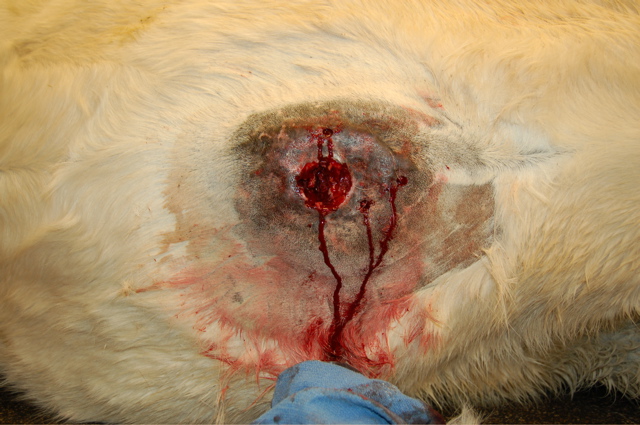
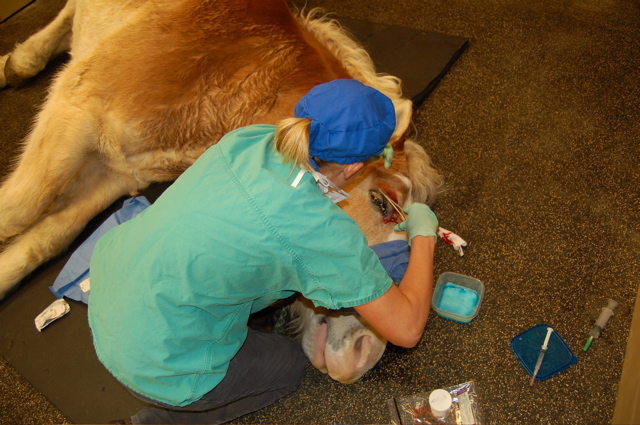
Because sarcoids have a tendency to multiply on a horse, Beaver has developed a new one on his upper eyelid, which Erin is removing in this shot:
Erin had located a lady in Virginia who makes custom belly bands for equine hospitals, and I ordered a giant one for Beaver this afternoon. When it arrives later this week, I will clean out the tumor site again, apply the Aldara for the first time to both his belly tumor and his eyelid tumor, and then put the belly band on him to keep the tumor site as sanitary as possible. Wish us luck!
—
Ironically, Beaver was the healthy one of our pair of Belgian draft horses. He came to us only because we had agreed to take his brother Rooster, who had a spinal condition. Sadly, Rooster's back problem significantly deteriorated last year, and we ended up having to euthanize him late last fall.


 Rolling Dog Farm Blog
Leave a reply to Bibi Cancel reply