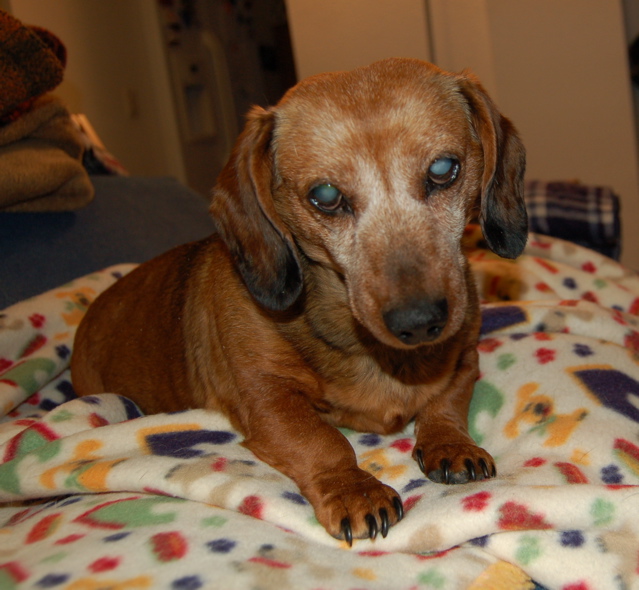
I was sitting in the living room about 8 p.m. last night, working on my laptop, when I suddenly heard a furious scratching noise coming from the couch. I looked over and saw blind Callie paddling her feet like crazy, her body trembling and quivering. She had been sleeping soundly just seconds before. I jumped up and put my hands on Callie to keep her from rolling off the couch. I called out to Alayne, who was in her office, and told her Callie was having a seizure.
We watched as the seizure increased in intensity, her plump little body going stiff, her legs outstretched, then pulled back again as another short-circuit sent tremors though her body. She rolled over on her side, gasping. We could tell quickly that this was definitely a grand mal seizure from the duration and the severity of it. She had peed on the couch, was foaming at the mouth, and towards the end of the seizure, she pooped.
After two minutes — which seemed like an eternity, it always does when you're watching a seizure — she started to quiet down. Finally she came out of it, but she was disoriented and exhausted from the physical exertion and stress of the episode.
Alayne cleaned the couch while I held Callie, and then we cleaned her up. We put her back on fresh bedding on the couch, and that's when I took the photo of her above. You can see how droopy she is from the experience.
We had never seen Callie seizure before, and given her age — we suspect she's around 12 or so — we were instantly worried about what this meant. Still, we have seen older dogs start seizuring later in life — like blind-and-deaf Spinner, whose seizures are thankfully very infrequent … while other dogs, like our blind Goldie, began having seizures early in life but then "grew" out of them. The real key is the frequency of the seizure episodes, and only time will tell.
Well, time told us this morning.
Callie had another violent seizure about 10:30 a.m., a repeat of last night. This, we instinctively knew, was a terrible sign: far too close to the first one. While Callie was in the middle of today's seizure, I called our vet clinic and talked with one of our primary care vets, Dr. Jennifer Rockwell. Jennifer asked if we had valium on hand, which we do — an emergency stash of valium syringes for Spinner. She told us what dose to give Callie if she had another seizure today and it became uncontrollable.
Jennifer said the first step would be blood work to see if there was some kind of metabolic disturbance that could be causing these seizures. If the blood work was normal, then there might be an intercranial cause, i.e. tumors or growths. Jennifer explained that an onset in young dogs frequently pointed to epilepsy, but that was typically not the case in a dog of Callie's age.
Since I was already scheduled to head to Missoula tomorrow, Jennifer suggested I have our internal medicine specialist there, Dr. Dave Bostwick, look at Callie. As luck would have it, Dave had an opening tomorrow morning and was going to be doing CAT scans in the afternoon, so if her bloodwork is routine, we can proceed straight to a CAT scan to look for intercranial causes.
I'll post more tomorrow evening. In the meantime, please keep your fingers crossed for Callie.


 Rolling Dog Farm Blog

Leave a reply to Julie Brown Cancel reply