I had just returned this afternoon from taking blind Helen to our vet clinic in Helena for her chemotherapy, and I was still unloading the truck when I suddenly heard clanging and banging from the corrals. I looked over and saw blind Bo's head high above the corral panels, about 75 yards (68 meters) away. Unless he really had grown a giraffe neck during last week's worming, something was odd about his height and body position. Then I heard the clanging again, saw Bo lurch and whinny, and I dashed for the corrals.
Alayne had brought Bo and blind Rosie in from pasture today while I was in Helena to get them ready for the cold blast. When I got to their corral, I immediately realized the problem wasn't with Bo but Rosie — she was lying on her side up against the corral panels and had two of her feet hooked over the bars. Whenever she tried to move, the clanging and banging freaked out Bo, who knew his damsel was in distress but didn't know why.
I called over to Alayne to come help, and together we unhooked her legs, looped ropes over them, and rolled her back over on her side. She laid there for a while, and then hauled herself to her feet. But strangely, she took a few steps, laid back down on the ground, and started rolling. Over and over again. We realized this was how she got herself stuck on the corral panels. Occasionally she even stopped a roll in mid-motion to lie on her back, feet straight up in the air … a very odd posture.
As she kept rolling, Alayne and I watched in amazement. Then I turned to Alayne and said, "Colic." Alayne said, "Sure is." While rolling is a common symptom of a horse colicking, it's usually intermittent; they'll roll once or twice, get up, turn their head to stare at their belly, kick at their belly, and do other things in addition to rolling to signal the abdominal pain. But we had never seen a horse constantly rolling. We couldn't get her to stop.
I called our equine vet, Dr. Erin Taylor, who wanted me to give her a sedative and some banamine, both intravenously, and then get her in the trailer and on to the hospital. I told her that we couldn't get her to stop rolling, let alone get her to her feet, so I doubted I could get the drugs on board. She told me to give it a shot, so to speak, and if I couldn't, to just get her to Missoula as fast as possible. This was a bad colic, and she needed surgery right away. I ran to the house to look for the drugs while Alayne stayed to see if she could get a halter on Rosie and work her to her feet.
A few minutes later I was headed out of the house when Alayne came around the barn with Rosie in tow. But as soon as Alayne slowed down, Rosie's legs would buckle and she'd sink to the ground to start rolling. I realized that if we didn't get her in the trailer any second, she might go down and stay down. So I abandoned any idea of getting drugs in her. Instead, I ran back into the house, grabbed the keys for the other truck, and backed it up to the horse trailer. As I was hitching it up, Alayne kept walking Rosie around and around the drive, trying to keep her up long enough for me to finish getting the trailer ready.
Finally, I swung open the trailer doors, Alayne handed me the halter, and I walked her on board. As soon as I stopped, she started buckling … and I was trapped at the front of the trailer. I started jerking on her halter, trying to get her to remain standing, while I yelled to Alayne to open the escape door. Just as she got it open and I jumped out, Rosie went down. Even though it's a four-horse trailer, when you have 1000 pounds (453 kg) of a horse going over on you, there isn't enough room to get out of the way!
As I drove down Highway 200 towards Missoula, I could feel the trailer lurch behind me as Rosie rolled and rolled on the floor. Fortunately, with a big horse trailer, stabilizer bars, and a one-ton pick-up, we had the equipment to handle it. We had to leave Rosie loose in the trailer, because to tie her up would have meant breaking her neck. She was determined to go down, so the last thing you'd want to do is have her head tied.
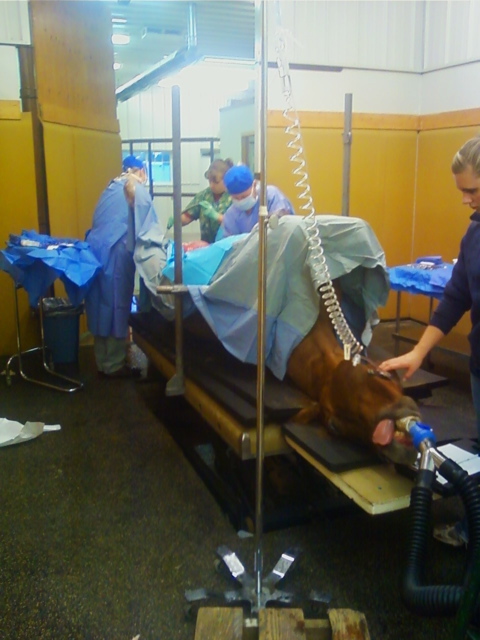
Erin was waiting for us when I got to the hospital, and in less than two minutes Rosie was in the surgery suite and under anesthesia. I had left the ranch so fast I didn't have time to grab the camera, so I had to take these photos with my cellphone.
Colic surgery is always a major deal. A horse's small and large intestines together can total about 100 feet in length (30 meters), so it's a very complicated procedure to find out exactly where in that long span of gut the compaction or twist is … and then fix it. Equine surgeons have to actually pull out part of the intestines and set them on a tray so they can move around enough inside the body cavity to find the problem. In Rosie's case, Erin found the culprit — a fecal clump that had compacted in her small intestine.
Here's a shot of Erin the foreground, with Dr. Angela Langer, our other large animal vet, assisting in the surgery:
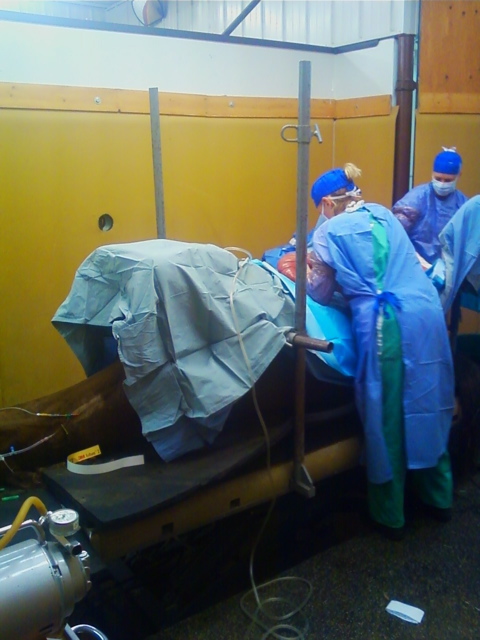
To give you some idea of the sheer mass that these surgeons are dealing with, here's a close-up of Erin working on Rosie … and that huge piece of flesh lying on top of Rosie is just her cecum, a 4-foot section of the large intestine:
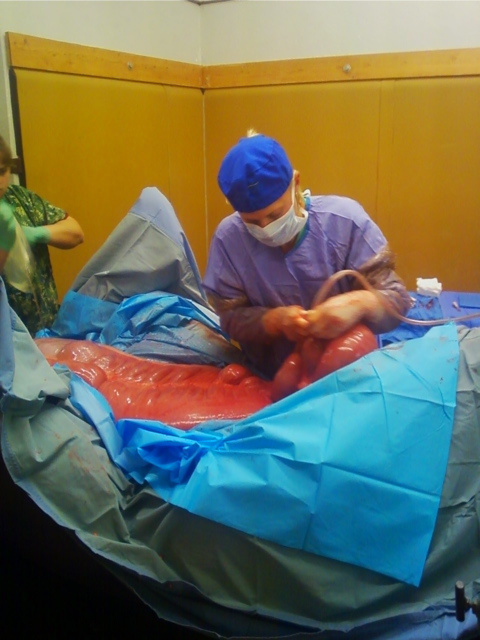
Only 96 more feet to go!
The surgery takes a long time — for Rosie, it lasted about an hour and a half. Erin called late this evening to say Rosie came through the operation, had recovered from anesthesia, and was now in a stall being monitored. Rosie is still not out of the woods — there are plenty of risks ahead and a long road to recovery. She will be in the hospital for a week, and then will need to be stall-bound here for quite a while.
—
Still No. 1!
Please keep voting for us every
day in The Animal Rescue
Site/PetFinder's Shelter Challenge.
Thanks
to your votes, we came in third nationwide and won $3,000 for the
animals in the previous contest. Now we have a shot at No. 1 and the
$20,000 grand prize! Enter
"Rolling Dog Ranch" and our state postal code, MT for Montana,
and it will bring up our listing so you can cast your vote. Please ask
your family and friends to vote, too. Thank you!


 Rolling Dog Farm Blog
Leave a reply to ginger, Tobias & Tlingit Cancel reply