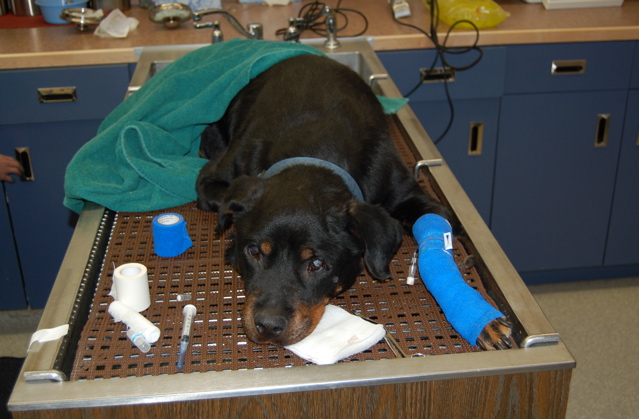
Almost exactly a month ago, I wrote a post about how well blind Helen was doing with her chemotherapy. A week ago, I emailed Helen's primary care vet, Dr. Jennifer Rockwell, to tell her that Helen was tolerating her new chemo drug, Lomustine, wonderfully and had shown none of the long list of potential side-effects that can accompany the use of this drug. In fact, I told Jennifer that Helen had seemed like the "bionic" dog when it came to withstanding both of her rounds of chemotherapy.
Until last night.
Suddenly, she threw up her dinner. A few minutes later, she threw up blood-flecked pink water that pooled on the floor. Seeing that, I picked up the phone and called our clinic's emergency number. Dr. Britt Culver, our internal medicine specialist in Helena, called right back. He said that the Lomustine had probably caused some gastric upset and bleeding, and that we should stop the chemo, give her Pepcid to soothe her stomach, and to call if she continued vomiting. We were scheduled to take Helen in on Tuesday any way to check her blood work and X-ray her lungs again, so I told Britt we'd stick to that schedule unless she didn't improve.
When we got up this morning, Helen was sleeping in Alayne's office and there was no sign she'd had any problems overnight. Whew.
 Ten minutes later, Alayne was walking back down the hall, glanced into the office, and said in a horrified voice, "Oh, no!" There was a huge pool of pure blood on Helen's bed, and blood splattered across the floor. She had just vomited nothing but blood, and it was everywhere. (I made this photo really, really small so as to minimize the ick factor, but if you want to gross yourself out, feel free to click on the image and you'll get a much "better" view.) Helen was over in the corner of the office, laying on top of more blood she had vomited. It was 7:45 a.m. I took a photo and emailed it to Britt so he could see what we were seeing, and then I called the emergency number again.
The timing couldn't have been worse. A winter snowstorm had been howling all Saturday night, and in the dawn light we could see that snow drifts were everywhere. I wasn't even sure if we could get out our county road to the highway, and there were no county snowplow trucks working yet. I'd have to plow my way down our 1/4 mile-long (.40 km) drive in the tractor and then see if the road to the highway was passable. Of course, because the storm was forecast to last until Monday evening, I wasn't planning to begin plowing until Monday and thus hadn't plugged in the engine block heater on the tractor with the plow. Would the tractor start in the 3 below zero (-19 C) cold?
And Helen was sinking fast. I told Britt she was getting what vets call "shocky," i.e. beginning to go into shock from blood loss and dehydration. I didn't know yet how long it would take me to dig out, but once I got to Highway 200, I still faced a long, slow drive in snowpacked, windswept conditions for the 70 miles to Helena — normally an hour and 15 minutes but this morning, likely to take at least two hours.
While I got the tractor fired up — my oh my, we love these hardy Kubotas — and began plowing, Alayne let the dogs out of the cottages and started doing the morning chores. Finally, about 9:30 a.m., we loaded Helen in the truck and I set off for Helena. The county roads had indeed not been plowed, and only a 4WD truck as high as our Chevy Silverados would have been able to clear the snow. On Highway 200 I had to drive 40 to 50 miles per hour because of the snow and ice. It seemed like it took forever.
Britt and his vet tech Maddie met me at the clinic when I got there about 11:30 a.m. We had to carry Helen in; she was too weak to walk. Britt immediately put her on IVs and then pulled blood to run a chem panel. Britt's working assumption was that she had gastrointestinal hemorrhaging from the chemo, but her blood chemistry panel would indicate whether the bleeding was from another cause — like kidneys shutting down.
I asked Britt why the chemo could cause GI hemorrhaging. He explained that chemotherapy drugs target rapidly dividing cells in the body — i.e., cancers — but there are three "normal" parts of the body that also have rapidly dividing cells: bone marrow, the GI tract, and hair. (That's why people undergoing chemo often lose their hair. Dogs typically don't lose hair during chemotherapy because their hair isn't constantly growing, as human hair does.)
Within 30 minutes of the first IV, Helen started to perk up. Then the VetScan blood analyzer printed the chem panel results, and all her values looked good. That meant she wasn't losing blood internally from other causes. Fabulous.
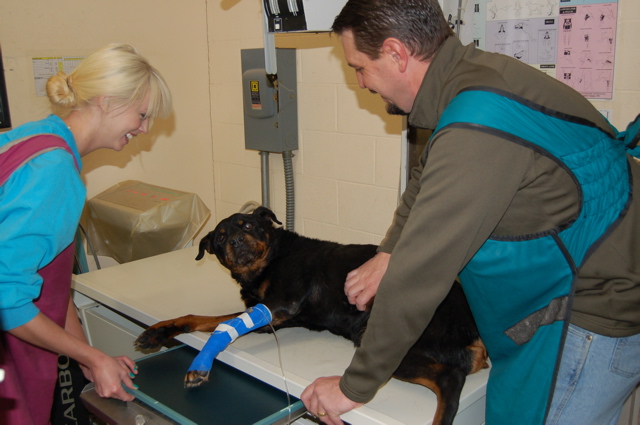 Finally we took chest and abdominal X-rays to make sure there wasn't blood elsewhere inside her where it shouldn't be. I was so relieved when Britt showed me how clear the images were — no fluid present. Helen was feeling good enough by this point to enjoy having her tummy scratched by Britt in between X-rays, as you see in this photo. (Click on the image for a larger version.)
But the best news? The cancerous nodules in her lungs had disappeared. Britt pulled up the last set of X-rays from October and compared them side-by-side with today's views, and it was amazing — we couldn't see them. That meant her chemotherapy had continued to shrink the tumors.
By the time I left, Helen was definitely on the mend. I could tell she was already feeling much better. Britt put her on various medications for her GI issue — among them, antibiotics to prevent infection from GI bacteria getting into her bloodstream — and she'll continue on IVs for a while.
Britt and Jennifer will consult with the oncologist at WSU, Dr. Janean Fidel, to determine the best course for Helen going forward. But after a day that started off terribly, it ended with our hope
s up that we'll have this big, blind love of a dog for quite a while yet.
—
 In The Final Week — Still No. 1 — But That Iowa Group Is Moving Up Fast!
Please keep voting for the ranch every
day in The Animal Rescue
Site/PetFinder's Shelter Challenge. Thanks
to your votes, we came in third nationwide and won $3,000 for the
animals in the previous contest earlier this year. Now we have a shot at No. 1 and the
$20,000 grand prize in the current contest! Enter
"Rolling Dog Ranch" and our state postal code, MT for Montana,
and it will bring up our listing so you can cast your vote. Please ask
your family and friends to vote, too.
You can see how fast the rankings can change, so we really need an
extra push in the last week of the contest to hold that No. 1
spot. It ends on December 20th, so we're in the home stretch — and $20,000 for the animals is in sight! Thank you!


 Rolling Dog Farm Blog
Leave a reply to Linda Cancel reply