
As I had mentioned in earlier posts, I took Wilbur to see our veterinary ophthalmologist last week as well. Although we knew from our primary care vet's initial exam with our Tono-Pen that Wilbur does not currently have glaucoma, we still wanted a definitive diagnosis of what was going on with his eyes, especially with his right eye. When he first arrived he could see out of this eye, but in the few weeks he's been here we noticed he's been losing vision rapidly in that eye as the cataract in it became larger and thicker. So we wanted to know if we could save his vision with cataract surgery, or if there was something else we could do for him.
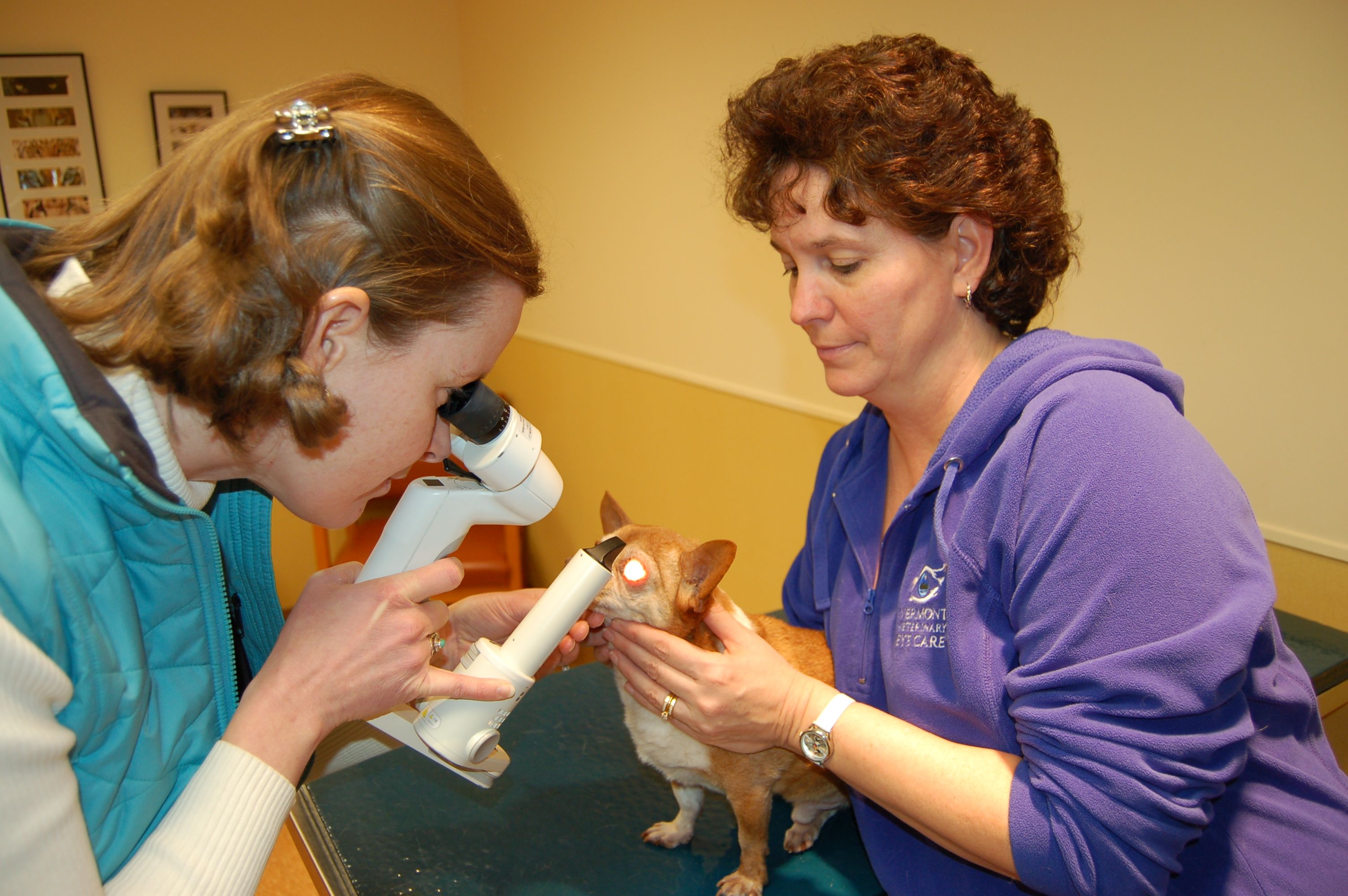
In the photo above, Dr. Sarah Hoy examines Wilbur's blind eye with the slit-lamp (an ophthalmic microscope) while her vet tech Patty holds him. It turns out that the lens in that eye is "luxated," i.e., has come loose, as well as having a mature cataract. He had no menace (or blink) reflex, dazzle reflex or pupillary light reflex, so as we had already seen, no vision to speak of. While currently the eye is not painful, he is at risk for the lens lodging against the back of the cornea, which can be very painful. Here's another view:
Dr. Hoy thought it was possible he might have already had glaucoma in that eye and it "burned out," but it's hard to know at this point for sure.
His right eye, on the other hand, still had all of the essential reflexes, but the cataract had "opacified" or covered 75% of the lens — which is why we were noticing him acting more and more like he is losing vision. In addition, the lens is loose inside the eye — the tiny fibers that hold it in place were mostly gone. This meant he would soon have the lens entirely displaced, which could lead to retinal detachment or glaucoma.
Because the lens was aleady loose, Wilbur would not be a candidate for cataract surgery because the procedure itself could cause the few fibers still holding it in place to rupture. So Dr. Hoy recommended lens removal surgery, or a lensectomy. There are synthetic lenses that can be inserted in dogs but they don't come in a small enough size for a little guy like Wilbur. However, he would still be able to see — he would just be far-sighted. And it would take care of the fast-growing cataract in the process.
But there was still one more thing to check before knowing whether he would be a candidate for the lensectomy: making sure the retina in his visual eye hadn't started to detach. To determine this, Dr. Hoy ultrasounded the eye, which is what she's doing here:
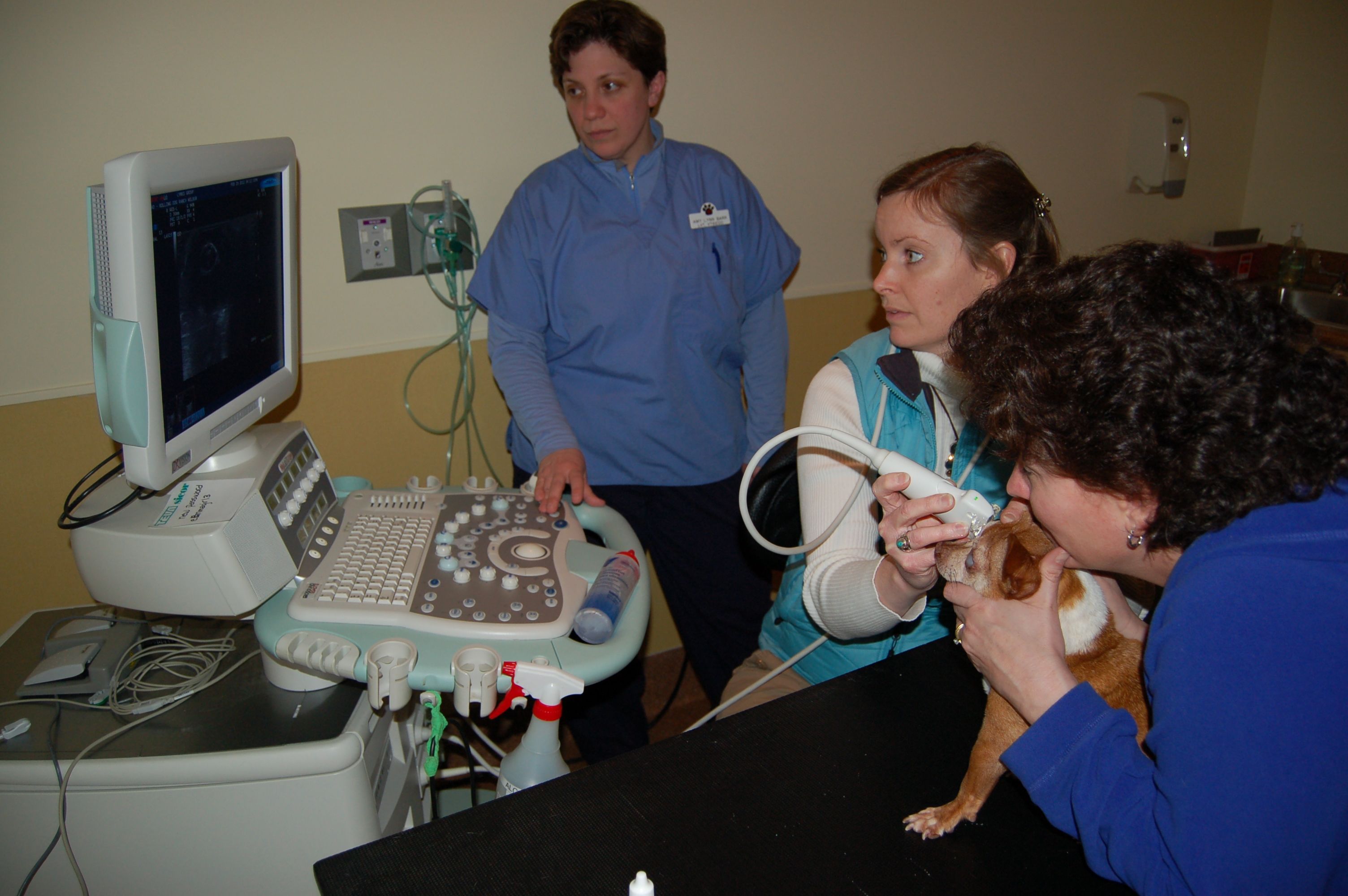
Patty is holding Wilbur while Dr. Hoy's other vet tech Amy is capturing images from the ultrasound for archiving purposes. The ultrasound showed his retina is still very much attached.
As a result, we have Wilbur scheduled for the lens surgery next week, and Dr. Hoy will remove his other eye at the same time.
Through it all, Wilbur was the best little patient — quiet, still, and never complaining … even when the big glob of ultrasound gel covered up his eye. (The probe itself was wider than his head!) He was a just a gem through the whole thing.
—
The new Shelter Challenge started Monday, January 9 and ends at midnight on March 18. Grand prize in this round is $5,000, plus $1,000 for weekly winners and $1,000 for state winners. There are also other categories … please see the Shelter Challenge website for details.
*** We are now LISTED UNDER OUR NEW NAME, ROLLING DOG FARM. State is still NH for New Hampshire. ***
Please remember, you can vote every day … consider bookmarking the voting page to make it easy.
We just won $1,000 as a weekly winner for Week 4 in this current contest, and thousands more in the previous contests. The Shelter Challenge really does bring in a lot of money for the animals here!
You can vote in the Shelter Challenge here.


 Rolling Dog Farm Blog
Leave a reply to Valerie Cancel reply