
New England is well known for rocky ground (with New Hampshire called the "Granite State") and historically, farming in this part of the country involved clearing lots of rocks before you could begin tilling. Hence the thousands of stone walls around fields across the region. Over the last 100 years or so, as farms were increasingly abandoned and people moved to towns and cities or to better farmlands in the Midwest, a lot of agricultural land here reverted to forest, or … if it was occasionally bush-hogged (mowed), to weedy pastures. And during those decades, rocks that were once buried gradually worked their way to the surface through frost-heaves and other natural forces. With no farmer still working the fields to pull them out, the once cleared land became rocky again.
This was painfully evident when we began trying to till an old pasture about a month ago. My goal was to turn it into a new farm field for a corn crop. We are short of level, dry and well drained land for crops, and this field was all that and more, with great exposure. There had been a few trees on it that were logged before we moved here, but it looked like tilling with the tractor wouldn't be too much of a problem. I've tilled "virgin ground" here before in different parts of the farm and this field looked better than what I had already plowed.
But every time I put the plow in the ground and started moving forward, I'd get 10 to 20 yards and suddenly the shear pin on the plow would snap and the plow would rotate up and out of the ground. This is a safety feature designed to protect the plow and tractor from damage. Yet I wasn't hitting rocks — indeed, in other fields the plow could actually handle decent sized rocks and not bust a shear pin. In fact, I'd never broken the shear pin before! But on this field, I wouldn't feel a thing in the tractor — I'd just be gliding along and suddenly the plow had popped up in the back.
It turned out the problem was tree roots — masses of tree roots just below the surface of the ground. Even though the stumps had been pulled and the land looked relatively clean, one particular type of tree seemed to have left a network of roots snaking through the ground, just under the surface. The plow would make no sound as it encountered the roots, but it couldn't slice through them, so it slowly gathered the roots along the front of the blade as I drove forward until the pressure was too much — and the shear pin would break.
A rototiller on the tractor couldn't handle it either, which meant calling in our neighbor Jim, who has a small excavator. So Jim went to work pulling up the roots with the teeth on the excavator bucket. As the roots came up … so did the rocks. It seems the roots had actually been holding the rocks in place, keeping many of them from making it to the surface.
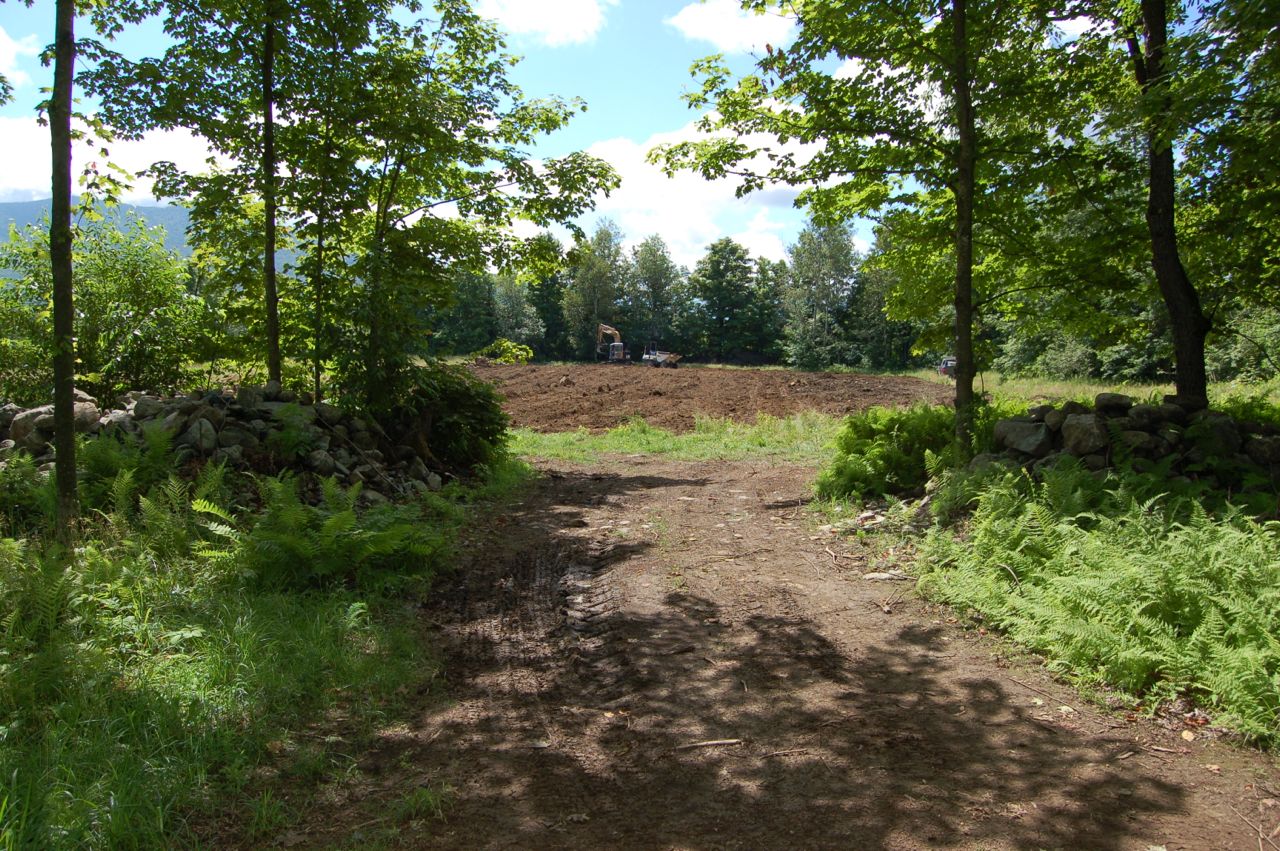
Thus what started out as a root project became a rock project, too. In the photo above, you can see the new stone wall on the left of the cleared field that Jim was building with the rocks he pulled. (Click on photo for larger image.) I joked that he's probably the first person in at least 50 years to build a new stone wall in New England. It's taken a few weeks to get the major clearing done — that was because of lots of rain delays, since you can't work the ground when the soil is wet.
Now what's left is for Kate and me to pull the remaining smaller rocks — the ones too small for an excavator bucket — by hand, and then I will use the tractor-mounted rototiller to work the soil into a seedbed. We are probably too late now for a corn crop, so this year I may just plant it to a good clover/timothy mix as a ground cover, get an early hay crop off it next year, then till it in and plant other crops.
As much work as this has been, it makes me realize how unbelievably fortunate we are to have machines to help us do it. I just marvel at the sheer strength and tenacity of our ancestors, who did all this work by hand and built miles and miles of stone walls with their own physical labor. Here's a photo of the stone wall around this field:

To give you a sense of how high this is, here's the same stone wall with the opening we made in it to get access to this new field:
That wall is three to four feet high. We have stone walls like this all across the farm. Our ancestors not only pulled those rocks by hand but loaded them on to sleds (called, appropriately enough, stoneboats) that oxen or horses dragged to the fenceline, then built the walls by hand, too. It's amazing to me what they accomplished. Some of our favorite books about this era are the illustrated ones by Eric Sloane, like Once Upon A Time: The Way America Was and The Seasons of America Past.
For now, though, we are very grateful to have a neighor with an excavator!
—

Please Vote for the Farm!
The latest Shelter Challenge started Monday, July 9 and ends at midnight on September 16. Grand prize in this round is $5,000, plus $1,000 for weekly winners and $1,000 for state winners. There are also other categories … please see the Shelter Challenge website for details.
*** We are now LISTED UNDER OUR NEW NAME, ROLLING DOG FARM. State is still NH for New Hampshire. ***
Please remember, you can vote every day … consider bookmarking the voting page to make it easy.
We just won $1,000 as a weekly winner in the last contest, and thousands more in the previous contests. The Shelter Challenge really does bring in a lot of money for the animals here!
You can vote in the Shelter Challenge here.
Thank you for your votes!


 Rolling Dog Farm Blog
Leave a reply to Lynne Parker Cancel reply