
This is a day that we have been dreading, and one we hoped would never come. Long-time blog readers may remember that blind Widget had eye surgery back in 2006 because of painful glaucoma in her left eye, and that our vet, Dr. Brenda Culver, put an intraocular prosthesis inside the eyeball itself. This kept her "natural" look and that irresistible Widget face.
Ever since, we have monitored her right eye for signs of discomfort. In particular, we worried about the luxated lens in that eye, which had flopped into the back of the eye but so far had not caused any problems; what we always looked for was whether the lens had flipped forward and was laying against the cornea, which would cause discomfort. But what happened instead is that the retina in that eye has now detached, causing bleeding and debris to float around inside the chamber. The pressure in her right eye remains low, meaning glaucoma is not an issue. Instead, the real culprit is uveitis, which can be very painful. And it was clear she needed relief. Given the nature of the problem, surgery was the only effective way to provide that relief.
Widget's experience is yet another example of why we so often say that blindness is only a symptom of disease, not the end stage. Too many people think that once an animal is blind, there isn't anything else that can or needs to be done, nothing more to worry about — that a blind eye is, in effect, a "dead eye." Nothing could be farther from the truth. A blind eye may not be able to see, but it can feel just as much as an eye that can see — and there are few organs in our bodies more sensitive to pain than the eye.
In these photos I took this morning Brenda is looking at Widget while vet tech Jenny holds her:

We have done both enucleations (removing the eye altogether) as well as the prosthetic implants on many blind animals — Briggs and Dusty were two who had the intraocular prosthetics inserted. Both procedures ultimately remove the pain from the underlying problem in the blind eye. But after going through both of these procedures so many times, we have carefully weighed the pros and cons of each approach.
We have finally come to the conclusion that enucleation is a better alternative for the animal. The procedure is simpler, the recovery is faster, and the degree of post-operative pain is significantly less than with the intraocular prosthetic. Most important, the post-op pain ends much sooner. There is also less risk of post-op complications; indeed, we almost lost Widget's prosthetic implant back in 2006, though quick intervention by Brenda saved the day.
So why do the prosthetic implants at all rather than enucleation? Honestly, the only reason people opt for the implants is so their animals can keep their natural appearance — those faces we know and love so much. And that is why we have dreaded this day, because we knew we wouldn't put Widget through the prosthetic implant procedure again — that if her right eye became painful and required surgery, we would opt for enucleation. That meant she would never look the same … her adorable, bug-eyed face would be changed forever.
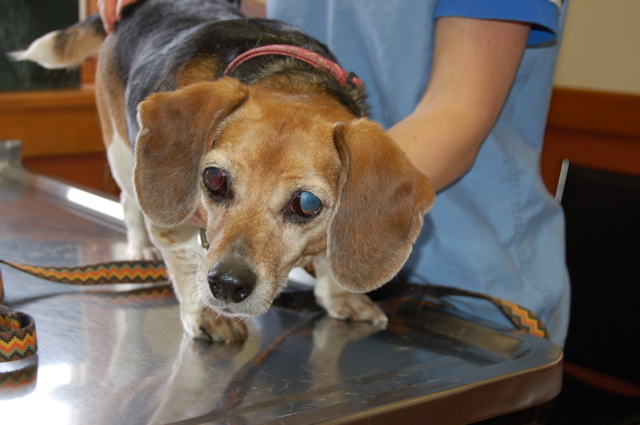
But that's about us, not her. She didn't care what she looked like. What was best for her? What would be the least painful, fastest recovery?
I was fighting back tears in the exam room this morning when Brenda was looking at Widget's eye. I knew what we were going to decide.
Widget's enucleation is scheduled for tomorrow, Thursday. Please keep our little girl in your thoughts.
—
Please vote
for the ranch in the Shelter Challenge — and you can
vote every day! We're currently in third place, putting us on track to
win $3,000 for the animals. Enter "Rolling Dog Ranch" and our state
postal code,
MT, for Montana, and it will bring up our listing.
Vote in the Shelter Challenge here.
Last
year we won $3,000 in the first round and then won the $20,000 Grand
Prize in the second round, so your votes really do add up and make for
a wonderful gift for the animals here.
Thank you!


 Rolling Dog Farm Blog
Leave a reply to boundforglory Cancel reply